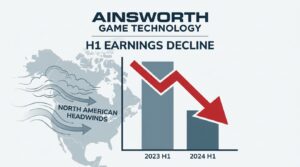
Ainsworth Game Technology, the Australian-listed gaming equipment manufacturer, reported a significant drop in first-half earnings as softer performance across its North American operations weighed heavily on group results. The company’s interim figures reveal a business navigating a tougher competitive landscape in its most critical growth market, even as other regions showed pockets of resilience. For an industry that has leaned on post-pandemic recovery momentum, the results raise pointed questions about whether that tailwind has finally stalled for mid-tier suppliers.
What Ainsworth’s Half-Year Numbers Signal for Gaming Equipment Makers
The headline figures tell a story of margin compression and revenue pressure concentrated in one geography. But beneath the surface, the strategic implications extend further, touching on product mix, competitive positioning, and the sustainability of recurring revenue models in a maturing North American market. Here are the key takeaways:
- North America drove the decline: Weaker sales and installations in the region were the primary drag on group earnings, underscoring how dependent Ainsworth’s growth thesis has become on this single market.
- Earnings fell sharply year-on-year, with the company flagging both lower unit shipments and reduced revenue per unit in key segments.
- Other markets, including Australia and Latin America, offered partial offsets but were insufficient to compensate for the North American shortfall.
- The results put renewed pressure on Ainsworth’s strategy to expand its recurring revenue base through gaming operations and digital channels.
- Competitive dynamics in North America continue to intensify, with larger rivals investing aggressively in cabinet innovation and floor share.
North America: From Growth Engine to Earnings Drag
For several reporting periods, Ainsworth had pointed to North America as its most promising corridor for expansion. The region’s casino operators, flush with capital expenditure budgets during the post-COVID recovery cycle, were refreshing gaming floors at an accelerated pace. Ainsworth positioned itself to capture share with its a-star cabinet line and a broadening game library.
That momentum appears to have cooled considerably.
Unit shipments into the North American market declined in the first half, and the company acknowledged pricing pressures that compressed margins on hardware sales. Casino operators, arguably more selective now about which suppliers earn premium floor positions, have been consolidating their purchasing around a smaller number of proven performers. For a supplier of Ainsworth’s scale (a tier below the likes of Aristocrat and Light & Wonder), this dynamic is particularly punishing. Winning new placements requires not just competitive hardware but a game content pipeline deep enough to sustain operator interest over multiple refresh cycles.
What remains less clear is whether this represents a cyclical dip tied to operator capex timing or something more structural in Ainsworth’s competitive position.
How Regional Diversification Cushioned the Blow
Australia and Latin America provided some counterbalance. The domestic Australian market, where Ainsworth’s gaming technology portfolio retains strong brand recognition, delivered steadier results. Latin American operations, still a smaller contributor to group revenue, showed growth as the company expanded its installed base in regulated jurisdictions across the region.
Still, neither market is large enough to offset a meaningful North American decline. The arithmetic is straightforward: Ainsworth needs North America to perform for the group numbers to work. Diversification helps at the margins, but it doesn’t change the centre of gravity.
Recurring Revenue and the Digital Question
One area Ainsworth has been building toward is a higher proportion of recurring revenue, primarily through gaming operations where the company owns machines placed on casino floors and earns a share of daily win. This model smooths revenue volatility compared to outright hardware sales, and it aligns with a broader industry shift toward participation-based economics.
In the first half, however, the gaming operations segment did not grow fast enough to meaningfully reshape the earnings profile. The installed base of participation units expanded modestly, but average daily revenue per unit faced pressure in certain markets. And while digital and online gaming represent a theoretical growth avenue, Ainsworth’s presence in that space remains nascent compared to larger competitors who have invested billions in iGaming platforms and content.
The gap between aspiration and execution here is worth watching closely.
Competitive Pressures Intensifying Across the Sector
Ainsworth operates in a segment where scale advantages compound. Larger rivals can spread R&D costs across bigger installed bases, negotiate more favourable placement agreements with operators, and invest in data analytics that optimise game performance on the floor. Aristocrat Leisure, the dominant Australian-listed gaming supplier, reported strong North American results in its most recent period, suggesting the market itself isn’t shrinking so much as consolidating around top-tier suppliers.
For mid-tier manufacturers, the strategic calculus grows harder each cycle. Product differentiation becomes the critical variable.
| Metric | H1 Current Period | Trend vs. Prior Year |
|---|---|---|
| Group Earnings | Sharply lower | Significant decline |
| North America Revenue | Below expectations | Down materially |
| Australia/Latin America | Relatively stable | Modest positive contribution |
| Gaming Operations (Recurring) | Modest growth in units | Revenue per unit under pressure |
Strategic Framing: What Shapes the Second Half
The gaming equipment sector operates on long product development cycles, and decisions made eighteen months ago on cabinet design and game mathematics are only now reaching casino floors. Ainsworth’s ability to recover in the second half depends on several factors that are already largely locked in: the reception of new game titles scheduled for release, the conversion rate on operator trials, and whether the North American replacement cycle picks up pace in the back half of the fiscal year.
Management will also face questions about capital allocation. With earnings under pressure, the tension between investing in R&D to stay competitive and preserving balance sheet flexibility becomes more acute. Cost discipline in the near term could help protect margins, but underinvesting in content development risks ceding further ground to better-resourced competitors.
Can Ainsworth regain North American momentum?
That depends on whether upcoming product launches resonate with operators. The company has new cabinet platforms in the pipeline, but floor trials take time to convert into volume orders, and operators are under no obligation to expand allocations to any single supplier.
Is the recurring revenue model viable at Ainsworth’s scale?
In theory, yes. In practice, building a participation base large enough to materially shift the earnings mix requires sustained capital deployment and strong game performance metrics, both of which are harder to achieve when the core hardware business is under pressure.
What does this mean for shareholders?
The first-half result resets expectations. Investors will be watching the second half for signs of stabilisation in North America and evidence that the product pipeline can deliver improved sell-through rates. Without that, the valuation case becomes harder to defend.



