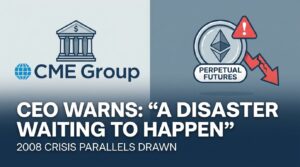
CME Group CEO Terry Duffy has issued a stark public warning against newly approved US-regulated perpetual futures contracts, labeling them “a disaster waiting to happen.” Duffy drew a direct comparison to the conditions that preceded the 2008 financial crisis, arguing that excessive leverage embedded in these products could devastate retail traders who lack the sophistication to manage the risk. The remarks land at a moment when regulators are actively expanding access to crypto-linked derivatives, raising pointed questions about whether investor protection frameworks have kept pace with product innovation.
Why Duffy’s Warning Carries Weight for Derivatives Markets
Terry Duffy doesn’t make these kinds of statements lightly. As the head of the world’s largest derivatives exchange operator, CME Group’s futures and options marketplace, his comments carry institutional gravity that reverberates across both traditional finance and crypto markets. Before unpacking the broader implications, here are the critical takeaways from his remarks:
- Leverage risk at the retail level: Duffy specifically flagged the danger that retail participants face when engaging with perpetual futures, products that carry no expiration date and can amplify losses far beyond initial capital
- Regulatory timing under scrutiny: The approval of these instruments by US regulators comes during a period of loosening oversight posture toward digital assets, a shift Duffy appears to view as premature
- 2008 echo is deliberate: By invoking the financial crisis, Duffy is signaling that the systemic risk isn’t hypothetical; he sees structural parallels in how leverage, complexity, and retail exposure are converging
- The comments position CME Group as a counterweight to exchanges and platforms rushing to list perpetual products in the US market
- Market credibility gap: Perpetual futures have operated for years on offshore crypto exchanges with minimal oversight. Bringing them onshore doesn’t automatically resolve the underlying risk architecture
What Are Perpetual Futures, and Why Do They Worry Duffy?
Perpetual futures, sometimes called “perps,” differ from traditional futures in one fundamental way: they never expire. Conventional futures contracts settle on a fixed date, which imposes a natural discipline on positioning. Perps remove that constraint entirely. Traders can hold leveraged positions indefinitely, paying or receiving periodic funding rates to keep the contract price tethered to the underlying spot market.
This mechanism has been a cornerstone of offshore crypto trading for years, particularly on platforms like Binance and Bybit, where leverage ratios of 100x or more have been common. And while that leverage has generated enormous volume, it has also produced cascading liquidation events that wiped out billions in trader capital within hours.
Duffy’s concern isn’t abstract. He’s watched these dynamics play out repeatedly in unregulated venues. What troubles him now is the migration of these instruments into the regulated US market, where retail investors may assume that regulatory approval implies safety (a distinction regulators have been slow to clarify).
The 2008 Comparison: Provocation or Precision?
Drawing parallels to 2008 is a loaded rhetorical move. But Duffy’s framing isn’t without substance. The pre-crisis period was defined by complex financial products, mortgage-backed securities and credit default swaps, that were poorly understood by many of the participants trading them. Leverage was layered on top of leverage. And when the underlying assumptions broke, the unwinding was catastrophic.
Perpetual futures share at least some of these structural features. They are synthetic instruments. They involve significant leverage. And they are increasingly accessible to participants who may not fully grasp the mechanics of funding rates, margin calls, or liquidation cascades.
Still, the analogy has limits. Perpetual futures on crypto assets don’t carry the same systemic interconnectedness that mortgage derivatives did in 2008. The banking system isn’t directly exposed in the same way. What remains less clear is whether concentrated retail losses could trigger political or regulatory backlash severe enough to reshape the broader crypto derivatives landscape.
Key Structural Differences and Similarities
| Factor | 2008 Crisis Products | Perpetual Futures (2025) |
|---|---|---|
| Leverage | High, often hidden in structured tranches | Explicit but extreme, commonly 20x–100x on offshore platforms |
| Retail exposure | Indirect, through pension funds and bank deposits | Direct, retail traders are primary participants |
| Regulatory oversight | Minimal pre-crisis | Emerging, with recent US approvals |
| Systemic risk | Deeply embedded in global banking | Largely contained within crypto markets, for now |
| Product complexity | Opaque, multi-layered | Mechanically simpler but behaviorally dangerous |
How Framing Shapes Market Perception
Duffy’s choice of language matters beyond the policy debate. When the CEO of the world’s largest derivatives exchange invokes 2008, it doesn’t just inform. It anchors. In behavioral terms, the comparison creates a cognitive frame that shapes how traders, regulators, and legislators process the risk profile of perpetual futures going forward.
This kind of anchoring effect, well-documented in decision science, means that even if the structural parallels are imperfect, the emotional and associative weight of “2008” will color how stakeholders evaluate these products. For retail traders considering perpetual futures, the framing may trigger loss aversion, a tendency to overweight potential losses relative to gains. That’s arguably a healthy instinct in this context.
For regulators, the framing creates pressure. No official wants to be the one who approved the next crisis-era product. And for competing exchanges eager to list perps, Duffy’s comments introduce reputational friction that may slow adoption or force more conservative leverage limits at launch.
The deeper question is whether this framing will translate into concrete regulatory guardrails, position limits, mandatory risk disclosures calibrated to retail comprehension levels, or leverage caps that meaningfully reduce blowup risk. Language shapes perception, but perception alone doesn’t prevent liquidation cascades.
What Happens Next in US Perpetual Futures Regulation
The CFTC has signaled openness to these products, and several exchanges have either launched or filed to list perpetual futures contracts tied to Bitcoin and Ethereum. Duffy’s comments won’t reverse that trajectory. But they may accelerate the timeline for supplemental rulemaking around leverage limits, margin requirements, and retail suitability standards.
Whether the CFTC treats Duffy’s warning as a genuine risk signal or as competitive positioning from an incumbent protecting market share will depend on how the next few quarters of trading data look. If retail losses mount quickly, his remarks will age as prescient. If markets absorb the products without incident, they’ll be filed under institutional conservatism.
Either way, the tension between innovation access and investor protection just found its loudest voice.
Frequently Asked Questions
What are perpetual futures contracts?
Perpetual futures are derivative contracts that track the price of an underlying asset but have no expiration date. Traders maintain positions by paying or receiving funding rates, and leverage can amplify both gains and losses significantly.
Why is the CME Group CEO concerned about them?
Terry Duffy believes the combination of high leverage and retail participation creates conditions similar to those that preceded the 2008 financial crisis. His concern centers on the potential for large-scale retail losses that could undermine market confidence.
Are perpetual futures legal in the United States?
Yes. US regulators, including the CFTC, have approved certain perpetual futures products for trading on regulated exchanges. However, the regulatory framework governing leverage limits and retail access is still evolving, and not all market participants agree on whether current safeguards are sufficient.



