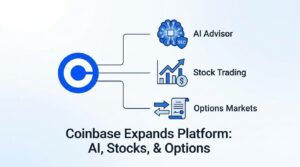
Coinbase unveiled a broad set of new features on Tuesday under its recurring “System Update” banner, pushing aggressively into services that have traditionally belonged to retail brokerages. The package includes an SEC-registered AI investment advisor, stock and ETF trading on its professional platform, and options markets covering both equities and crypto. Taken together, the moves signal a deliberate attempt to reposition Coinbase not merely as a crypto exchange but as a full-spectrum financial platform competing with the likes of Fidelity, Schwab, and Robinhood.
What Coinbase’s Latest Push Means for Markets and Competitors
The timing here is worth examining. Crypto-native firms have spent the past two years navigating regulatory headwinds in the United States, and Coinbase itself fought a high-profile legal battle with the SEC. Yet rather than retreating, the company is doubling down on regulated financial products, apparently betting that the regulatory environment is shifting in its favor. Before diving into specifics, here are the strategic takeaways that matter most for industry stakeholders:
- An SEC-registered AI advisor puts Coinbase in direct competition with robo-advisory incumbents like Betterment and Wealthfront, while layering in a crypto-native edge that neither currently offers.
- Adding stock and ETF trading to its professional platform collapses the boundary between crypto exchanges and traditional brokerages, a convergence that regulators will watch closely.
- Options markets for both equities and crypto open new revenue streams and attract a more sophisticated trader demographic, potentially increasing average revenue per user.
- The bundled rollout suggests a platform strategy rather than piecemeal feature additions, which raises the competitive stakes for every fintech player operating in adjacent verticals.
- Regulatory registration of the AI advisor (not just a chatbot, but a registered investment advisor) creates a compliance moat that smaller competitors will struggle to replicate quickly.
The AI Advisor: More Than a Chatbot
Calling it an “AI investment advisor” undersells the regulatory significance. Registering with the SEC as an investment advisor subjects Coinbase to fiduciary-level obligations, including suitability requirements, disclosure mandates, and ongoing compliance audits. That’s a meaningful commitment. Most fintech firms offering AI-driven portfolio suggestions have carefully avoided the RIA designation, preferring to classify their tools as educational or informational.
Coinbase appears to have chosen the harder path deliberately. By accepting the regulatory burden, the company gains the legal authority to provide personalized investment recommendations, a capability that transforms user engagement from transactional to advisory. Whether the underlying model can deliver on that promise remains an open question (and one that the SEC’s examination staff will presumably be keen to test).
Stocks, ETFs, and the Blurring of Platform Boundaries
For years, the crypto industry talked about “tokenizing everything.” Coinbase seems to have taken a more pragmatic route: instead of tokenizing stocks, just offer them directly. The addition of equities and ETFs to Coinbase’s professional trading platform means that institutional and advanced retail traders can now manage crypto and traditional assets from a single interface.
This is not a trivial operational expansion. Equities trading requires broker-dealer licensing, clearing relationships, and market data infrastructure that differ substantially from crypto exchange architecture. The fact that Coinbase is launching this capability suggests months, possibly years, of behind-the-scenes regulatory and technical groundwork.
Still, the competitive implications cut both ways. Traditional brokerages have been adding crypto to their platforms at an accelerating pace. Coinbase entering their territory creates a two-front war where neither side holds a definitive structural advantage.
How the Offering Stacks Up
| Feature | Coinbase (New) | Traditional Brokerages | Crypto-Native Competitors |
|---|---|---|---|
| SEC-Registered AI Advisor | Yes | Select firms (e.g., Schwab Intelligent Portfolios) | No |
| Stock & ETF Trading | Professional platform | Core offering | Limited or absent |
| Crypto Options | Yes | Emerging (via partners) | Available on select platforms like Deribit |
| Equity Options | Yes | Core offering | No |
| Unified Crypto + Equities Interface | Yes | Increasingly common | Rare |
Options Markets: Courting a Different Kind of Trader
The launch of options trading across both asset classes deserves separate attention. Options attract a trader profile that tends to be more active, more sophisticated, and more profitable per trade than spot-only users. For Coinbase, which has historically derived the bulk of its revenue from transaction fees on relatively simple buy-and-sell orders, this represents a deliberate shift up the complexity curve.
Crypto options, in particular, remain a comparatively thin market in the U.S. due to regulatory constraints. If Coinbase can offer regulated crypto options alongside equity options on a single platform, it occupies a niche that, at least on paper, no other U.S.-regulated entity currently fills.
Reframing the Competitive Landscape Through Behavioral Anchoring
What makes this rollout strategically potent goes beyond product features. Coinbase is engaging in what behavioral economists would call anchoring: by presenting itself as a unified financial platform rather than a crypto exchange, it reshapes how users, regulators, and investors categorize the company. This reframing matters enormously. When a user perceives Coinbase as their primary financial platform rather than a place to buy Bitcoin, switching costs rise, engagement deepens, and lifetime value compounds.
The psychology of platform loyalty follows well-documented patterns. Users who consolidate financial activity into a single interface develop stronger habitual attachment, a phenomenon amplified when the platform layers in advisory services that feel personalized. The AI advisor plays a specific role here: it creates a sense of ongoing relationship, not just a series of discrete transactions. Each recommendation, each portfolio adjustment, reinforces the user’s identity as a Coinbase client rather than a casual crypto buyer.
And there’s a subtler dynamic at work. By bundling regulated advisory services with trading, Coinbase introduces what psychologists call commitment escalation. A user who trusts the platform enough to accept investment advice is far less likely to migrate to a competitor for execution alone. The advisory layer becomes an emotional and cognitive anchor that traditional exchanges, lacking that fiduciary relationship, cannot easily replicate. Whether competitors recognize this as the real threat, rather than the headline features, will likely determine how effectively they respond.
Frequently Asked Questions
Is Coinbase now a full brokerage?
Not exactly, though the gap is narrowing fast. Coinbase has added stock and ETF trading alongside its crypto offerings, but the depth of its equities infrastructure and product range still trails firms like Fidelity or Schwab. The trajectory, however, is unmistakable.
What does SEC registration of the AI advisor mean for users?
It means the AI advisor operates under fiduciary-level regulatory obligations, including suitability requirements and disclosure rules. Users receive personalized investment recommendations with legal protections that unregistered tools do not provide.
Can I trade crypto options on Coinbase now?
Coinbase announced the launch of options markets for both crypto and equities. Availability may depend on user eligibility, jurisdiction, and platform tier. Details on specific contracts and underlying assets have not been fully disclosed.
How does this affect other crypto exchanges?
Competitors that remain crypto-only face a widening feature gap. Platforms offering equities or advisory services alongside crypto will find themselves in more direct competition with Coinbase, while those that don’t may need to accelerate their own diversification plans or risk losing higher-value users.