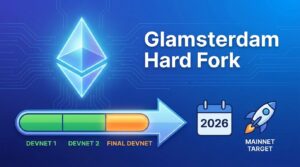
Ethereum’s Glamsterdam hard fork reached its final devnet milestone on Tuesday, effectively locking in the bundle of Ethereum Improvement Proposals (EIPs) that core developers plan to shepherd through public testnets and, ultimately, to mainnet activation in the second half of 2026. The upgrade is being positioned as the most sweeping protocol change since the Merge transitioned Ethereum to proof-of-stake in September 2022. And while the timeline remains ambitious, the progression to this stage signals a level of technical consensus that has eluded several prior upgrade cycles.
What the Final Devnet Stage Means for Ethereum’s Roadmap
Before unpacking the specifics, it helps to understand what reaching the final devnet actually represents in practice. Devnets are controlled testing environments where client teams validate new code against a shared specification. Graduating from this phase doesn’t guarantee a smooth path to mainnet, but it does narrow the window of uncertainty considerably. Here’s what stands out from the Glamsterdam milestone:
- EIP bundle locked: The set of protocol changes bundled into Glamsterdam has been finalized at the devnet level, reducing the likelihood of last-minute additions or removals that have delayed past upgrades.
- Public testnet deployment next: Core developers are expected to move the upgrade to public testnets (Goerli, Sepolia, Holesky) in the coming months, opening the code to broader validator and dApp testing.
- The scope of changes is being described as the largest since the Merge, suggesting deep modifications to execution, consensus, or both layers of the protocol.
- Mainnet target: Second half of 2026 remains the working timeline, though Ethereum’s history of delayed upgrades makes this a soft projection rather than a hard commitment.
- Client diversity remains a focal point, with multiple execution and consensus clients expected to pass interoperability checks before testnet deployment proceeds.
Why “Largest Since the Merge” Carries Weight
Ethereum developers do not invoke the Merge comparison lightly. That September 2022 event retired proof-of-work entirely, a transition years in the making that carried existential risk for a network securing hundreds of billions in value. Glamsterdam, by contrast, operates within the established proof-of-stake framework. Still, the breadth of its EIP bundle suggests changes that go well beyond routine gas optimizations or minor opcode additions.
What remains less clear is which specific EIPs are driving the “largest since the Merge” characterization. The full story, reported by The Defiant, frames the release around the scale of the protocol change, but granular EIP-level details will matter enormously to infrastructure providers, Layer 2 teams, and DeFi protocols that need to assess backward compatibility.
For validators and node operators, the practical question is straightforward: how much client software needs to change, and how quickly must they upgrade once mainnet activation is scheduled?
A Testing Gauntlet That Has Tripped Up Previous Upgrades
Reaching the final devnet is necessary. It is not sufficient. Ethereum’s Shanghai/Capella upgrade in April 2023, which enabled staked ETH withdrawals, spent months cycling through testnets before developers were confident enough to set a mainnet date. The Dencun upgrade (proto-danksharding) followed a similar pattern, with testnet hiccups pushing timelines by weeks.
Glamsterdam faces an arguably steeper gauntlet. If the scope truly rivals the Merge, public testnet phases could surface edge cases that devnets, by design, cannot replicate at scale. Validator behavior under adversarial conditions, MEV dynamics with new transaction types, and cross-client consensus bugs all tend to emerge only when real-world complexity enters the picture (a distinction that devnet environments intentionally avoid).
How Ethereum’s Recent Upgrade Timeline Has Played Out
| Upgrade | Initial Target | Actual Mainnet Date | Delay |
|---|---|---|---|
| The Merge | Early 2022 | September 15, 2022 | ~6 months |
| Shanghai/Capella | March 2023 | April 12, 2023 | ~4 weeks |
| Dencun (EIP-4844) | Late 2023 | March 13, 2024 | ~3–4 months |
| Glamsterdam | H2 2026 | TBD | Pending |
The pattern is consistent: every major Ethereum upgrade has shipped later than initially projected.
Strategic Implications for the Broader Ecosystem
Layer 2 rollups, which now handle the majority of Ethereum’s transaction volume, are arguably the most sensitive stakeholders. Protocol-level changes to how data availability works, how calldata is priced, or how the EVM processes certain operations can cascade through rollup economics in ways that are difficult to model in advance. Teams building on Ethereum’s execution layer will need to begin compatibility assessments well before testnet deployment begins.
DeFi protocols face a different calculus. Smart contracts already deployed on mainnet are immutable, but the infrastructure they depend on (oracles, bridges, sequencers) may need updates. The window between testnet deployment and mainnet activation will be the critical period for auditing and stress-testing.
Institutional participants watching Ethereum’s development cadence will note something else: the network’s ability to execute large-scale upgrades without disruption has become, in itself, a form of technical credibility. Each successful hard fork reinforces the governance model. Each delay, however minor, feeds the counter-narrative.
Frequently Asked Questions
What is the Glamsterdam hard fork?
Glamsterdam is the codename for Ethereum’s next major protocol upgrade, bundling multiple EIPs into a single hard fork that core developers describe as the most significant change since the network’s transition to proof-of-stake in 2022.
When will Glamsterdam go live on Ethereum mainnet?
The current working target is the second half of 2026, though this remains subject to the outcome of public testnet deployments. Given Ethereum’s track record, some slippage would not be unusual.
Do Ethereum users need to do anything to prepare?
Not yet. Validators and node operators will eventually need to update their client software before the mainnet activation block. Regular users holding ETH or interacting with dApps typically do not need to take direct action during a hard fork, though monitoring protocol communications closer to the activation date is advisable.
How does this compare to the Merge?
The Merge replaced Ethereum’s entire consensus mechanism. Glamsterdam operates within the existing proof-of-stake framework but is being characterized as comparable in scope due to the breadth of its EIP bundle. The risk profile differs substantially, but the engineering effort appears significant.