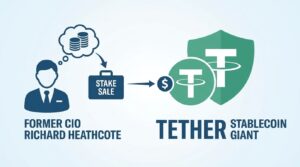
Richard Heathcote, who stepped down as Tether Holdings SA’s chief investment officer earlier this year, is reportedly preparing to offload a small stake in the world’s largest stablecoin issuer. According to Bloomberg, Heathcote has engaged investment bank PJT Partners to facilitate the sale. The move arrives at a moment when Tether’s dominance in the stablecoin market faces both intensifying regulatory scrutiny and surging demand, making the valuation and governance of the company a subject of keen interest across digital asset markets.
What Heathcote’s Planned Sale Signals for Tether’s Future
Before diving into the strategic implications, it’s worth framing what this development means for the broader stablecoin landscape and for stakeholders watching Tether’s trajectory closely.
- Liquidity event for a private company: Tether is not publicly traded, so any secondary sale of equity provides a rare external price signal for the company’s valuation, which some estimates have placed in the tens of billions of dollars.
- Governance questions surface again: A departing senior executive selling equity often prompts investors and regulators to ask what motivated the exit and what it reveals about internal dynamics.
- The choice of PJT Partners, a respected advisory-focused investment bank, suggests this is a structured, institutional-grade process rather than an informal arrangement.
- Timing matters: The sale comes as U.S. lawmakers advance stablecoin legislation that could reshape compliance requirements for issuers like Tether.
Why This Transaction Draws Outsized Attention
Tether’s USDT remains the most widely used stablecoin globally, with a circulating supply that has at times exceeded $110 billion. The company has reported substantial profits, driven largely by the yield on U.S. Treasury holdings that back its reserves. Yet for all its financial heft, Tether’s corporate structure and ownership remain opaque by the standards of traditional finance.
That opacity is precisely what makes Heathcote’s planned stake sale so closely watched.
Secondary transactions in private companies often serve as informal valuation benchmarks. In Tether’s case, where no public market exists for equity, even a small stake changing hands could recalibrate how investors, counterparties, and regulators assess the firm’s worth. And while the reported stake is described as small, the identity of the buyer (or buyers) could itself carry strategic significance, particularly if institutional capital enters Tether’s cap table for the first time in a visible way.
The PJT Partners Angle
PJT Partners is known for advising on complex, high-profile transactions. Its involvement here suggests Heathcote is targeting sophisticated buyers, possibly family offices, crypto-native funds, or sovereign-adjacent capital pools seeking exposure to stablecoin infrastructure without the volatility of token markets. Still, whether any buyer would gain governance rights or board representation alongside equity remains an open question (a distinction that matters enormously in a company this influential yet this tightly held).
Regulatory Backdrop: A Market in Transition
The sale doesn’t happen in a vacuum. U.S. stablecoin regulation has moved from theoretical debate to active legislative drafting. The proposed GENIUS Act and competing House frameworks both contemplate new reserve, audit, and licensing requirements for stablecoin issuers operating at scale. Tether, headquartered outside the United States, has historically argued that its offshore structure insulates it from direct U.S. jurisdiction. But the practical reality is more nuanced: USDT circulates heavily in dollar-denominated markets, and any U.S. regulatory framework would inevitably affect its competitive positioning.
European regulators have already acted. Under MiCA, the EU’s Markets in Crypto-Assets regulation, stablecoin issuers face capital adequacy and reserve transparency requirements that took effect in 2024. Tether’s response has been to pursue selective compliance while maintaining its base of operations in jurisdictions with lighter oversight.
Whether Heathcote’s departure and subsequent stake sale reflect any internal disagreement over regulatory strategy is, at least on paper, unknown. The company has not publicly commented on his exit.
How Stablecoin Equity Differs from Token Exposure
One underappreciated dimension here involves the distinction between holding USDT (the token) and holding equity in Tether (the company). Token holders bear redemption risk and rely on reserve backing. Equity holders, by contrast, participate in the company’s profits, which have been extraordinary by any measure.
| Dimension | USDT Token Holder | Tether Equity Holder |
|---|---|---|
| Revenue participation | None | Direct exposure to company profits |
| Risk profile | Redemption and reserve risk | Business and regulatory risk |
| Liquidity | High (traded on exchanges) | Very low (private, secondary sales only) |
| Governance influence | None | Potentially, depending on terms of the stake |
This gap between token economics and equity economics is arguably one of the least understood dynamics in the stablecoin sector. Heathcote’s sale, if completed, would bring that gap into sharper focus for market participants.
Reading Between the Lines: What Drives Executive Stake Sales
Executive departures followed by equity disposals can mean many things. Sometimes they reflect nothing more than personal financial planning. Other times, they hint at strategic divergence or shifting risk appetite. In Tether’s case, the company’s extraordinary profitability would seem to argue against selling unless the seller perceives either a need for liquidity or a belief that current valuations represent a peak.
But that framing may be too simple. Heathcote could equally be capitalizing on growing institutional appetite for stablecoin infrastructure plays, timing a sale to coincide with peak demand rather than peak concern. The psychology of such decisions often hinges on how the seller perceives the regulatory trajectory: if compliance costs are expected to rise sharply, locking in value now carries its own logic.
And while Tether has consistently dismissed concerns about its reserves and governance, the mere act of a former CIO selling equity through a top-tier investment bank introduces a new data point into a narrative the company has long sought to control.
Frequently Asked Questions
How large is the stake Heathcote plans to sell?
Bloomberg described it as a small stake. No specific percentage or dollar figure has been disclosed publicly.
Does this sale affect USDT holders directly?
No. An equity transaction in Tether Holdings SA does not alter the reserves backing USDT or the token’s redemption mechanics. These are separate layers of the company’s structure.
Who might buy the stake?
Given PJT Partners’ involvement, likely buyers include institutional investors, crypto-focused funds, or family offices seeking private exposure to stablecoin infrastructure. No buyer has been named.
What does this mean for Tether’s valuation?
Any completed transaction would provide a rare external benchmark for valuing a company that does not trade publicly. The price achieved could reshape how analysts model Tether’s enterprise value going forward, though a small stake sale may carry a liquidity discount that complicates direct comparisons.