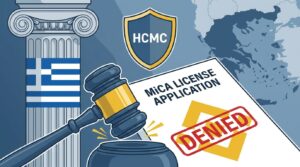
Greece’s Hellenic Capital Market Commission is reportedly preparing to reject Binance’s application for a Markets in Crypto-Assets (MiCA) license, a decision that could effectively shut the world’s largest cryptocurrency exchange out of the European Union market by July 1. Reuters broke the story, citing sources familiar with the regulatory process. Binance has pushed back against the characterization, maintaining that its application remains active and under review. Still, the implications of a formal denial would ripple well beyond Athens.
What a Greek Denial Means for Binance’s EU Ambitions
The stakes here are not abstract. Under MiCA, the EU’s comprehensive crypto-asset regulatory framework that entered full application in late 2024, exchanges must obtain authorization from a national competent authority in at least one member state to operate across the bloc. Greece was Binance’s chosen gateway. A rejection there doesn’t just close one door; it forces the exchange to restart the licensing process elsewhere, with no guarantee of a friendlier reception.
That timeline matters. July 1 marks the end of the transitional period during which previously registered crypto firms can continue operating without a full MiCA license. If Binance cannot secure authorization before that deadline, it faces the prospect of suspending services to EU-based users, a client base numbering in the millions.
- Regulatory bottleneck: Binance chose Greece as its MiCA licensing jurisdiction, and a denial forces a complete strategic reset with limited time remaining before the July 1 transitional deadline
- Market access at risk: Without a MiCA-compliant license from any EU member state, Binance would lose the legal basis to serve clients across all 27 member countries
- Competitors holding MiCA licenses already, including several smaller European exchanges, stand to absorb displaced trading volume
- Reputational cost: Even if Binance eventually secures a license elsewhere, the public nature of a Greek rejection compounds existing perceptions of regulatory friction around the exchange
- The decision could signal broader EU regulatory skepticism toward offshore-origin crypto platforms seeking to operate under MiCA’s passport system
Why Greece, and Why Now?
Binance’s decision to route its MiCA application through Greece was itself a calculated move. The Hellenic Capital Market Commission, while competent, is not among the EU’s most prominent financial regulators (a distinction that arguably made it an attractive entry point). Smaller national authorities have historically been perceived as more accessible for firms seeking initial authorization, a dynamic the EU has tried to address through supervisory convergence mechanisms.
But the Greek regulator appears to have applied the same rigor that larger authorities would. What remains less clear is whether the reported rejection stems from deficiencies in Binance’s application, broader concerns about the exchange’s compliance infrastructure, or political signals from EU-level bodies like the European Securities and Markets Authority (ESMA).
Binance, for its part, has invested heavily in compliance over the past two years. The exchange overhauled its global regulatory strategy following a $4.3 billion settlement with U.S. authorities in November 2023, which included the departure of founder Changpeng Zhao from executive leadership. Richard Teng, who succeeded Zhao as CEO, has repeatedly emphasized the company’s pivot toward regulatory engagement.
The Competitive Landscape Shifts
A Binance exit from EU markets, even temporarily, would reshape competitive dynamics in European crypto trading. Exchanges like Bitstamp, Kraken, and OKX have either secured or advanced their own MiCA licensing efforts. Coinbase obtained registration in multiple EU jurisdictions well before MiCA’s full application date.
| Exchange | MiCA Status (Reported) | Primary EU Jurisdiction |
|---|---|---|
| Binance | Application reportedly facing rejection | Greece |
| Coinbase | Licensed / Registered | Ireland |
| Kraken | Application in progress | Multiple |
| Bitstamp | Licensed | Luxembourg |
| OKX | Application in progress | France / Malta |
The volume at stake is substantial. Binance consistently handles more daily spot trading volume than any other exchange globally, and European users represent a significant share of that activity.
How MiCA Is Redrawing the Rules of Market Entry
This situation illustrates something broader about MiCA’s real-world impact. On paper, the regulation was designed to create a single, harmonized framework that would make it easier for compliant firms to operate across Europe. In practice, the licensing process has become a filter, and not every major player is passing through it smoothly. The regulation demands robust governance structures, segregation of client assets, detailed risk disclosures, and ongoing supervisory reporting. These are not trivial requirements for exchanges that grew up in a largely unregulated environment.
And while MiCA’s architects intended the passport mechanism to reduce fragmentation, the reality is that national regulators still serve as gatekeepers. A rejection in one jurisdiction doesn’t formally blacklist an applicant across the EU, but it creates a paper trail that subsequent regulators will scrutinize.
What Comes Next for Binance and EU Crypto Users
Binance has several options, none of them quick. It could appeal the Greek decision through administrative channels, though the timeline for such proceedings would almost certainly extend past July 1. Alternatively, it could file a fresh application with another member state’s regulator, a process that typically takes months. A third possibility involves restructuring its EU operations through an acquisition of a firm that already holds a MiCA license.
For EU-based users, the practical question is whether they will face service disruptions. Binance has not publicly outlined contingency plans for a scenario in which it loses EU market access, though the exchange has historically maintained operations in jurisdictions where its regulatory status was contested, sometimes longer than critics expected.
Frequently Asked Questions
What is MiCA and why does it matter for crypto exchanges?
MiCA, or the Markets in Crypto-Assets Regulation, is the EU’s comprehensive regulatory framework for digital asset service providers. It requires exchanges, wallet providers, and token issuers to obtain authorization from a national regulator in order to operate across all 27 EU member states. The transitional period for previously registered firms ends July 1, 2025.
Can Binance still operate in the EU if Greece rejects its application?
Not without securing a license from another member state. A Greek rejection doesn’t permanently bar Binance from the EU, but it eliminates the most advanced pathway the exchange had. Reapplying elsewhere would take time, and the July 1 deadline leaves very little of it.
Has Binance commented on the reported rejection?
Binance has disputed the characterization, stating that its application is still under active review. The exchange has not confirmed or denied specific details of the regulatory process in Greece.
Which exchanges already have MiCA licenses?
Several firms, including Bitstamp and Coinbase, have secured authorizations or registrations in EU jurisdictions. Others like Kraken and OKX are at various stages of the application process. The competitive advantage for early movers grows with each day that larger rivals remain unlicensed.