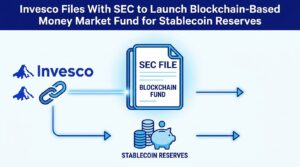
Invesco, the global asset manager overseeing $2.45 trillion in assets, has filed with the U.S. Securities and Exchange Commission to create a money market fund with a distinctive twist: its shares would be recorded as tokens on public blockchains. The fund is explicitly designed to hold reserves backing stablecoins, positioning Invesco at the intersection of traditional asset management and digital asset infrastructure. This move signals a deepening institutional commitment to tokenized finance at a moment when regulatory clarity around stablecoins appears closer than it has been in years.
Why Invesco’s Stablecoin Reserve Fund Filing Matters
The filing arrives against a backdrop of accelerating legislative activity in Washington. Congress has been advancing stablecoin-specific legislation, and the broader regulatory posture toward digital assets has shifted from outright skepticism to cautious engagement. For an asset manager of Invesco’s scale to step into this space with a product purpose-built for stablecoin backing is not a minor development. It reflects a calculated bet that the stablecoin market’s infrastructure needs are about to become a serious revenue opportunity.
- Institutional validation: A $2.45 trillion asset manager entering the stablecoin reserve business lends significant credibility to the tokenized finance ecosystem and could encourage other traditional firms to follow.
- Regulatory timing: The filing coincides with growing momentum behind U.S. stablecoin legislation, suggesting Invesco sees a near-term path to regulatory approval and market demand.
- On-chain transparency: Recording fund shares as tokens on public blockchains introduces a layer of verifiability that current stablecoin reserve arrangements largely lack (a distinction regulators have been slow to enforce).
- The product could reshape how stablecoin issuers manage reserve attestation and compliance, potentially setting a new standard for the industry.
- Competitive positioning: Invesco is arguably staking an early claim in what could become a multi-hundred-billion-dollar market for institutional-grade stablecoin reserve management.
The Architecture: Tokenized Shares on Public Chains
What separates this filing from a conventional money market fund registration is the blockchain-native structure. Shares in the Invesco fund would exist as tokens on public blockchains, meaning ownership records, transfers, and potentially settlement would occur on-chain rather than through legacy clearing systems.
This matters for stablecoin issuers in particular. Today, most stablecoin reserves sit in traditional bank accounts and Treasury holdings, with periodic attestations from accounting firms. The transparency is retrospective and intermittent. A tokenized money market fund, by contrast, could offer something closer to real-time proof of reserves, visible to anyone with access to the blockchain.
Still, questions remain about which blockchains Invesco intends to support, how redemption mechanics would function across chains, and whether the SEC will treat tokenized fund shares differently from conventional ones in its review process. The company has not disclosed these specifics publicly.
Stablecoin Reserves: A Quiet but Enormous Market
The stablecoin market currently exceeds $160 billion in total circulation, with Tether’s USDT and Circle’s USDC accounting for the vast majority. Behind every dollar of stablecoin in circulation sits, at least on paper, a corresponding reserve asset. These reserves are predominantly held in U.S. Treasury bills, reverse repurchase agreements, and bank deposits.
Managing those reserves generates meaningful revenue. Tether reported over $6 billion in profit in the first half of 2024 alone, largely from interest earned on its reserve holdings. That kind of margin has not gone unnoticed by traditional finance. Invesco’s asset management platform is well-positioned to capture a share of this flow, particularly if new legislation mandates stricter reserve standards that favor regulated, institutional-grade custodians.
And while Circle has been transparent about its reserve composition, not all issuers have matched that standard. A purpose-built fund from a regulated asset manager could become the default option for issuers seeking both compliance and credibility.
How This Fits the Broader Tokenization Trend
Invesco is not operating in isolation. BlackRock launched its BUIDL tokenized Treasury fund in early 2024, which has already attracted hundreds of millions in assets. Franklin Templeton has been running a tokenized money market fund on public blockchains since 2021. The competitive landscape is forming quickly.
| Asset Manager | Product | Blockchain | Focus |
|---|---|---|---|
| BlackRock | BUIDL Fund | Ethereum | Tokenized Treasuries |
| Franklin Templeton | OnChain U.S. Gov Money Fund | Stellar, Polygon | Tokenized money market |
| Invesco | Stablecoin Reserve Fund (filed) | Not yet disclosed | Stablecoin reserve backing |
But Invesco’s filing is distinct in one critical respect: it targets stablecoin reserves specifically, rather than offering a general tokenized Treasury product. That narrow focus could prove to be either a strategic advantage or a constraint, depending on how the regulatory and market landscape evolves.
Reframing Trust in Digital Dollar Infrastructure
At its core, the stablecoin reserve question is a trust problem. Users holding USDT or USDC are implicitly trusting that the issuer maintains adequate, liquid reserves. Periodic attestations help, but they are snapshots. They do not capture what happens between reporting dates.
A tokenized fund structure introduces a different trust model. Rather than relying solely on the issuer’s word and an auditor’s quarterly stamp, market participants could verify reserve holdings through on-chain data. This shift from periodic attestation to continuous transparency represents a meaningful upgrade in how confidence is constructed in digital dollar systems. It reframes the relationship between issuer and holder from one based on faith to one anchored in observable, programmable proof.
For institutional adopters and regulators alike, this reframing carries psychological weight. When reserve verification becomes ambient rather than episodic, the perceived risk profile of stablecoins changes. That perception shift could accelerate adoption among banks, payment processors, and corporate treasuries that have so far remained on the sidelines. The narrative moves from “trust us” to “check for yourself,” and that distinction, subtle as it sounds, has historically been the difference between niche adoption and mainstream integration in financial products.
Frequently Asked Questions
What is Invesco’s new fund designed to do?
The fund is structured as a money market vehicle whose shares are tokenized on public blockchains, specifically intended to hold the reserve assets that back stablecoins. It combines traditional money market fund mechanics with blockchain-based record-keeping.
Has the SEC approved the fund?
No. Invesco has filed with the SEC, but approval has not been granted. The timeline and outcome of the review process remain uncertain.
Why does this matter for stablecoin issuers?
It offers a regulated, transparent alternative for managing reserves. Rather than holding assets in opaque bank arrangements, issuers could point to a tokenized fund managed by a major asset manager as proof of backing. That carries weight with both regulators and users.
How is this different from BlackRock’s BUIDL fund?
BlackRock’s BUIDL is a broader tokenized Treasury product. Invesco’s filing targets stablecoin reserves explicitly, which narrows its use case but potentially deepens its relevance for issuers navigating upcoming compliance requirements.



