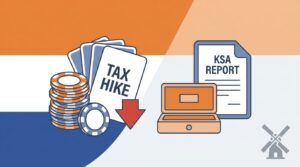
The Netherlands’ gambling regulator, Kansspelautoriteit (KSA), has confirmed that the country’s recent gambling tax increase has fallen short of its intended fiscal goals. An extensive monitoring report released by the regulator reveals that actual state revenue from the higher tax rate came in below projections set by the Ministry of Finance. The shortfall exposes a fundamental gap between the static economic models used to forecast revenue and the behavioural shifts that followed among players and operators alike.
What the KSA Report Reveals About the Tax Shortfall
Before diving into the strategic implications, it’s worth grounding the core findings. The KSA’s monitoring report documents a clear divergence between what policymakers expected and what actually materialised. The tax hike was designed to boost treasury inflows in a straightforward, linear fashion: raise the rate, collect more money. But gambling markets don’t behave like static spreadsheets.
- The increased tax rate prompted measurable shifts in player behaviour, with some migrating to unlicensed offshore platforms where Dutch tax obligations do not apply
- Licensed operators absorbed margin pressure, and several adjusted their product offerings or promotional strategies in response
- Revenue collected by the state fell below the Ministry of Finance’s original fiscal projections
- The report underscores the limits of static modelling when applied to a market as elastic and behaviour-sensitive as online gambling
- Regulatory credibility now faces scrutiny, as the policy outcome contradicts the government’s own stated rationale for the increase
Why Static Models Broke Down
Policymakers relied on assumptions that treated the gambling market as inelastic. Raise the price, keep the volume. That logic works for certain goods. Gambling, arguably, is not one of them.
When tax rates climb, licensed operators face a choice: absorb the cost, pass it to consumers through worse odds and fewer bonuses, or scale back operations in the jurisdiction entirely. Players, meanwhile, are not passive. A segment of the Dutch market shifted activity toward unlicensed platforms (a distinction regulators have been slow to enforce at scale), where tax obligations vanish and product restrictions are looser. The net effect: a smaller taxable base than projected, and a treasury yield that disappointed.
This pattern is not unique to the Netherlands. Other European jurisdictions that have pursued aggressive tax increases on gambling have encountered similar dynamics. France and Italy both saw channelisation rates dip when fiscal pressure on licensed operators crossed certain thresholds. What remains less clear is whether Dutch policymakers studied those precedents before moving forward.
Operator and Market Reactions
Licensed operators in the Dutch market have responded to the tax environment in varied ways. Some reduced marketing spend. Others restructured bonus mechanics or tightened wagering requirements to protect margins. A few have reportedly reassessed their long-term commitment to the Dutch market altogether.
The Dutch gambling authority’s regulatory framework was designed to create a competitive, well-channelised licensed market. Yet higher taxation risks undermining that very objective by making the licensed environment less attractive relative to unregulated alternatives. And when channelisation drops, so does the regulator’s ability to enforce responsible gambling standards, monitor problem gambling indicators, and collect accurate market data.
The Channelisation Problem Gets Harder to Ignore
Channelisation rate measures the share of total gambling activity that occurs within the licensed, regulated market. It is, in practice, the single most important metric for evaluating whether a regulatory regime is working. A high rate means players are gambling where the state can see them, tax them, and protect them. A low rate means the opposite.
The KSA report does not provide a precise updated channelisation figure, but the implication is hard to miss. If revenue fell short despite a higher tax rate, the taxable base contracted. That contraction almost certainly reflects migration toward unlicensed operators. The question policymakers now face is whether the marginal revenue gained from the higher rate justifies the regulatory control lost through reduced channelisation.
Broader Implications for European Gambling Regulation
The Dutch experience carries weight beyond its borders. Several EU member states are actively reviewing their own gambling tax frameworks, and the Netherlands has effectively provided a case study in what happens when fiscal ambition outpaces market reality.
| Factor | Expected Outcome | Actual Outcome |
|---|---|---|
| State Revenue | Increase proportional to tax rate hike | Below projections due to base erosion |
| Player Behaviour | Minimal change assumed | Migration toward unlicensed platforms observed |
| Operator Response | Compliance with new rate | Margin compression, reduced investment, strategic withdrawal considerations |
| Channelisation | Stable or improving | Likely declined, though precise figures remain unreleased |
Still, not every regulator will draw the same lesson. Some may view the Dutch shortfall as a calibration error rather than a structural flaw, arguing that a more moderate increase could have captured additional revenue without triggering the behavioural shifts observed. Others will see it as confirmation that gambling taxation has a ceiling beyond which returns diminish rapidly.
How Behavioural Economics Reshapes the Policy Debate
At its core, this outcome is a lesson in behavioural economics applied to regulatory design. Players are not rational actors in the way that static fiscal models assume. They respond to perceived value, convenience, product availability, and trust. When a licensed platform offers worse odds or fewer promotions because of tax-driven cost pressures, the player’s decision calculus shifts. The unlicensed alternative doesn’t need to be better in absolute terms. It just needs to feel less restrictive.
This framing matters because it reorients the policy conversation. Instead of asking “what tax rate maximises revenue?” regulators should arguably be asking “what tax rate maximises channelisation while still generating sustainable fiscal returns?” These are different questions with different answers. The Dutch case suggests the current rate overshoots the second target, even if it was designed to hit the first.
Understanding player psychology through the lens of neuro-linguistic programming principles adds another dimension. Players anchor their expectations to prior experiences. When the value proposition of a licensed platform degrades, the psychological contract between player and platform weakens. Loss aversion kicks in: players perceive the reduced value as a loss rather than a neutral adjustment, which accelerates their willingness to explore alternatives. Framing effects also play a role. Unlicensed operators often frame their offerings in terms of what players gain, while licensed platforms, burdened by compliance messaging and reduced promotional flexibility, inadvertently frame the experience around restrictions. The net perceptual effect pushes a meaningful segment of players toward environments that feel more rewarding, regardless of the actual risk involved.
Frequently Asked Questions
Why did the Dutch gambling tax increase fail to meet revenue targets?
The increase assumed player behaviour would remain constant. In practice, a portion of the market migrated to unlicensed platforms, shrinking the taxable base and producing lower-than-expected revenue.
What is channelisation and why does it matter here?
Channelisation refers to the percentage of total gambling activity occurring within the licensed, regulated market. When it drops, the state loses both tax revenue and regulatory oversight. The Dutch tax hike appears to have pushed channelisation in the wrong direction.
Could the Netherlands reverse or adjust the tax rate?
That remains a political question as much as an economic one. The KSA’s report provides the evidential basis for a policy review, but whether the government acts on it depends on competing fiscal priorities and political appetite for reversal.
Are other European countries watching this outcome?
Yes. Multiple EU jurisdictions are reviewing their gambling tax structures. The Dutch experience offers a real-world data point that complicates the case for aggressive rate increases.



