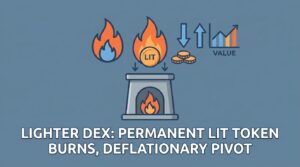
Lighter, ranked among the largest decentralized perpetuals exchanges by trading volume, has announced a structural change to its tokenomics: the platform will begin permanently burning LIT tokens acquired through its buyback program, replacing its previous approach with a decisively deflationary mechanism. The exchange has already repurchased approximately 15.5 million LIT tokens, representing roughly 6.3% of total supply. Going forward, staking rewards will be funded from Lighter’s ecosystem token reserve rather than recycled buybacks. The move marks a deliberate shift in how the protocol manages value accrual for token holders.
What Lighter’s Deflationary Shift Means for LIT Holders
Before diving into the strategic details, it’s worth framing why this matters beyond the headline. Buyback-and-burn mechanisms are not new in DeFi, but the timing and scale of Lighter’s decision carry specific implications for how decentralized exchanges compete on tokenomics in 2025.
- Supply contraction is now permanent: With 6.3% of LIT supply already bought back, the shift to burning rather than redistributing these tokens removes them from circulation entirely, creating sustained downward pressure on available supply.
- Staking incentives get a dedicated funding source: By routing staking rewards through the ecosystem reserve, Lighter decouples reward distribution from exchange revenue cycles, which could stabilize yield expectations for stakers.
- The protocol is effectively choosing long-term scarcity over short-term liquidity incentives, a bet that token price appreciation will attract and retain users more effectively than emissions-heavy models.
- Competitive positioning: As perpetuals DEXs battle for market share against platforms like dYdX, Hyperliquid, and GMX, tokenomics design has become a differentiator that sophisticated DeFi participants weigh heavily.
How the Mechanism Actually Works
Lighter generates revenue from trading fees on its decentralized perpetuals trading platform. A portion of that revenue has been used to buy LIT tokens on the open market. Previously, these repurchased tokens could theoretically re-enter circulation through various channels. Under the new framework, every token bought back gets sent to a burn address, permanently reducing total supply.
Staking rewards, meanwhile, will draw from a separate ecosystem reserve. That’s a meaningful architectural distinction. It means the protocol doesn’t need to choose between rewarding stakers and reducing supply; both happen simultaneously through independent funding streams.
Still, questions linger about the size and longevity of the ecosystem reserve. If staking demand grows faster than anticipated, the reserve’s runway becomes a critical variable (one the team has not publicly detailed with granular projections).
The Broader DeFi Tokenomics Landscape
Lighter’s pivot arrives during a period of intense experimentation across decentralized finance. Protocols are increasingly abandoning inflationary reward models that dilute existing holders in favor of mechanisms that tie token value more directly to protocol revenue. Hyperliquid’s points-based system, GMX’s fee-sharing model, and dYdX’s governance-linked staking each represent different philosophies on the same core problem: how do you make a governance or utility token worth holding?
Burn mechanisms carry a particular psychological weight. They signal commitment. When a protocol destroys its own tokens, it tells the market that management believes in scarcity-driven value over liquidity-driven growth. Whether that belief is justified depends entirely on whether trading volume and fee generation continue to scale.
And that’s the tension at the heart of this announcement. A burn is only as powerful as the revenue engine behind it.
Comparing Perpetuals DEX Tokenomics Models
| Protocol | Primary Token Mechanism | Burn Component | Staking Reward Source |
|---|---|---|---|
| Lighter | Buyback and burn | Yes, permanent | Ecosystem reserve |
| GMX | Fee sharing | No direct burn | Protocol fees (ETH/AVAX) |
| dYdX | Governance staking | Limited | Trading fee redistribution |
| Hyperliquid | Points and airdrop-based | Not applicable yet | Varies by program phase |
Why Scarcity Narratives Resonate in Current Markets
Behavioral finance research consistently shows that perceived scarcity amplifies demand, even when fundamental value remains unchanged. In crypto markets, this effect is arguably more pronounced than in traditional equities because token holders often function simultaneously as users, investors, and governance participants. When supply shrinks visibly and verifiably on-chain, it creates a feedback loop: holders anticipate price appreciation, reduce selling pressure, and reinforce the very scarcity they’re responding to.
Lighter’s team appears to understand this dynamic. By making burns permanent and publicly trackable, they’re not just implementing a mechanical change; they’re constructing a narrative framework that gives existing holders a reason to stay and prospective holders a reason to enter. The 15.5 million tokens already repurchased serve as proof of concept, demonstrating that the protocol generates enough revenue to sustain meaningful buybacks.
Yet narrative alone doesn’t sustain protocols. The critical test will be whether Lighter can maintain or grow its trading volume in a market where perpetuals competition intensifies by the quarter. Execution on product, liquidity depth, and cross-chain expansion will matter far more than tokenomics in isolation.
Frequently Asked Questions
What happens to LIT tokens after the buyback?
Under the new policy, all LIT tokens purchased through revenue-funded buybacks are sent to a burn address and permanently removed from circulation. They cannot be recovered or reissued.
How will staking rewards be funded going forward?
Staking rewards will come from Lighter’s ecosystem token reserve, a pool set aside specifically for protocol incentives. This separates reward funding from the buyback-and-burn mechanism entirely.
Does this make LIT a deflationary token?
In practical terms, yes. As long as buybacks continue and burned tokens are not replaced by new emissions, the circulating supply of LIT will decrease over time. The rate of deflation depends on trading volume and the share of revenue allocated to buybacks.
How does Lighter compare to other perpetuals DEXs?
Lighter competes with platforms like GMX, dYdX, and Hyperliquid. Its buyback-and-burn model distinguishes it from fee-sharing and points-based systems, though each approach carries different risk and reward profiles for token holders.