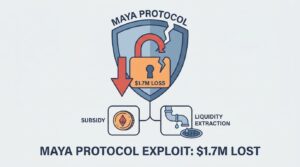
Maya Protocol, a cross-chain decentralized exchange, suffered an exploit that drained approximately $1.7 million in digital assets after an attacker manipulated the platform’s accounting through a fabricated subsidy mechanism. Blockchain security firm CertiK identified the breach, reporting that the attacker extracted roughly 48.87 million CACAO tokens and 98.82 LINK from shared liquidity pools. The incident underscores persistent vulnerabilities in DeFi liquidity infrastructure, particularly around subsidy and accounting logic that protocols rely on to manage pooled assets.
What the Maya Protocol Exploit Reveals for DeFi Liquidity Security
Before diving into the specifics, a few strategic takeaways stand out from this incident. The attack vector here wasn’t a flashy zero-day or a novel smart contract bug. It was, arguably, something more mundane and more dangerous: a logic flaw in how the protocol tracked subsidies and valued liquidity positions.
- The attacker inflated internal accounting by introducing a false subsidy, a technique that manipulated the protocol’s perception of pool value without requiring external price oracle manipulation.
- Approximately 48.87 million CACAO and 98.82 LINK were siphoned from shared liquidity, meaning the losses were distributed across liquidity providers rather than isolated to a single vault.
- CertiK’s analysis points to shared liquidity as the source of extracted funds, raising questions about how cross-chain DEXs compartmentalize risk across pooled capital.
- The $1.7 million loss, while not catastrophic by DeFi exploit standards, highlights that subsidy-related logic remains an underaudited attack surface in decentralized exchanges.
- Protocols that rely on internal accounting mechanisms for liquidity management face compounding risks when those mechanisms lack robust validation checks.
How the Attack Unfolded
The exploit followed a sequence that security researchers have flagged as increasingly common in DeFi: inflate, add, extract. First, the attacker introduced a false subsidy into Maya Protocol’s system. That single action distorted the protocol’s internal ledger, making it appear as though more value existed in the liquidity pool than actually did.
With inflated accounting in place, the attacker then added liquidity to the pool. Because the protocol’s internal math was already compromised, the attacker’s deposit was credited at an artificially favorable rate. The final step was straightforward: withdraw. By removing liquidity, the attacker pulled out more than they had deposited, pocketing the difference in CACAO and LINK tokens.
What makes this particularly instructive is the simplicity. No complex multi-step flash loan choreography. No cross-protocol arbitrage chain. Just a subsidy value that the system trusted without adequate verification.
Shared Liquidity: A Design Trade-Off Under Scrutiny
CertiK’s report noted that the drained assets originated from shared liquidity pools. Maya Protocol’s cross-chain liquidity model aggregates capital from multiple providers into unified pools, enabling efficient swaps across different blockchain networks. That design choice improves capital efficiency. It also means that when an exploit hits, losses spread across all participants in the pool rather than being contained.
This is a tension that cross-chain DEX architects have grappled with for years (and one that no protocol has fully resolved). Shared liquidity pools offer deeper markets and tighter spreads, but they create systemic exposure. A single accounting flaw can bleed value from every liquidity provider simultaneously.
Still, the alternative isn’t obviously better. Isolated pools fragment capital, reduce trading efficiency, and can introduce their own set of vulnerabilities around rebalancing logic.
Broader Implications for DeFi Protocol Auditing
The Maya Protocol exploit arrives at a moment when the DeFi sector is under intensifying pressure to demonstrate security maturity. Subsidy mechanisms, reward distribution logic, and internal accounting systems have historically received less audit scrutiny than core swap or lending functions. Yet these peripheral systems often hold the keys to pool valuation.
What remains less clear is whether existing audit frameworks are structured to catch this class of vulnerability consistently. Traditional smart contract audits tend to focus on reentrancy, overflow, and access control. Accounting logic flaws, especially those involving subsidies or rebasing mechanisms, require auditors to model economic behavior alongside code execution.
CertiK’s blockchain security monitoring identified the exploit post-execution, which is valuable for transparency but does not prevent the initial loss. The gap between detection and prevention in DeFi security remains wide.
Key Metrics from the Exploit
| Detail | Value |
|---|---|
| Estimated total loss | ~$1.7 million |
| CACAO tokens extracted | ~48.87 million |
| LINK tokens extracted | ~98.82 |
| Attack vector | False subsidy inflation + liquidity extraction |
| Source of drained funds | Shared liquidity pools |
| Identifying firm | CertiK |
Reframing Risk Perception in Decentralized Finance
Events like this exploit reshape how liquidity providers and protocol teams perceive risk in decentralized finance. From a behavioral standpoint, the tendency in DeFi communities is to anchor risk assessment on past exploits: flash loan attacks, oracle manipulation, rug pulls. But anchoring to familiar patterns creates blind spots. When a protocol is exploited through a mechanism that doesn’t fit the expected template, the psychological impact often exceeds the financial one.
For liquidity providers, the lesson here extends beyond Maya Protocol. It touches on how individuals evaluate trust in systems they cannot fully inspect. Most LPs rely on audit reports, team reputation, and TVL metrics as proxies for security. These proxies are useful but incomplete. A protocol can pass multiple audits and still harbor a subsidy logic flaw that no auditor thought to model.
Protocol teams, meanwhile, face a framing challenge. Communicating vulnerability without triggering panic requires precision. The language used in post-exploit disclosures shapes community response as much as the technical remediation itself. Teams that acknowledge specific failures and outline concrete fixes tend to recover trust faster than those that default to vague reassurances. And in a sector where trust is the primary asset, how a team responds to an exploit can matter more than the exploit itself.
Frequently Asked Questions
What is a false subsidy attack in DeFi?
A false subsidy attack involves injecting fabricated subsidy data into a protocol’s internal accounting system, tricking it into overvaluing liquidity positions. The attacker then exploits the inflated valuation to withdraw more assets than they deposited.
Were user funds directly stolen from wallets?
No. The extracted assets came from shared liquidity pools, meaning the losses were distributed across liquidity providers who had deposited into those pools. Individual wallets were not directly compromised.
How large was the Maya Protocol exploit compared to other DeFi hacks?
At roughly $1.7 million, this exploit falls on the smaller end of major DeFi incidents. For context, several exploits in 2024 and 2025 have exceeded $50 million. But the attack vector itself, targeting subsidy logic rather than more commonly audited functions, makes it notable regardless of scale.