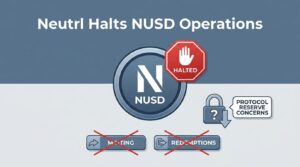
Neutrl, a DeFi protocol designed to generate market-neutral yield through its synthetic dollar NUSD, suspended core operations on Thursday after identifying undisclosed circumstances affecting its protocol reserves. The freeze covers minting, redemptions, and other key protocol functions. At the time of the halt, NUSD carried a market capitalization of roughly $53.3 million. The move, which Neutrl said followed legal counsel, immediately raised questions about the integrity of the reserves backing the synthetic asset.
What the NUSD Suspension Signals for Synthetic Dollar Protocols
Synthetic dollar products have proliferated across DeFi over the past eighteen months, each promising some variation of stable value paired with yield generation. Neutrl’s pitch centered on market-neutral strategies, a structure that, at least on paper, hedges directional risk while capturing funding rate differentials. That the protocol felt compelled to freeze all activity suggests something went wrong beneath the surface of that hedging model.
- Immediate liquidity impact: With minting and redemptions paused, NUSD holders cannot exit their positions through the protocol itself, forcing any selling pressure onto secondary markets where liquidity is typically thinner.
- Reserve opacity under scrutiny: Neutrl cited “circumstances affecting protocol reserves” without elaborating. The vagueness itself is a data point, one that echoes previous episodes in DeFi where delayed disclosure compounded losses.
- The $53.3 million market cap, while modest by stablecoin standards, still represents meaningful exposure for liquidity providers and yield farmers who allocated capital based on the protocol’s risk framework.
- Legal involvement signals severity: Neutrl stated it acted on advice from counsel, a detail that distinguishes this from a routine technical pause and hints at potential counterparty, custodial, or regulatory complications.
A Pattern That Keeps Repeating
This is not the first time a yield-bearing synthetic dollar has stumbled. The DeFi landscape is littered with protocols that promised delta-neutral returns only to discover that tail risks, whether from exchange counterparty failures, liquidation cascades, or funding rate inversions, were not as contained as their models assumed. Neutrl’s architecture, which relies on hedged positions to back NUSD, shares structural DNA with several of these predecessors.
What remains less clear is whether the reserve issue stems from an external shock or an internal miscalculation. The distinction matters enormously. An external event, say the failure of a centralized exchange where hedging positions were held, would implicate the protocol’s counterparty risk management. An internal error would raise harder questions about governance and risk modeling.
Either way, the decision to halt all protocol functions rather than selectively restrict activity suggests the team assessed the situation as systemic to NUSD’s peg mechanics.
How Market-Neutral Yield Strategies Actually Work
For readers less familiar with the mechanics: market-neutral yield protocols typically hold a long spot position in a cryptocurrency while simultaneously shorting that same asset via perpetual futures. The yield comes from the funding rate, a periodic payment between long and short traders that fluctuates based on market sentiment. When funding rates are positive (as they often are during bullish periods), the short side collects payments.
The strategy sounds elegant. But it carries risks that are easy to underestimate. Funding rates can turn negative for extended periods, eroding returns. Exchange risk is ever-present. And the complexity of managing these positions across multiple venues introduces operational vulnerabilities that simple backtests rarely capture. Neutrl’s market-neutral yield framework was built on this foundation, and the current pause raises questions about which of these risk vectors materialized.
What NUSD Holders Should Understand Right Now
With redemptions frozen, NUSD holders face a binary outcome: either the protocol resolves the reserve issue and reopens, or the situation deteriorates further. Secondary market pricing will reflect the probability-weighted expectations of both scenarios.
Historically, synthetic dollars that pause redemptions rarely return to full peg confidence quickly, even when the underlying issue is resolved. Trust, once fractured in DeFi, rebuilds slowly. And the absence of a detailed public explanation from Neutrl compounds that challenge.
Frequently Asked Questions
Can NUSD holders still trade their tokens?
Protocol-level minting and redemptions are paused, but tokens may still trade on decentralized exchanges. Expect significant price dislocation from the intended $1 peg, though, given the uncertainty.
Why did Neutrl involve legal counsel before making this decision?
The protocol has not disclosed specifics. Legal involvement typically indicates potential counterparty disputes, regulatory exposure, or fiduciary considerations that go beyond a simple technical issue.
Is the $53.3 million in NUSD at risk of total loss?
That depends entirely on the nature and severity of the reserve shortfall. Until Neutrl provides a full accounting of its reserve positions, no definitive assessment is possible.
The Broader Reckoning for DeFi Yield Products
Every incident like this sharpens the regulatory argument for mandatory reserve disclosures and real-time attestation requirements across DeFi yield products. Regulators in the EU, under MiCA, and in the United States through ongoing SEC and CFTC scrutiny, have pointed to exactly these scenarios when justifying tighter oversight of crypto-native financial instruments (a distinction that voluntary transparency initiatives have so far failed to render moot).
Arguably, the market itself is performing a regulatory function here: capital will flow away from opaque reserve structures and toward protocols that offer verifiable, on-chain proof of backing. Whether that shift happens fast enough to prevent the next freeze is another matter entirely.
For now, all eyes are on Neutrl’s next disclosure. The protocol owes its depositors specifics, not just about what went wrong, but about what the recovery path looks like and whether the reserve gap can be closed without socializing losses across holders.



