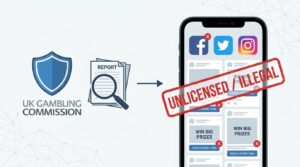
The UK Gambling Commission has published new research laying bare the mechanics and prevalence of illegal paid-entry raffles run by individuals, influencers, and small businesses across social media platforms. These operations, which often disguise themselves as prize competitions or giveaways, meet the legal definition of a lottery under the Gambling Act 2005 and are being conducted without the required licences. The findings arrive at a moment when regulators across Europe are sharpening their focus on the grey zone between social commerce and gambling, and they raise pointed questions about platform accountability.
What the Commission’s Research Actually Found
Before unpacking the strategic implications, it helps to understand the shape of the problem. The Gambling Commission’s research examined how paid-entry raffles proliferate on platforms like Instagram, Facebook, and TikTok, often promoted by influencers or micro-businesses selling raffle tickets for prizes ranging from luxury goods to cars and cash. The critical legal point: when participants pay to enter a draw where winners are selected by chance, that constitutes a lottery. And operating a lottery in the UK without a licence is unlawful.
The research highlighted several recurring patterns in how these raffles operate, who runs them, and why consumers are drawn in despite the risks.
- Operators frequently frame raffles as “competitions” or “giveaways” to sidestep the perception of gambling, even though the structure (payment + chance = prize) meets the statutory definition of a lottery
- Many are run by individuals or small businesses with no awareness that they need a licence, though ignorance of the law offers no defence
- Influencer-driven promotion amplifies reach rapidly, with some raffles generating thousands of entries at price points that can exceed £5 per ticket
- Consumer protections are virtually nonexistent: no transparency on odds, no independent draw verification, and no recourse if prizes go undelivered
- The Commission noted that some operators deliberately structure raffles to avoid scrutiny, using private groups or encrypted messaging to manage entries
Why This Matters Beyond Enforcement
Illegal raffles are not new. But their migration to social media has changed the calculus entirely. What was once a localised nuisance (a pub raffle here, a charity draw there) has become a scalable, cross-border operation with real financial volume. A single Instagram raffle can pull in tens of thousands of pounds in ticket sales within hours. And because these operators sit outside any regulatory framework, there is no audit trail, no player protection, and no guarantee the draw is fair.
That last point deserves emphasis.
Without independent oversight, there is nothing stopping an operator from rigging the outcome, failing to deliver the prize, or simply disappearing with the funds. The Gambling Commission’s regulatory framework for licensed lotteries exists precisely to prevent these outcomes, requiring operators to meet standards around transparency, fairness, and consumer protection. Unlicensed raffles bypass all of it.
The Platform Problem No One Wants to Own
One dimension the research surfaces, at least implicitly, is the role of social media platforms themselves. Instagram and Facebook host thousands of these raffle accounts. TikTok’s algorithm can push raffle content to millions of users in a matter of hours. Yet platform enforcement remains inconsistent at best.
Some platforms have policies against gambling-related content, but enforcement tends to be reactive rather than systematic. Accounts get flagged, sometimes removed, and frequently reappear under new names within days. The Commission’s research doesn’t call for platform regulation directly (a distinction regulators have been slow to force into public debate), but the implication is hard to miss: without platform cooperation, enforcement against individual operators becomes a game of whack-a-mole.
Still, the burden of compliance sits squarely with the operators. The Gambling Commission has made clear that running an unlicensed lottery is a criminal offence, carrying penalties of up to 51 weeks’ imprisonment and an unlimited fine. Whether those penalties are being applied at scale is another matter entirely.
How Consumers Can Identify Unlicensed Raffles
The research also carries implications for consumer awareness. Many participants in these raffles do not realise they are engaging with an unlicensed gambling product. The Commission has outlined several red flags:
| Indicator | What It Suggests |
|---|---|
| Entry requires payment (no free entry route) | Likely meets the legal definition of a lottery |
| No licence number displayed | Operator is almost certainly unlicensed |
| Draw conducted privately with no independent verification | No assurance of fairness or legitimacy |
| Prizes seem disproportionately valuable relative to ticket price | May indicate unsustainable economics or outright fraud |
| Operator uses multiple accounts or private messaging for sales | Deliberate evasion of platform policies and regulatory visibility |
Reframing the Conversation: Perception, Trust, and Behavioural Triggers
What makes illegal raffles so effective isn’t just the prize. It’s the psychology. Influencer endorsement activates social proof, one of the most powerful behavioural triggers in consumer decision-making. When a trusted figure promotes a raffle, followers don’t evaluate it as a gambling product; they process it as a recommendation from someone they admire. That reframing, from “gambling” to “opportunity,” is precisely what makes these schemes so difficult to counter through traditional enforcement alone.
The language operators use reinforces this. Words like “giveaway,” “win,” and “chance of a lifetime” anchor the experience in aspiration rather than risk. Scarcity cues (“only 500 tickets left”) create urgency. And the low individual ticket price (often £2 to £10) triggers a mental accounting shortcut: the cost feels trivial relative to the potential reward, even when the odds are never disclosed. This is textbook framing effect, and it works because consumers are not making a calculated decision. They are responding to emotional and social signals that bypass rational evaluation.
Regulators and consumer advocates may need to think beyond legal enforcement and invest in counter-messaging that addresses these behavioural levers directly. Telling people something is illegal has limited impact when the experience doesn’t feel like gambling. Showing them how the odds are stacked, how prizes go undelivered, and how operators profit regardless of outcomes would arguably land harder.
Frequently Asked Questions
Are all online raffles illegal in the UK?
No. Raffles operated by licensed societies for charitable or non-commercial purposes can be lawful, provided they comply with the Gambling Act 2005. What is unlawful is running a paid-entry raffle for private profit without a licence.
What should I do if I suspect an illegal raffle?
Report it to the Gambling Commission. You can also flag the account on the relevant social media platform, though removal is not guaranteed.
Can influencers be held liable for promoting illegal raffles?
Potentially. While the primary liability rests with the operator, anyone involved in promoting an unlicensed lottery could face scrutiny. The legal boundaries here remain largely untested in court.
Why don’t social media platforms do more?
Platforms generally rely on user reports and automated detection, neither of which catches every instance. Some argue that without regulatory mandates compelling platforms to act, voluntary enforcement will remain patchy.



