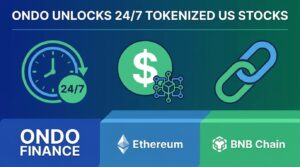
Ondo Finance has rolled out continuous minting and redemption for tokenized US stocks and ETFs across Ethereum and BNB Chain, eliminating the restriction that previously confined position creation and cancellation to US market hours on weekdays. The upgrade dissolves one of the more persistent friction points in tokenized securities: the mismatch between blockchain’s always-on infrastructure and traditional finance’s clock-bound settlement windows. For institutional participants and DeFi-native traders alike, this shift represents a structural change in how tokenized real-world assets (RWAs) can be accessed and managed.
What This Upgrade Means for Tokenized Securities
Before this change, users interacting with Ondo’s tokenized stock products could only mint or redeem during US trading hours, typically between 9:30 AM and 4:00 PM Eastern, Monday through Friday. That constraint reflected the underlying dependency on traditional equity markets for pricing and settlement. Now, with the new architecture in place, those operations run around the clock, seven days a week.
This is not merely a convenience upgrade. It redefines the liquidity profile of tokenized equities. A trader in Singapore no longer needs to wait for New York to wake up. A fund rebalancing over a weekend doesn’t hit a wall. And while the underlying stocks themselves still trade on fixed schedules (a distinction worth watching as adoption scales), the tokenized layer now operates independently of those hours.
Strategic Implications for the RWA Market
An introductory note: the real-world asset tokenization sector has grown rapidly, with estimates from Boston Consulting Group and others projecting the market could reach $16 trillion by 2030. Ondo’s move positions it at the sharper end of that trajectory. Here’s what matters most from a business standpoint:
- Liquidity continuity: Removing time-of-day restrictions means tokenized stocks can now function more like stablecoins or crypto-native assets in terms of availability, which could attract a broader class of DeFi participants.
- Cross-chain reach: Deploying on both Ethereum and BNB Chain simultaneously widens the addressable user base considerably, tapping into two of the largest smart contract ecosystems.
- The competitive signal here is loud: protocols that still gate RWA operations behind traditional market hours may find themselves losing ground to platforms offering always-on access.
- Institutional relevance: For asset managers exploring tokenized portfolios, 24/7 operability reduces operational drag and aligns better with global trading desks that already operate across time zones.
How Ondo’s Architecture Handles Off-Hours Pricing
One question that naturally surfaces: how does continuous minting work when the reference assets aren’t actively trading? Ondo has historically relied on net asset value (NAV) calculations tied to market close prices for its treasury-backed products like OUSG. Extending that model to equities and ETFs during off-hours likely involves a pricing mechanism that references the last available market price or uses a time-weighted approach.
That mechanism matters enormously. Get it wrong, and arbitrage opportunities emerge that could destabilize the peg between tokenized and underlying assets. Get it right, and you build the kind of trust that pulls traditional finance participants onto the chain. The protocol’s tokenized finance platform has not yet published full technical documentation on the pricing oracle design for this specific upgrade, so the details bear watching.
Where This Sits in the Broader Competitive Landscape
Ondo isn’t operating in a vacuum. Securitize, Backed Finance, and Maple Finance are all pursuing variations of tokenized securities and structured products. BlackRock’s BUIDL fund, tokenized through Securitize on Ethereum, has already crossed $500 million in assets. Franklin Templeton’s on-chain money market fund continues to grow.
But none of these competitors have publicly announced 24/7 minting and redemption for equity-linked products. That gives Ondo a first-mover edge in a specific and increasingly important niche. Whether that edge holds depends on execution, regulatory clarity, and whether users actually shift behavior to take advantage of off-hours access.
Comparing Key RWA Tokenization Platforms
| Platform | Asset Types | Chains Supported | 24/7 Minting |
|---|---|---|---|
| Ondo Finance | US Stocks, ETFs, Treasuries | Ethereum, BNB Chain | Yes (newly enabled) |
| Securitize (BlackRock BUIDL) | Money Market / Treasuries | Ethereum | Not publicly confirmed |
| Backed Finance | Tokenized ETFs | Ethereum, Gnosis | No |
| Franklin Templeton | Money Market Fund | Stellar, Polygon | No |
Regulatory Dimensions Worth Tracking
Tokenized securities sit in a regulatory grey zone in most jurisdictions. The US SEC has not issued definitive guidance on how tokenized representations of registered securities should be treated, particularly when minting and redemption occur outside regulated market hours. Whether Ondo’s products qualify as securities under the Howey test (or fall into a different classification) remains an open question that regulators have been slow to address.
Still, the direction of travel is clear. The SEC’s recent engagement with crypto-native firms, combined with growing institutional appetite for on-chain products, suggests that regulatory frameworks will eventually catch up. Ondo’s proactive approach to expanding functionality could either position it favorably when rules crystallize or expose it to scrutiny if enforcement priorities shift.
Frequently Asked Questions
What does 24/7 minting and redemption mean in practice?
It means users can create or cancel tokenized stock positions at any time, including weekends and holidays, without waiting for US equity markets to open. The blockchain layer operates continuously, decoupling token operations from traditional trading schedules.
Which chains support this feature?
Ethereum and BNB Chain. Both are among the most widely used smart contract platforms, giving Ondo access to a large and diverse user base across DeFi ecosystems.
Does this affect the price accuracy of tokenized stocks?
Potentially. During off-hours, when underlying equities aren’t trading, the pricing mechanism becomes critical. Ondo has not fully disclosed how it handles NAV calculations during these periods, which is something market participants should monitor closely.
Is Ondo Finance regulated?
Ondo operates in a space where regulatory classification remains unsettled. Its products interact with US securities, but the tokenized layer introduces jurisdictional complexity that existing frameworks don’t neatly address.



