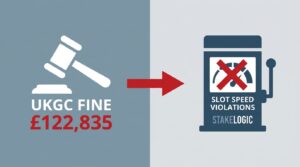
The UK Gambling Commission (UKGC) has settled a regulatory case against Stakelogic BV for £122,835 after an investigation found the B2B gaming software supplier allowed several online slot games to run faster than permitted under British gambling law. The penalty stems from breaches of technical standards tied to the provider’s remote gambling software licence, specifically rules designed to curb the risks of high-speed wagering. It marks another instance of the Commission targeting the supply side of the gambling chain, not just operators.
What Stakelogic’s Settlement Signals for B2B Suppliers
Enforcement actions against software providers remain relatively uncommon compared to operator-facing penalties, which makes this case worth watching closely. The UKGC’s willingness to pursue a B2B licensee over spin speed compliance suggests a broadening of regulatory focus that could reshape how suppliers approach product testing and deployment in the UK market.
- Spin speed rules are now a clear enforcement priority. The Commission treated violations of minimum game cycle times as a standalone compliance failure serious enough to warrant financial penalty.
- B2B suppliers cannot rely on operators to catch technical non-compliance; the UKGC is holding software providers directly accountable under their own licence conditions.
- The £122,835 figure, while modest by industry standards, carries reputational weight that may concern Stakelogic’s operator partners across regulated markets
- Supplier due diligence obligations are tightening. Any provider distributing games in Great Britain should treat this as a prompt to audit spin speed configurations across their entire portfolio.
Technical Failures in Spin Speed Controls
At the core of the investigation were the UKGC’s Remote Technical Standards, which set minimum cycle times for online gambling products. These rules exist for a specific reason: faster spins mean faster losses. A slot game that completes a cycle in under the mandated timeframe effectively accelerates the rate at which a player can wager and lose money, undermining protections that the Commission considers fundamental to harm reduction.
Stakelogic’s online slot game portfolio was found to include titles that breached these minimum thresholds. The company did not dispute the findings. What remains less clear is how many individual games were affected, or how long the non-compliant versions were live in the UK market before the issue surfaced during a compliance assessment.
That gap matters. Even a short window of non-compliance across a high-traffic game can translate into significant player exposure.
Why the UKGC Is Tightening the Screws on Suppliers
For years, regulatory enforcement in British gambling focused overwhelmingly on operators: the brands consumers interact with directly. Suppliers operated in a quieter regulatory lane. But the Commission has been signalling a shift. Its 2023–2026 strategy explicitly references the need to hold the full supply chain accountable, and actions like the Stakelogic settlement are the practical expression of that intent.
This is not an isolated case. The UKGC has previously penalised other software providers for failures in game fairness, RTP accuracy, and technical compliance. Still, spin speed violations occupy a particular space in the regulatory framework because they sit at the intersection of product design and player protection (a distinction regulators have been slow to enforce until recently). When a game spins too fast, the harm is not theoretical; it compounds with every additional cycle a player completes in a given session.
And while the £122,835 penalty may not dent Stakelogic’s balance sheet in any material way, the precedent it sets could prove more consequential than the figure itself.
How Spin Speed Regulation Works in the UK
| Requirement | Detail |
|---|---|
| Minimum game cycle time | Online slots must not complete a full spin cycle in under 2.5 seconds |
| Applicable licence type | Remote gambling software licence holders |
| Governing framework | UKGC Remote Technical Standards (RTS) |
| Enforcement mechanism | Licence reviews, regulatory settlements, and potential licence suspension for repeated breaches |
| Rationale | Reducing the speed of play to limit the rate of financial loss and support responsible gambling objectives |
Broader Market Implications for Game Developers
The settlement arrives at a time when multiple European jurisdictions are tightening rules around game mechanics, speed of play, and autoplay features. Suppliers operating across borders face a patchwork of technical requirements, and the cost of non-compliance is rising. For a company like Stakelogic, which distributes games to operators in several regulated markets, a UK enforcement action can trigger scrutiny from other regulators watching the same product catalogue.
Arguably, the bigger risk for B2B providers is not the fine itself but the downstream commercial impact. Operators selecting software partners increasingly weigh regulatory track records into procurement decisions. A settlement with the UK Gambling Commission becomes a data point in those evaluations, one that competitors will quietly reference.
Suppliers who treat compliance as a post-launch audit rather than a pre-deployment gate are the ones most exposed. The UKGC has made clear it expects technical standards to be met before games reach players, not corrected after a regulator flags the problem.
Frequently Asked Questions
What did Stakelogic do wrong?
Stakelogic permitted several of its online slot games to operate with spin speeds faster than the minimum cycle time required under the UKGC’s Remote Technical Standards. The minimum is 2.5 seconds per game cycle for online slots in Great Britain.
How much was the penalty?
The regulatory settlement totalled £122,835.
Does this affect Stakelogic’s UK licence?
The UKGC resolved the matter through a financial settlement rather than licence suspension or revocation. However, repeated non-compliance could escalate future enforcement outcomes, and the settlement itself becomes part of the company’s regulatory record.
Are other suppliers at risk of similar action?
Yes. The Commission has indicated that supply chain accountability is a strategic priority. Any B2B provider holding a remote gambling software licence in Great Britain should treat this case as a clear signal to review their own technical compliance, particularly around game speed mechanics and cycle time configurations.



