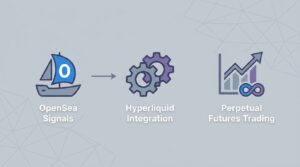
OpenSea, long recognized as the dominant NFT marketplace by historical trading volume, appears to be charting a course into derivatives territory. On Sunday, Zack Brenner, the platform’s Product Marketing Lead, posted on X asking who wanted early access to what he described as perpetual futures powered by Hyperliquid. When a user pressed for confirmation that the product would leverage Hyperliquid’s infrastructure, Brenner replied with a single word: “YES.” The move, if fully realized, would mark a dramatic pivot for a company built almost entirely on the NFT economy.
What OpenSea’s Perpetual Futures Push Means for the Market
This isn’t a minor product update. A marketplace synonymous with digital collectibles venturing into perpetual futures signals a broader strategic recalibration, one that reflects shifting revenue realities across the crypto landscape. Before unpacking the implications, here are the critical takeaways:
- Revenue diversification play: NFT trading volumes have cratered from their 2021–2022 peaks, and OpenSea’s core business has suffered accordingly. Perpetual futures represent a high-volume, fee-generating product line that could stabilize the platform’s economics.
- Hyperliquid as infrastructure backbone: By building on Hyperliquid’s decentralized exchange layer, OpenSea gains access to an order book model with deep liquidity and low latency, without constructing that stack from scratch.
- The signal to competitors is unmistakable: NFT-native platforms can no longer survive on collectibles alone.
- User acquisition potential: Perpetual futures attract a fundamentally different trader profile than NFT collectors, which could broaden OpenSea’s addressable market considerably.
- Regulatory exposure widens: Derivatives products carry heavier scrutiny from regulators in the U.S. and Europe, a dimension OpenSea will need to navigate carefully given its existing legal entanglements.
Why Hyperliquid?
Hyperliquid has carved out a distinct position in the decentralized derivatives space. Its fully on-chain order book model differentiates it from the automated market maker designs that dominate most DEX platforms. For OpenSea, this matters. Perpetual futures demand execution speed and tight spreads, and Hyperliquid’s on-chain order book architecture delivers both without requiring users to trust a centralized intermediary.
Still, the choice raises questions. Hyperliquid is relatively young. Its track record, while impressive in throughput metrics, hasn’t been tested through the kind of prolonged market stress that separates resilient infrastructure from fragile experiments. Whether OpenSea conducted extensive due diligence or simply moved fast to capture a narrative moment remains an open question (one the company hasn’t addressed publicly).
The NFT Marketplace Isn’t What It Was
Context matters here. OpenSea’s dominance in NFTs has eroded significantly. Blur entered the market with aggressive token incentives and trader-first features, siphoning volume at a pace that caught many observers off guard. Monthly NFT trading volumes across all platforms fell below $500 million in multiple months during 2023 and into 2024, a stark contrast to the multi-billion-dollar months of early 2022.
Against that backdrop, OpenSea’s pivot looks less like ambition and more like necessity.
The platform had already begun experimenting with broader crypto functionality, including token trading features and a refreshed interface. But perpetual futures represent a qualitatively different product category, one that requires margin systems, liquidation engines, risk management protocols, and compliance frameworks that NFT marketplaces have never needed to build.
How This Reshapes OpenSea’s Competitive Position
If OpenSea successfully launches perpetual futures trading, it would position the company at the intersection of two previously separate crypto verticals: collectibles and leveraged trading. That combination is unusual. And arguably, it’s precisely the kind of unconventional positioning that could differentiate OpenSea from both pure-play NFT platforms and established derivatives exchanges.
| Factor | NFT Marketplace Model | Perpetual Futures Model |
|---|---|---|
| Revenue driver | Transaction fees on spot NFT sales | Trading fees, funding rates, liquidation fees |
| User profile | Collectors, artists, speculators | Active traders, institutions, arbitrageurs |
| Volume consistency | Highly cyclical, sentiment-driven | More consistent across market conditions |
| Regulatory burden | Moderate (varies by jurisdiction) | Substantially higher, especially in the U.S. and EU |
| Infrastructure needs | Metadata, wallet integration, listings | Order matching, margin engines, oracle feeds, risk systems |
Regulatory Terrain Gets Steeper
OpenSea already faces regulatory headwinds. The SEC issued the company a Wells Notice in 2024, signaling potential enforcement action related to its NFT marketplace operations. Adding derivatives to the mix doesn’t simplify that picture.
Perpetual futures, even when offered through decentralized infrastructure, sit in a grey zone that regulators in multiple jurisdictions have been actively trying to define. The CFTC has taken the position that certain crypto derivatives fall under its purview. Whether OpenSea structures its offering to avoid direct custody or order routing responsibilities could determine how much regulatory friction it encounters.
Frequently Asked Questions
What are perpetual futures in crypto?
Perpetual futures are derivative contracts that let traders speculate on an asset’s price without an expiration date. Unlike traditional futures, they use a funding rate mechanism to keep the contract price aligned with the spot market. They’re among the most traded instruments in crypto.
Is OpenSea leaving the NFT business?
No. The perpetual futures initiative appears to be an expansion of OpenSea’s product suite, not a replacement for its NFT marketplace. The company has continued investing in its core NFT platform alongside these newer features.
When will OpenSea’s perpetual futures launch?
No official launch date has been announced. Zack Brenner’s post on X solicited early access interest, suggesting the product is in a pre-launch or testing phase. Timing remains uncertain.
Why does the Hyperliquid partnership matter?
Hyperliquid provides the decentralized trading infrastructure, specifically its on-chain order book, that OpenSea would need to offer perpetual futures without building a derivatives engine internally. It accelerates time-to-market and reduces technical risk, at least on paper.