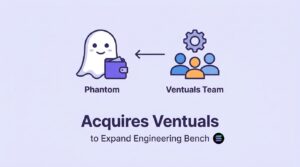
Phantom, the dominant Solana wallet by market share, has confirmed that three members of the Ventuals team are joining the company this week. The hires include Ventuals co-founders Alvin Hsia and Emily Hsia, alongside engineer Aris Samad. The move comes just weeks after Ventuals, a Hyperliquid-based perpetuals trading venue, ceased operations. For Phantom, the acquisition of talent signals a deliberate push to deepen its product capabilities at a time when wallet infrastructure is becoming a competitive battleground across crypto.
What the Ventuals Acquisition Means for Phantom’s Strategy
Acqui-hires in crypto tend to fly under the radar, but this one carries more weight than the headline suggests. Ventuals operated on Hyperliquid, a chain that has attracted serious attention for its approach to on-chain perpetual futures. The fact that Phantom is pulling engineers and founders from that ecosystem hints at where the wallet provider sees its next frontier.
Before diving into the broader implications, here are the key strategic signals embedded in this move:
- Talent over technology: Phantom is acquiring people, not a product. Ventuals shut down before this hire was announced, meaning the value here is in the team’s experience building decentralized trading infrastructure.
- Perpetuals expertise enters the wallet layer: Alvin Hsia, Emily Hsia, and Aris Samad bring direct experience with on-chain derivatives, a category that wallets have largely left to standalone dApps
- Phantom’s competitive moat increasingly depends on engineering depth, not just user interface polish
- Cross-chain knowledge: The Ventuals team built on Hyperliquid, not Solana. Their arrival at Phantom could accelerate multi-chain ambitions or introduce new trading-adjacent features within the wallet itself.
Why Wallets Are Becoming the Real Battleground
There was a time when wallets were utilities. Simple key managers. That era is over. Phantom has already expanded well beyond basic send-and-receive functionality, integrating token swaps, NFT browsing, and staking directly into its interface. Competitors like Backpack and Solflare have pushed in similar directions, but Phantom’s Solana wallet retains the largest user base by a comfortable margin.
And while the wallet wars have mostly played out on the UX front, the Ventuals hire suggests Phantom is now investing in backend sophistication. Perpetuals trading, even if it never surfaces as a native Phantom feature, requires deep understanding of order matching, margin systems, and liquidation mechanics. That kind of knowledge doesn’t just sit idle inside a company.
What remains less clear is whether Phantom intends to build trading features in-house or simply wants engineers who understand the full stack of DeFi infrastructure. Either path reshapes what a wallet can be.
The Hyperliquid Connection
Hyperliquid has carved out a distinct niche in the perpetuals market, processing billions in trading volume with a custom Layer 1 architecture. Ventuals operated within that ecosystem, building a venue designed to handle leveraged positions on-chain. The platform’s closure wasn’t widely attributed to technical failure (a distinction worth noting), but the team’s pivot to Phantom happened quickly enough to suggest conversations were already underway.
This also raises a question about talent flow between chains. Solana and Hyperliquid serve different purposes, but the engineering challenges overlap in meaningful ways: throughput, latency, state management. Phantom gains engineers who have stress-tested infrastructure under real trading conditions, arguably more valuable than hiring from a team that only shipped a testnet.
Acqui-Hires and What They Reveal About Market Conditions
The crypto industry has seen a wave of acqui-hires over the past 18 months, particularly as smaller projects run out of runway or fail to find product-market fit. But not all acqui-hires are equal. Some are lifelines for struggling founders. Others, like this one, look more like targeted recruitment by a company with the resources to absorb top-tier talent.
| Factor | Ventuals → Phantom | Typical Acqui-Hire |
|---|---|---|
| Product status | Shut down before hire | Often still operational |
| Team size acquired | 3 (lean, senior) | Varies widely, often 5–15 |
| Chain alignment | Cross-chain (Hyperliquid → Solana) | Usually same ecosystem |
| Strategic signal | Expansion into trading infrastructure | Often defensive or talent-hoarding |
Three people is a small number. But in crypto engineering, small teams with shipping experience routinely outperform larger groups still debating architecture decisions.
How This Fits the Broader DeFi Wallet Evolution
Wallets are absorbing functionality that used to require separate applications. Swap aggregation came first. Then staking. Then NFT management. The next logical layer is more sophisticated financial tooling, and perpetuals sit right at the center of that expansion.
Still, building derivatives features inside a wallet carries regulatory complexity that simple swaps do not. Perpetual futures, at least on paper, fall into a gray area that varies dramatically by jurisdiction. Whether Phantom plans to surface any trading functionality directly or simply wants the engineering muscle to improve its existing infrastructure is a distinction that will matter to regulators watching the space.
Even so, the direction of travel is unmistakable. Wallets that remain static utilities will lose users to those that function as financial operating systems. Phantom appears to be betting on the latter.
Frequently Asked Questions
What was Ventuals?
Ventuals was a perpetuals trading venue built on Hyperliquid’s on-chain derivatives infrastructure. It shut down recently, and three of its team members have now joined Phantom.
Why did Phantom hire the Ventuals team?
Phantom hasn’t detailed specific product plans tied to the hires, but the Ventuals team brings deep experience in decentralized trading systems, order execution, and margin mechanics. That expertise could inform a range of future wallet features or backend improvements.
Does this mean Phantom will offer perpetuals trading?
No announcement has been made to that effect. The hire could support internal infrastructure work rather than a user-facing trading product, though the possibility hasn’t been ruled out either.
How does this affect Solana’s wallet ecosystem?
It reinforces Phantom’s position as the most aggressively expanding wallet on Solana. Competitors will need to match not just on design, but on the depth of their engineering teams and the sophistication of their underlying systems.