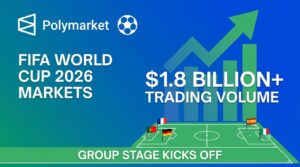
Polymarket, the blockchain-based prediction platform, has crossed $1.8 billion in cumulative trading volume on its 2026 FIFA World Cup markets, a figure that underscores how deeply decentralized betting infrastructure has embedded itself in global sporting events. France and Spain sit as razor-thin co-favorites heading into their group stage clash, while more than $66 million in open interest signals sustained conviction from traders. The numbers land at a moment when prediction markets are drawing scrutiny from regulators and fascination from institutional observers in roughly equal measure.
What $1.8 Billion in Volume Tells Us About Prediction Market Maturity
Before parsing the odds and matchups, it’s worth stepping back to consider what this milestone actually represents for the prediction market sector. The volume figure is not merely a sports betting statistic. It reflects a structural shift in how risk is priced, how sentiment is aggregated, and how crypto-native platforms are competing with traditional sportsbooks for attention and liquidity.
- Polymarket’s World Cup markets have generated over $1.8 billion in cumulative trading volume, making this arguably the largest prediction market event in the platform’s history
- France and Spain are priced as the tightest co-favorites, a pricing dynamic that mirrors traditional bookmaker consensus but with on-chain transparency
- Open interest exceeding $66 million suggests traders are holding positions rather than flipping contracts, indicating genuine directional conviction
- The group stage alone is driving substantial liquidity, which historically accelerates during knockout rounds
- This volume cements prediction markets as a parallel pricing layer for major global events (a distinction regulators have been slow to enforce)
France, Spain, and the Pricing of Tournament Favorites
That France and Spain occupy virtually identical implied probabilities is telling. Traditional sportsbooks have oscillated between the two for months, but Polymarket’s crowd-sourced pricing has converged on near-parity. The two nations meet during the group stage, and the outcome of that single match could shift contract prices across dozens of related markets overnight.
What makes prediction market pricing different from a Vegas line? Liquidity composition. On Polymarket’s decentralized prediction platform, contracts are bought and sold by a mix of retail speculators, quantitative traders, and what appear to be semi-professional bettors running models. The result: a market caught between sports analytics and crypto-native speculation.
Still, the spread between France and Spain is narrow enough that a single red card or injury could flip the implied favorite. Traders seem aware of this fragility, which may explain why open interest remains elevated rather than concentrated in short-term positions.
How Prediction Markets Are Reshaping Event-Driven Trading
The World Cup volume spike doesn’t exist in isolation. Polymarket saw enormous activity during the 2024 U.S. presidential election cycle, and the platform has steadily expanded into entertainment, climate, and geopolitical event markets. But sports, particularly tournaments with clear binary outcomes, remain the most natural fit for prediction contract structures.
Several dynamics are converging to drive this growth:
| Factor | Impact on Volume | Outlook |
|---|---|---|
| Global tournament with fixed schedule | Creates predictable liquidity windows | Volume likely peaks during quarterfinals and semifinals |
| On-chain settlement transparency | Attracts traders skeptical of traditional bookmaker opacity | Trust advantage grows as platform matures |
| Cross-market arbitrage | Quantitative traders exploit pricing gaps between Polymarket and centralized sportsbooks | Narrows spreads, deepens liquidity |
| Regulatory ambiguity in key jurisdictions | Allows growth without formal licensing friction, at least for now | Uncertain; CFTC posture remains unresolved |
Whether this trajectory holds depends partly on whether U.S. regulators treat prediction markets as derivatives, gambling products, or something else entirely. The CFTC has signaled interest but has not drawn a definitive line.
The Behavioral Layer: Why Crowds Price Risk Differently
Beyond the raw numbers, there’s a behavioral dimension worth examining. Prediction markets function as aggregation mechanisms for dispersed knowledge, a concept rooted in what information theorists call the “wisdom of crowds” effect. But crowds are not always wise. And in tournament-style events, cognitive biases shape pricing in ways that pure probability models wouldn’t predict.
Recency bias, for instance, tends to inflate the implied probability of teams that performed well in recent friendlies or qualifying rounds, even when those results carry limited predictive value for tournament play. Anchoring effects also emerge: once France or Spain is labeled a “favorite” in early markets, subsequent traders anchor to that framing rather than independently reassessing.
Neuro-linguistic programming principles suggest that the language surrounding these markets matters as much as the data. When a contract is framed as “France to win the World Cup” versus “All other teams to win,” the psychological weight shifts. Traders respond differently to positive framing than to negative framing, even when the underlying probabilities are mathematically identical. This is not a flaw in the market. It is the market. The gap between rational pricing and human behavior is where edge lives, and sophisticated participants on Polymarket appear to be exploiting exactly that gap.
Even the interface design of prediction platforms subtly shapes decision-making. Contracts displayed with green upward arrows trigger different engagement patterns than those shown in neutral formats. Platform designers understand this, and the choices they make about presentation are, in practice, choices about market microstructure.
What Remains Unresolved
For all the volume and attention, several questions hang over this market. Can Polymarket sustain liquidity through the knockout rounds, or will open interest collapse as losing positions are liquidated? How will the platform handle settlement disputes if a match outcome is contested due to officiating controversy?
And then there’s the broader question that no single tournament can answer: whether prediction markets will eventually be regulated as financial instruments, which would fundamentally alter who can participate and how contracts are structured. The $1.8 billion in World Cup volume makes that question harder for regulators to ignore.
Frequently Asked Questions
What is Polymarket?
Polymarket is a decentralized prediction market platform built on blockchain infrastructure, allowing users to trade contracts on the outcomes of real-world events ranging from elections to sporting tournaments.
How is trading volume different from open interest?
Trading volume measures the total value of contracts bought and sold over a period. Open interest reflects the value of contracts currently held by traders, meaning positions that haven’t yet been settled or closed. The distinction matters because high volume with low open interest can indicate speculative churn rather than genuine conviction.
Who are the current favorites to win the 2026 FIFA World Cup on Polymarket?
France and Spain are priced as near-identical co-favorites, with their group stage matchup expected to be a significant catalyst for price movement across multiple related contracts.
Is trading on Polymarket legal?
Regulatory status varies by jurisdiction. In the United States, the CFTC has engaged with prediction market platforms but has not issued a comprehensive framework. Users should assess their own jurisdictional rules before participating.



