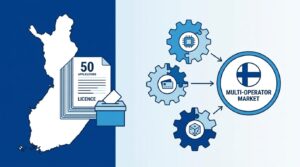
Finland’s National Police Board Gambling Administration has confirmed receipt of 50 formal gambling licence applications since its introductory registration portal went live. The milestone signals the first tangible operational phase of Finland’s departure from its decades-old state monopoly model toward a competitive, multi-licence gambling framework. A significant share of the applications reportedly originates from international digital gaming operators seeking localised compliance ahead of the country’s official market liberalisation. The intake has already triggered documentation audits, background vetting, and cross-border corporate structure verification.
What 50 Applications Tell Us About Finland’s Licensing Trajectory
The volume itself is worth pausing on. Fifty applications in the introductory window suggests that operator appetite for a regulated Finnish market runs deeper than some analysts anticipated. But raw numbers only tell part of the story. What matters more is the composition of the applicant pool and the regulatory machinery now being stress-tested for the first time.
- International operators dominate the early applicant cohort, reflecting strong commercial interest in Finland’s relatively affluent, digitally literate consumer base
- Background vetting and asset evaluation protocols are already underway, indicating the regulator intends to enforce rigorous entry standards from day one
- Cross-border corporate structure verification adds a layer of complexity that could slow approvals for operators with fragmented holding arrangements
- The licensing process will likely serve as a benchmark for other Nordic jurisdictions still weighing monopoly reform
- Early movers who secure licences stand to capture significant market share before saturation sets in
From Monopoly to Market: Why Finland Changed Course
For years, Finland’s gambling landscape was anchored by Veikkaus, the state-owned operator that held exclusive rights across lotteries, casino gaming, and sports betting. That arrangement, while politically convenient, increasingly struggled to contain the flow of Finnish consumers toward unlicensed offshore platforms. The European Commission had also raised questions about the compatibility of monopoly models with EU single-market principles (a distinction regulators across the Nordics have been slow to reconcile).
Helsinki’s decision to open the market reflects a pragmatic calculation: channelisation. By licensing credible operators and imposing enforceable standards, Finnish authorities aim to redirect consumer spending into a regulated, taxable ecosystem. Sweden’s 2019 liberalisation offered both a template and a cautionary tale, with early-stage bonus wars and advertising saturation prompting subsequent regulatory tightening.
Finland appears to have studied those lessons. The emphasis on pre-licensing audits and corporate transparency suggests a deliberate effort to avoid the chaotic first year that characterised Sweden’s transition.
Regulatory Architecture Under Pressure
Processing 50 applications simultaneously is no small administrative feat. Each submission requires the Finnish National Police Board’s gambling division to evaluate financial stability, beneficial ownership chains, responsible gambling commitments, and technical platform integrity. And that is before assessing marketing plans, anti-money laundering frameworks, and data protection compliance under GDPR.
The question nobody has answered yet: does the Gambling Administration have the staffing and technical infrastructure to process this volume without creating a bottleneck that delays the market’s launch timeline?
Arguably, the regulator’s credibility hinges on getting this phase right. A slow, opaque process risks frustrating applicants and undermining confidence in the framework. A rushed one risks granting licences to operators who haven’t been properly vetted. Neither outcome serves Finnish consumers.
Key Compliance Requirements Emerging from the Application Process
| Compliance Area | Requirement Detail | Likely Impact on Operators |
|---|---|---|
| Background Vetting | Full disclosure of beneficial owners and key personnel | Operators with complex multi-jurisdictional structures may face delays |
| Asset Evaluation | Demonstration of financial reserves sufficient to cover player liabilities | Smaller operators could struggle to meet capital thresholds |
| AML Protocols | Robust anti-money laundering systems aligned with EU directives | Requires investment in transaction monitoring technology |
| Responsible Gambling | Mandatory self-exclusion tools, deposit limits, and intervention mechanisms | Operators must integrate these features before launch, not after |
| Technical Standards | Platform security, RNG certification, and data protection under GDPR | Third-party audits will add time and cost to the licensing process |
Strategic Positioning: Who Stands to Gain
Large, publicly listed operators with existing Nordic footprints hold a structural advantage. Companies already licensed in Sweden, Denmark, or Estonia can repurpose compliance documentation and leverage established regional infrastructure. Still, the Finnish market’s specific requirements around localisation, language, and payment processing mean that even experienced operators will need to invest in tailored solutions.
For mid-tier operators, Finland represents something different: a chance to establish a foothold in a premium market before the competitive field hardens. The economics are compelling. Finland’s population of 5.6 million punches above its weight in per-capita gambling spend, and the shift from monopoly to open market is expected to expand the total addressable market as product diversity increases.
How Finland’s Licensing Model Could Reshape Nordic Gambling Norms
What makes Finland’s approach particularly worth watching is its timing. Norway remains committed to its own monopoly model under Norsk Tipping, while Iceland maintains strict state control. Finland’s success or failure in building a functional multi-licence regime will inevitably shape the political calculus in those countries. If channelisation rates climb and tax revenues meet projections, the pressure on holdout monopolies will intensify.
Even so, the Finnish experiment carries risks that extend beyond regulatory capacity. Advertising saturation, problem gambling rates, and the potential erosion of Veikkaus’s funding contributions to Finnish sports and culture are all live concerns. Legislators have signalled that advertising restrictions will be tight, but the specifics remain under development.
Common Questions About Finland’s Gambling Licence Process
How many gambling licence applications has Finland received?
The Gambling Administration has confirmed 50 formal applications since the registration portal opened.
When will Finland’s regulated gambling market officially launch?
The precise launch date has not been publicly confirmed. The current phase focuses on processing applications and establishing the regulatory framework. Timelines will depend partly on how quickly the administration can complete its vetting procedures.
Can international operators apply for a Finnish gambling licence?
Yes. A substantial portion of the 50 applications reportedly comes from international digital gaming operators. However, cross-border corporate structures face additional scrutiny during the verification process, which may extend processing times for some applicants.
What happens to Veikkaus under the new system?
Veikkaus is expected to continue operating, but it will no longer hold exclusive market rights. It will compete alongside newly licensed operators under the same regulatory conditions.



