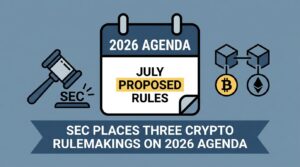
The Securities and Exchange Commission has added three crypto-focused rulemakings to its 2026 Unified Regulatory Agenda, signaling that proposed rules could arrive as early as July. Published on reginfo.gov under the agency’s own rule list, the entries address crypto asset offerings, broker-dealer custody arrangements, and exchange trading standards. The move marks the most concrete regulatory roadmap the SEC has laid out for digital assets in years, and it arrives at a moment when the industry is caught between growing institutional adoption and persistent legal ambiguity.
What the SEC’s 2026 Crypto Agenda Actually Covers
Before unpacking the strategic implications, it helps to understand what these three rulemakings target and why their sequencing matters.
- Crypto asset offerings: A proposed framework for how digital tokens and coins are issued, registered, or exempted under existing securities law. This could reshape how projects raise capital and who qualifies as an issuer.
- Broker-dealer custody: Rules governing how registered broker-dealers hold, safeguard, and report crypto assets on behalf of clients. Current ambiguity here has kept several traditional financial firms on the sidelines.
- Exchange trading standards, which would establish baseline requirements for platforms listing digital assets, potentially bridging the gap between decentralized trading venues and regulated marketplaces
Each entry carries a proposed rule target date in July 2026, though the SEC’s rulemaking timelines have historically slipped. Still, the fact that all three appear simultaneously on the Unified Agenda suggests coordinated intent rather than piecemeal response.
Why This Timing Reshapes the Regulatory Calculus
For years, the SEC’s approach to crypto regulation relied heavily on enforcement actions rather than formal rulemaking. That posture drew sharp criticism from industry participants and some members of Congress, who argued the agency was regulating by litigation. The inclusion of these items on the 2026 agenda represents a philosophical pivot, at least on paper.
The shift coincides with broader political pressure. Bipartisan legislative proposals for stablecoin oversight and market structure reform have gained traction in both chambers of Congress, and the SEC appears to be positioning itself to retain jurisdictional authority before lawmakers potentially carve out territory for the CFTC or a new standalone regulator. Whether the agency can finalize rules before legislative action overtakes it remains an open question.
And while the agenda entries themselves are procedural, their mere existence sends a signal to market participants: the SEC intends to build a framework, not just tear down non-compliant actors.
Institutional Stakes and Market Readiness
Broker-dealer custody rules, in particular, carry outsized importance for institutional adoption. Under current guidance (notably Staff Accounting Bulletin No. 121, which was revised in 2024), banks and broker-dealers face onerous balance sheet treatment when custodying crypto assets. A formal rulemaking could either codify those restrictions or, more likely, create a workable compliance pathway that brings traditional custodians into the fold.
Major financial institutions have been watching this space closely. Firms like Fidelity, BNY Mellon, and others have built crypto custody infrastructure but remain constrained by regulatory uncertainty. The SEC’s formal rulemaking process for digital asset custody could unlock billions in institutional capital that has been parked on the sidelines, waiting for legal clarity.
That clarity, arguably, matters more than any single enforcement outcome the agency has pursued to date.
Exchange Standards: The Harder Problem
Trading standards for crypto exchanges present a thornier challenge. Unlike traditional securities exchanges, many crypto platforms operate globally, list tokens without formal registration, and blend market-making with order execution in ways that would violate existing Regulation NMS principles. Crafting rules that accommodate the architecture of decentralized and hybrid exchanges without simply forcing them into a legacy mold will test the SEC’s willingness to adapt.
One sentence captures the tension: the SEC wants to regulate platforms that were designed, in many cases, to exist beyond regulatory reach.
How Market Participants Should Interpret the Agenda
Regulatory agendas are planning documents, not commitments. Items appear and disappear across cycles. But the specificity here (three distinct crypto rulemakings, each with a proposed rule stage and a target date) suggests more than aspirational listing. For compliance teams, legal departments, and C-suite strategists across the digital asset ecosystem, several practical considerations emerge now:
- Comment period preparation: Once proposed rules publish, the public comment window typically runs 60 to 90 days. Firms that begin drafting substantive responses now will have a structural advantage in shaping final rules.
- Custody infrastructure investment: Broker-dealers and banks should accelerate internal reviews of their crypto custody technology stacks, anticipating that a formal rule could set minimum standards for segregation, reporting, and insurance.
- Token classification audits: Projects that issued tokens under ambiguous legal frameworks should revisit their offering structures. A proposed rule on crypto asset offerings will likely force a reckoning on which tokens qualify as securities.
- Smaller exchanges and DeFi protocols face the most existential uncertainty, since trading standards rules could impose registration requirements that fundamentally alter their operating models
The Broader Regulatory Landscape in 2026
The SEC’s agenda does not exist in isolation. The CFTC continues to assert jurisdiction over crypto commodities, and stablecoin legislation could create an entirely separate regulatory track for payment tokens. What emerges is a fragmented but increasingly active regulatory environment where multiple agencies are staking claims simultaneously (a distinction that creates compliance complexity rather than reducing it).
For global firms, the picture grows more layered still. The EU’s Markets in Crypto-Assets Regulation entered full application in late 2024, and jurisdictions from Singapore to the UAE have finalized their own licensing regimes. U.S. rulemaking, if it proceeds on schedule, would bring the world’s largest capital market closer to alignment with international peers.
But schedule adherence is precisely where skepticism is warranted. The SEC has a long history of delaying complex rulemakings, and crypto rules will attract intense lobbying from all sides. July 2026 is a target, not a guarantee.
Frequently Asked Questions
What is the SEC’s 2026 Unified Regulatory Agenda?
It is a planning document published by federal agencies listing anticipated rulemakings. The SEC’s 2026 version includes three crypto-specific entries covering asset offerings, broker-dealer custody, and exchange trading standards, each targeting a proposed rule stage by July 2026.
Does this mean crypto regulations are finalized?
No. These are proposed rulemakings, meaning the SEC intends to publish draft rules for public comment. Final rules would follow only after a review of comments and potential revisions, a process that can take a year or longer.
How could broker-dealer custody rules affect institutional investors?
Clear custody rules would reduce the regulatory risk that currently discourages banks and broker-dealers from holding crypto on behalf of clients. This could significantly expand institutional participation in digital asset markets by providing a defined compliance framework.
Will DeFi protocols be affected by exchange trading standards?
Potentially. The scope of any proposed rule remains to be seen, but decentralized exchanges that facilitate trading in assets the SEC considers securities could face new registration or compliance obligations. The details will matter enormously here.