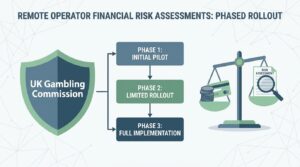
The UK Gambling Commission has confirmed it will deploy its long-debated Financial Risk Assessments (FRAs) through a structured, phased rollout rather than a single sweeping mandate. After more than 18 months of piloting, data evaluation, and consultation with the gambling industry, the regulator’s approach prioritises automated, data-driven checks powered by credit reference agency information. The first phase targets the largest remote operators, focusing on exceptional spending thresholds. It marks a deliberate pivot away from the sector’s entrenched reliance on manual document collection, a practice that has drawn criticism from both operators and consumers alike.
What the Phased Approach Signals for the Industry
Before diving into specifics, the broader strategic contour here deserves attention. The UKGC is not simply rolling out a new compliance tool. It is reshaping how affordability and financial vulnerability are assessed across the entire remote gambling ecosystem. The phased structure reflects both regulatory caution and a recognition that the industry’s infrastructure varies wildly between Tier 1 operators and smaller licensees.
- The rollout begins exclusively with the largest remote operators, reducing the risk of system-wide disruption while generating early performance data at scale.
- Automated checks via credit reference agencies replace much of the manual document burden, a shift that could meaningfully reduce customer friction and operator costs.
- By phasing implementation, the UKGC retains flexibility to adjust thresholds, data sources, and enforcement expectations based on real-world outcomes from Phase 1.
- Smaller operators gain additional runway to prepare their compliance systems, though the timeline for subsequent phases has not been publicly detailed.
- The approach arguably sets a precedent for how other gambling regulators globally might structure similar affordability frameworks without triggering market shocks.
How Automated FRAs Differ from Legacy Checks
For years, the standard approach to financial risk assessment in UK gambling involved requesting bank statements, payslips, or other sensitive documents directly from customers. The process was slow, intrusive, and widely blamed for driving players toward unlicensed offshore platforms. Operators complained about the operational cost. Players complained about the indignity.
The new model flips this. Instead of asking customers to prove they can afford to gamble, operators will pull anonymised financial indicators from credit reference agencies in near real-time. The check happens in the background. No documents change hands. And the process triggers only when spending crosses defined thresholds (a distinction regulators have been slow to clarify in public-facing communications).
Still, questions linger about the accuracy and completeness of credit reference data. Not every consumer’s financial picture is fully captured by these agencies, particularly those with irregular income streams or limited credit histories. Whether the UKGC has accounted for these gaps in its pilot evaluation remains an open thread.
Why the Largest Operators Go First
Targeting the biggest remote licensees first is more than logistical convenience. These operators handle the vast majority of UK online gambling transactions and possess the technical infrastructure to integrate automated data feeds without months of development work. They also represent the highest concentration of regulatory risk, given their customer volumes and the scale of potential harm.
There is a practical dimension too. Large operators like those holding licences through the UK Gambling Commission’s regulatory framework already maintain dedicated compliance teams and existing relationships with credit reference agencies. For them, the transition is an evolution, not a revolution. For a mid-market operator running a lean compliance function, the same mandate could be destabilising without adequate lead time.
The Threshold Question
Phase 1 centres on “exceptional” spending levels. But what counts as exceptional? The UKGC has historically avoided publishing rigid numerical thresholds, preferring principle-based guidance that gives operators discretion (and, critics would argue, too much room for inconsistency). Whether the phased rollout will come with more prescriptive trigger points is something the industry is watching closely.
Reframing the Consumer Experience
One underappreciated angle in this story is the psychological dimension. Gambling customers subjected to intrusive affordability checks often describe the experience as stigmatising. Being asked to upload payslips to continue placing bets creates a cognitive dissonance that can erode trust in the operator and, paradoxically, push vulnerable individuals toward unregulated alternatives where no such checks exist.
Automated, invisible checks address this directly. When the assessment happens without the customer’s active involvement, the friction disappears. The protective intent remains, but the experience shifts from interrogation to seamless safeguarding. This reframing matters enormously for customer retention and brand perception in a market where trust is currency.
From a behavioural standpoint, the move also aligns with principles of choice architecture. Rather than forcing consumers into a compliance interaction that feels punitive, operators can maintain a frictionless journey while still identifying and intervening with at-risk individuals. The nudge is invisible, which is precisely when nudges work best.
Yet the success of this model depends entirely on the quality of the underlying data and the sophistication of the algorithms interpreting it. A false positive that restricts a financially healthy customer’s account could be just as damaging to trust as the old document-request model. The calibration challenge is real, and the UKGC’s pilot data will need to demonstrate that error rates fall within acceptable bounds.
Broader Regulatory Implications
The UK’s approach does not exist in a vacuum. Regulators in Australia, parts of Europe, and several US states have been grappling with similar affordability questions, often with even less consensus on methodology. If the UKGC’s phased FRA rollout produces measurable reductions in gambling harm without cratering operator revenues, it becomes a template.
| Aspect | Legacy Manual Checks | Automated FRA Model |
|---|---|---|
| Data Source | Customer-submitted documents | Credit reference agency feeds |
| Customer Experience | Intrusive, often delayed | Background, near real-time |
| Operator Cost | High (manual review teams) | Lower at scale (system integration) |
| Coverage Gaps | Dependent on document quality | Limited by credit file completeness |
| Regulatory Flexibility | Difficult to standardise across licensees | Easier to mandate uniform thresholds |
Frequently Asked Questions
What are Financial Risk Assessments in UK gambling?
FRAs are compliance checks designed to evaluate whether a customer’s gambling spending is consistent with their financial circumstances. The UKGC’s new model automates these checks using credit reference agency data rather than requiring customers to submit personal financial documents.
Which operators are affected first?
The initial phase applies exclusively to the largest remote gambling operators in the UK. Smaller licensees will be brought into the framework in subsequent phases, though the UKGC has not published a detailed timeline for those later stages.
Will customers know they are being checked?
The automated model is designed to operate in the background without requiring direct customer interaction. That said, operators will still need to comply with data protection obligations, including transparency about how personal data is used.
Does this replace all existing affordability checks?
Not entirely. The FRA framework supplements rather than eliminates existing responsible gambling obligations. Operators retain duties around customer interaction triggers, self-exclusion tools, and broader harm prevention measures. What changes is the mechanism for the financial assessment itself.