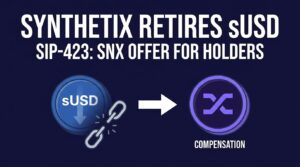
Synthetix governance has initiated a formal process to wind down its sUSD stablecoin, proposing to compensate all remaining holders at face value through vested SNX tokens. The proposal, designated SIP-423, was introduced on June 12 by founder Kain Warwick and core contributors. With sUSD currently trading at roughly $0.25 against its intended $1.00 peg, according to CoinGecko and DefiLlama data, the move acknowledges what markets had already priced in: the stablecoin’s peg mechanism has effectively failed. The decision marks a significant structural shift for one of DeFi’s earliest synthetic asset protocols.
What SIP-423 Means for sUSD Holders and the Broader Synthetix Ecosystem
Before diving into the specifics, it’s worth framing the scale of what’s being proposed. Synthetix isn’t merely adjusting parameters or introducing a new stability mechanism. It is retiring a core product and replacing outstanding liabilities with equity-like exposure to the protocol itself. That distinction matters, both for holders weighing their options and for the DeFi sector watching how distressed stablecoin situations get resolved.
- Full face-value redemption in SNX: All sUSD holders would receive vested SNX tokens equivalent to $1.00 per sUSD, despite the token trading at a 75% discount to peg at the time of the proposal.
- Vesting structure signals caution: The use of vested (rather than liquid) SNX suggests governance wants to prevent immediate sell pressure on the protocol’s native token while still honoring obligations.
- SIP-423 effectively concedes that sUSD’s peg recovery is no longer a viable path forward.
- Precedent-setting resolution: How this plays out could shape expectations for how other DeFi protocols handle stablecoin failures, particularly those backed by endogenous collateral.
- Governance-led wind-downs remain rare in DeFi; most depeg events end in abandonment rather than structured compensation.
A 75% Depeg That Governance Could No Longer Ignore
sUSD’s troubles didn’t arrive overnight. The stablecoin had been drifting below its dollar peg for months, a slow bleed that eroded confidence among users and liquidity providers alike. By the time SIP-423 surfaced, the token was changing hands at approximately $0.25 (a figure that, in traditional finance, would trigger immediate regulatory intervention).
What made the situation particularly thorny is that sUSD was not a conventional stablecoin backed by fiat reserves or overcollateralized crypto. It was a synthetic asset, minted against staked SNX collateral within the Synthetix protocol’s debt pool architecture. When the value of SNX declined and participation in staking waned, the reflexive dynamics that once supported the peg began working in reverse. Fewer stakers meant less collateral backing, which meant less confidence, which meant fewer stakers.
Still, the proposal to pay holders back at $1.00 in SNX is more generous than many expected. Whether it’s generous enough depends on your view of SNX’s own trajectory.
How the Vested SNX Compensation Would Work
Under SIP-423, each sUSD token would be redeemable for SNX at a rate reflecting the $1.00 face value. But the tokens wouldn’t be immediately liquid.
| Parameter | Detail |
|---|---|
| Redemption rate | $1.00 per sUSD in SNX equivalent |
| Token form | Vested SNX (not immediately transferable) |
| Current sUSD market price | ~$0.25 |
| Implied upside for current holders | ~4x if SNX price holds at redemption |
| Risk factor | SNX price volatility during vesting period could erode or amplify actual value received |
The vesting mechanism is doing double duty here. It protects the SNX market from a flood of sell orders while also binding former sUSD holders to the protocol’s future performance. Arguably, this converts stablecoin holders into something closer to equity participants, whether they wanted that exposure or not.
Why This Matters Beyond Synthetix
DeFi has seen stablecoins collapse before. UST’s implosion in May 2022 remains the most dramatic example, wiping out tens of billions in value with no structured recovery for holders. But the Synthetix approach is different in kind, if not in scale. Governance is stepping in before total collapse, offering a defined exit rather than leaving holders to scramble on secondary markets.
That shift in posture carries implications. Other protocols operating synthetic or algorithmic stablecoins will face pressure to articulate their own contingency frameworks. And regulators, who have increasingly scrutinized stablecoin reserves and redemption mechanisms, may view governance-led wind-downs as either a model worth encouraging or evidence that decentralized stablecoins remain fundamentally fragile.
Less clear is whether the vesting terms will satisfy holders who entered sUSD expecting dollar stability, not token-based equity risk.
The Psychology of a Structured DeFi Wind-Down
From a behavioral standpoint, SIP-423 represents something unusual in crypto governance: an explicit acknowledgment of failure paired with a concrete remediation plan. In neuro-linguistic programming terms, the framing matters enormously. By anchoring the compensation at $1.00 face value, Synthetix governance reframes the narrative from “loss” to “recovery,” even though the actual outcome depends entirely on future SNX performance. This anchoring effect can shift holder sentiment from panic to cautious optimism, a psychological lever that traditional restructuring professionals deploy routinely but that DeFi governance has rarely attempted.
Consider the alternative framing: if the proposal had offered liquid SNX at current sUSD market value ($0.25), the message would have been capitulation. Instead, the $1.00 anchor combined with vesting creates a forward-looking commitment. Holders are being asked to believe in the protocol’s future rather than accept its present. That’s a fundamentally different emotional contract, and it changes how participants process the information. The vesting period itself functions as a cooling mechanism, preventing reactive decision-making and forcing a longer time horizon onto participants who might otherwise sell immediately. Whether this constitutes fair treatment or clever narrative management depends on where you stand. But the structural choice to vest rather than distribute reveals a governance team thinking carefully about second-order behavioral effects, not just token mechanics.
Frequently Asked Questions
What happens if I hold sUSD right now?
If SIP-423 passes governance, you would be eligible to redeem your sUSD for vested SNX tokens at a rate reflecting $1.00 per sUSD. The tokens won’t be immediately liquid, so you’d hold vested SNX subject to whatever unlock schedule governance finalizes.
Is this proposal already approved?
No. SIP-423 has been introduced and is under governance review. It still needs to pass a community vote before implementation begins.
Why vested SNX instead of liquid tokens or USDC?
Vesting prevents a sudden wave of selling pressure on SNX, which would undermine the very compensation being offered. The protocol doesn’t hold large fiat-backed reserves, so SNX is the primary asset available for redemption.
Could sUSD recover its peg instead?
At $0.25, a return to $1.00 would require a fundamental shift in market dynamics and staking participation that governance appears to have judged unlikely. The proposal itself signals that recovery is off the table.