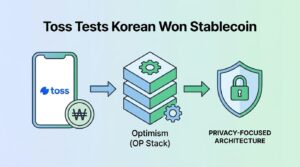
South Korean fintech giant Toss, which commands a user base of approximately 30 million registered accounts, has begun testing a Korean won-denominated stablecoin built on Optimism’s OP Stack. The proof of concept, disclosed by Optimism via X on Wednesday, also involves Sunnyside Labs and its “Privacy Boost” tool designed to shield transaction data on public blockchains. If the pilot advances beyond its current experimental phase, it could mark one of the most significant entries by a mainstream Asian fintech platform into the stablecoin space.
Why a Korean Won Stablecoin From Toss Matters
Before unpacking the technical and regulatory dimensions, it helps to frame what this move signals for the broader digital asset landscape in South Korea and beyond. A few strategic takeaways stand out:
- Toss’s 30 million user base gives any stablecoin initiative immediate distribution potential in one of Asia’s most digitally active economies
- Building on Optimism’s OP Stack suggests a preference for Ethereum-aligned Layer 2 infrastructure, which could influence how other fintechs evaluate their own blockchain strategies
- The inclusion of Sunnyside Labs’ privacy tooling indicates that transaction confidentiality remains a design priority, even on public chains
- South Korea’s evolving regulatory stance on digital assets makes the timing of this pilot particularly consequential for compliance frameworks around fiat-backed tokens
- A successful proof of concept could accelerate institutional interest in won-denominated stablecoins across DeFi and cross-border payment corridors
The Architecture: OP Stack and Privacy Boost
Optimism’s OP Stack has steadily gained traction as the modular framework of choice for projects seeking Ethereum-compatible rollup infrastructure. Toss’s decision to build its stablecoin proof of concept here is not arbitrary. The OP Stack offers a composable environment where developers can deploy application-specific chains while inheriting Ethereum’s security guarantees. That composability matters when the end goal is integrating a stablecoin into an existing fintech ecosystem serving tens of millions.
Sunnyside Labs enters the picture with its Privacy Boost tool. Public blockchains, by design, expose transaction data to anyone who cares to look. For a consumer fintech app handling sensitive financial activity, that transparency creates friction. Privacy Boost aims to resolve this tension by enabling selective disclosure, allowing users and institutions to control what information is visible on-chain (a distinction regulators have been slow to enforce in most jurisdictions). The pairing of a public Layer 2 with a privacy layer suggests Toss is thinking about enterprise-grade deployment, not just a token experiment.
South Korea’s Regulatory Landscape Adds Complexity
South Korea passed its Virtual Asset User Protection Act in 2023, which took effect in mid-2024. The law primarily targets exchange-listed crypto assets and investor safeguards, but its implications for stablecoins remain partially unresolved. Korean regulators have signaled interest in establishing clearer rules around fiat-pegged digital currencies, yet no comprehensive stablecoin-specific framework exists at the time of this pilot.
That gap creates both opportunity and risk for Toss. On one hand, moving early allows the company to shape regulatory conversations. On the other, launching a won stablecoin without explicit regulatory blessing could invite scrutiny from the Financial Services Commission. Whether Toss intends to seek formal authorization or position this purely as a technical demonstration will likely determine how regulators respond.
Still, the broader trajectory in Seoul points toward accommodation rather than prohibition. Korean policymakers have increasingly acknowledged the strategic importance of blockchain infrastructure, particularly as regional competitors in Japan and Singapore advance their own stablecoin regimes.
What This Means for Stablecoin Competition in Asia
The stablecoin market remains overwhelmingly dollar-denominated. Tether’s USDT and Circle’s USDC account for the vast majority of global stablecoin volume. But local-currency stablecoins have begun carving out niches, especially in markets where cross-border remittance costs remain high and domestic payment rails are ripe for disruption.
A won stablecoin backed by a platform like Toss’s consumer fintech ecosystem would differ meaningfully from most existing stablecoin projects. Rather than targeting crypto-native traders, it could serve as a bridge between traditional banking and on-chain finance for everyday users. Japan’s regulatory approval of yen-backed stablecoins in 2023 already demonstrated that Asian regulators can move decisively when the product design addresses compliance concerns upfront.
The competitive implications extend beyond Korea. If Toss proves that a privacy-enhanced, fiat-backed stablecoin can operate within a regulated fintech environment, it creates a replicable template for platforms across Southeast Asia and beyond.
How Privacy and Compliance Intersect on Public Chains
One of the harder questions in blockchain design involves reconciling transparency with privacy. Public ledgers offer auditability, which regulators value. But full transparency exposes users to surveillance, front-running, and competitive intelligence risks that traditional financial systems would never tolerate.
Sunnyside Labs’ approach with Privacy Boost attempts to thread this needle. The tool reportedly enables configurable privacy settings, meaning that transaction details can be hidden from the general public while remaining accessible to authorized parties such as regulators or compliance officers. In practice, this mirrors the “permissioned transparency” model that several enterprise blockchain projects have pursued, though few have attempted it on a public Layer 2 with consumer-scale ambitions.
Whether this architecture satisfies Korean regulators remains an open question. And whether users themselves will trust a privacy tool built atop Optimism’s open-source rollup framework depends heavily on how Toss communicates the technical guarantees involved.
Frequently Asked Questions
What is Toss?
Toss is a South Korean fintech application offering payments, banking, investment, and insurance services. It has approximately 30 million registered users, making it one of the largest consumer finance platforms in the country.
What is the OP Stack?
The OP Stack is a modular, open-source development framework created by Optimism for building Layer 2 rollups on Ethereum. It allows developers to deploy custom chains that benefit from Ethereum’s security while achieving lower transaction costs and higher throughput.
Is the Korean won stablecoin available to the public?
No. The project is currently a proof of concept. There has been no announcement regarding a public launch timeline, and regulatory approvals would likely be required before any consumer-facing deployment.
Why does privacy matter for stablecoins on public blockchains?
Public blockchains expose all transaction data by default. For a fintech platform handling millions of users’ financial activity, this level of exposure creates risks around user privacy, competitive intelligence, and regulatory compliance. Privacy tools like Sunnyside Labs’ Privacy Boost aim to give users and institutions control over what data is publicly visible while maintaining auditability for authorized parties.