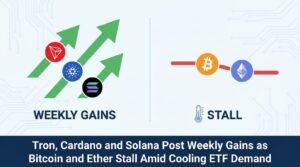
Tron, Cardano and Solana emerged as the strongest performers among the top 10 cryptocurrencies by market capitalisation this week, each posting notable gains while Bitcoin and Ether struggled to maintain momentum. The divergence coincided with a visible cooling in demand for US spot ETFs tied to Bitcoin and Ether, particularly on Thursday when net inflows slowed sharply. That split in performance raises pointed questions about where institutional appetite is actually heading — and whether altcoin rallies can sustain themselves without broader market tailwinds.
What the Weekly Numbers Reveal for Top Crypto Assets
Before diving into the strategic implications, it helps to frame the week’s price action in context. While Bitcoin remains the dominant asset by capitalisation, its inability to break higher despite months of ETF-driven optimism has opened a window for alternative layer-1 tokens to attract rotational capital. Here are the key takeaways from this week’s market movement:
- Tron (TRX), Cardano (ADA) and Solana (SOL) led the top 10 in weekly percentage gains, outperforming both Bitcoin and Ether by a meaningful margin.
- US spot Bitcoin and Ether ETFs saw reduced net inflows on Thursday, signalling a potential pause in institutional momentum that had been building through much of 2025.
- Bitcoin’s price remained range-bound, unable to capitalise on macro tailwinds that had previously supported upward moves.
- Altcoin outperformance may reflect a shift in risk appetite among traders seeking higher-beta exposure during periods of BTC consolidation.
- The ETF demand slowdown, if sustained, could weigh on sentiment across the broader digital asset market in the coming weeks.
ETF Inflow Dynamics: A Closer Look at Thursday’s Pullback
Spot Bitcoin ETFs in the United States had been a reliable source of buying pressure for months. Thursday broke that pattern. Net inflows declined noticeably across several major funds, though exact figures varied by issuer. Ether-linked ETFs followed a similar trajectory, with demand softening after a stretch of steady accumulation.
Why the pause matters is straightforward. ETF flows have become one of the most closely watched indicators of institutional conviction in crypto. When those flows decelerate, it tends to ripple through spot markets, dampening price action for the assets directly tied to those products. And while a single day of weaker inflows does not constitute a trend reversal, the timing is notable — it arrived just as Bitcoin was testing resistance levels that have held firm for weeks.
Still, not all market participants interpret the data the same way. Some view Thursday’s dip as routine profit-taking rather than a structural shift. Others point to macroeconomic uncertainty, including mixed signals from the Federal Reserve, as a more likely driver of caution among allocators.
Why Tron, Cardano and Solana Diverged
Each of the three outperformers this week has its own catalyst story, which makes the collective rally more interesting than a simple case of altcoin rotation.
| Asset | Weekly Performance | Key Catalyst |
|---|---|---|
| Tron (TRX) | Strong gain | Continued growth in stablecoin transfer volume on the Tron network, which handles a significant share of global USDT transactions |
| Cardano (ADA) | Notable uptick | Renewed developer activity and governance upgrades following the Voltaire era roadmap |
| Solana (SOL) | Solid weekly advance | Sustained DeFi and NFT ecosystem expansion, plus growing institutional interest in Solana’s high-throughput blockchain infrastructure |
Tron’s role as a dominant settlement layer for Tether (USDT) transfers gives it a utility floor that many competing chains lack. That real-world usage translates into consistent network revenue, which in turn supports token demand during periods when speculative interest rotates away from Bitcoin.
Cardano’s story is different. The network has historically been criticised for slow delivery on its technical roadmap, but recent governance milestones under the Voltaire phase have injected fresh optimism (a distinction the market had been reluctant to price in until now). Whether that optimism converts into lasting developer traction remains the open question.
Solana, arguably the most institutionally visible of the three, continues to benefit from a broadening application layer. Its transaction throughput and low fees have made it a preferred chain for both retail and institutional DeFi activity.
Reading the Market Through Behavioural Signals
Beyond the charts and flow data, the week’s divergence offers a window into trader psychology. When Bitcoin consolidates and ETF demand cools, capital doesn’t simply vanish — it migrates. The rotation into Tron, Cardano and Solana reflects a behavioural pattern well-documented in crypto cycles: traders seek asymmetric upside in altcoins when the dominant asset stalls.
This pattern is reinforced by anchoring bias. After months of watching Bitcoin climb on ETF narratives, many market participants have anchored their expectations to continued upward movement. When that expectation is disrupted, the psychological response is often to seek alternative vehicles that feel “undervalued” relative to their recent trajectory. Solana and Cardano, both of which had underperformed Bitcoin earlier in the year, fit that profile neatly.
There is also a framing effect at work. Headlines about ETF inflow slowdowns frame the narrative around Bitcoin weakness, even if the absolute numbers remain historically strong. That framing nudges sentiment toward altcoins, creating a self-reinforcing cycle of attention and capital allocation. Experienced traders recognise this dynamic and position accordingly, which is partly why altcoin rallies during BTC consolidation phases tend to be sharp but short-lived.
Loss aversion plays a role too. Holders who bought Bitcoin near recent highs and see stagnation are psychologically more inclined to diversify into assets showing momentum, even if the fundamental case for doing so is thin. Understanding these cognitive patterns doesn’t predict the next move — but it does explain why weeks like this one unfold the way they do.
What Happens If ETF Demand Stays Flat?
A sustained plateau in ETF inflows would test the market’s resilience in ways that a single soft Thursday cannot. Bitcoin’s price structure since early 2024 has been heavily supported by institutional buying through spot ETF products. Remove that pillar, at least on paper, and the asset becomes more dependent on organic spot demand and derivatives positioning.
For altcoins, the picture is more nuanced. Tokens like TRX and SOL with measurable on-chain utility may hold up better than those driven primarily by speculation. Cardano’s evolving governance framework gives it a narrative advantage, but narratives alone rarely sustain price action beyond a few weeks.
The broader takeaway: this week’s divergence is a signal, not a verdict. Whether it marks the beginning of a meaningful altcoin season or simply a brief rotation during a Bitcoin breather depends almost entirely on what ETF flows look like over the next fortnight.
Frequently Asked Questions
Why did Bitcoin underperform this week?
Bitcoin’s price remained range-bound as US spot Bitcoin ETF inflows slowed on Thursday, reducing a key source of buying pressure that had supported the asset for months.
Is the decline in ETF inflows a long-term concern?
Not necessarily. A single day of reduced inflows does not indicate a structural shift. However, if the trend persists over multiple weeks, it could weigh on Bitcoin and Ether prices more meaningfully. Context matters here — macro uncertainty and profit-taking are both plausible explanations.
What drove Tron’s outperformance?
Tron continues to process a large share of global USDT stablecoin transfers, giving the network consistent utility-driven demand that supports TRX during periods of broader market consolidation.
Should investors rotate into altcoins during Bitcoin consolidation?
Altcoin rallies during BTC stagnation are common but historically tend to be short-lived. Any allocation decision should weigh the specific fundamentals of each token rather than relying on rotational momentum alone.