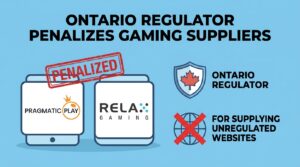
The Alcohol and Gaming Commission of Ontario (AGCO) has levied monetary penalties against two major gaming suppliers, Pragmatic Play and Relax Gaming, after determining that both companies allowed their products to appear on unregulated gambling websites accessible to Ontario residents. The enforcement actions represent a pointed escalation in Ontario’s effort to protect the integrity of its ring-fenced iGaming market, which launched in April 2022 as one of North America’s most closely watched regulated frameworks. Both suppliers hold registered status in the province, a designation that carries explicit obligations around where and how their content can be distributed.
What the AGCO’s Enforcement Actions Signal for Ontario’s iGaming Market
Before diving into the specifics, it’s worth framing the broader stakes. Ontario’s regulated iGaming model depends on every participant in the supply chain, not just operators, actively preventing leakage into grey or black-market channels. When a registered supplier’s games show up on unlicensed platforms targeting Ontario players, it undermines the entire regulatory architecture. That’s the core issue here.
- The AGCO found that both Pragmatic Play and Relax Gaming violated conditions of their supplier registration by allowing gaming content to reach unregulated sites serving Ontario’s market
- These penalties reinforce the regulator’s position that B2B suppliers carry direct accountability for where their products end up, not just B2C operators
- Ontario’s “ring-fenced” model requires all registered entities to ensure their services do not facilitate or profit from unlicensed gambling targeting provincial consumers
- The actions may prompt other registered suppliers to audit their distribution networks and tighten contractual controls with third-party aggregators
- For operators considering Ontario market entry, the message is clear: compliance obligations extend deep into the supply chain
How Ontario’s Ring-Fenced Model Creates Supplier-Level Liability
Most regulated gambling jurisdictions focus enforcement pressure on operators, the consumer-facing brands that hold the licence and process the wagers. Ontario’s framework goes further. By requiring B2B suppliers to register independently with the AGCO, the province creates a second layer of accountability that few other North American markets have attempted at this scale.
In practice, this means a slot developer or platform provider cannot simply point to its operator client and claim ignorance about where games are being served. The supplier itself must verify that its content does not appear on platforms operating outside Ontario’s regulated ecosystem. That’s a meaningful operational burden, particularly for large suppliers whose games are distributed through multiple aggregation layers across dozens of markets.
Still, the AGCO has shown little appetite for accepting complexity as an excuse. The regulator’s public posture has consistently emphasized that registration in Ontario is a privilege, not a right, and that maintaining it requires active, ongoing compliance (a distinction some suppliers may have underestimated when they first entered the market).
Who Are the Companies Involved?
Pragmatic Play’s portfolio of slots and live casino products ranks among the most widely distributed in the global iGaming industry. The company supplies content to hundreds of operators across regulated and emerging markets. Relax Gaming, acquired by Kindred Group and subsequently part of the La Française des Jeux (FDJ) ecosystem, operates both as a content developer and as an aggregation platform through its Relax Silver Bullet and Powered By partnerships.
Both companies are significant players. And that’s precisely why the AGCO’s decision carries weight beyond the immediate financial penalties. When a regulator targets suppliers of this profile, it sends a calibration signal to every other registered entity in the market.
Regulatory Ripple Effects Across North America
Ontario’s approach to supplier-level enforcement doesn’t exist in a vacuum. Several U.S. states with legal iGaming, including New Jersey, Michigan, and Pennsylvania, maintain their own supplier licensing regimes, though enforcement patterns vary considerably. What Ontario is doing arguably sets a more aggressive precedent for holding B2B companies directly responsible for distribution failures.
| Jurisdiction | Supplier Registration Required | Direct Supplier Penalties for Distribution Violations |
|---|---|---|
| Ontario (AGCO) | Yes | Yes, as demonstrated by these actions |
| New Jersey (DGE) | Yes | Possible but less frequently pursued at this level |
| Michigan (MGCB) | Yes | Enforcement focus has been primarily operator-facing |
| United Kingdom (UKGC) | Yes, via B2B licence | Yes, with established precedent for software supplier sanctions |
Whether other North American regulators follow Ontario’s lead on this front remains an open question. But the template now exists.
Operational Lessons for Gaming Suppliers
The practical takeaway for B2B companies operating in Ontario, or considering entry, is that distribution governance can no longer be treated as a downstream concern. Suppliers need robust mechanisms to monitor where their content surfaces, particularly when games are distributed through third-party aggregators or white-label arrangements that can obscure the end destination.
Several operational adjustments are likely to follow across the sector:
- Enhanced contractual clauses requiring aggregation partners to certify that content is not served to unlicensed platforms in regulated markets
- Real-time monitoring tools that flag when games appear on domains not associated with licensed operators
- Internal compliance teams with specific mandates to audit distribution chains on a market-by-market basis
- Some suppliers may reduce reliance on third-party aggregators altogether, preferring direct integration with licensed operators to maintain tighter control
The cost of these measures is non-trivial. But the cost of non-compliance, both in penalties and reputational damage, is arguably steeper.
Frequently Asked Questions
What did Pragmatic Play and Relax Gaming do wrong?
Both companies were found to have allowed their gaming products to be offered on unregulated websites that targeted Ontario players, violating the conditions of their AGCO supplier registration.
Does Ontario require gaming suppliers to register separately from operators?
Yes. Ontario’s iGaming framework mandates that B2B suppliers register independently with the AGCO and comply with ongoing regulatory obligations, including ensuring their content does not reach unlicensed platforms serving the province.
Could this affect other suppliers registered in Ontario?
Almost certainly. The enforcement actions serve as a clear signal that the AGCO holds suppliers directly accountable for distribution failures. Other registered suppliers would be wise to audit their content distribution networks proactively, rather than wait for the regulator to come knocking.
How does Ontario’s enforcement compare to other jurisdictions?
Ontario’s willingness to penalize B2B suppliers directly for distribution violations places it among the more aggressive regulators globally on this issue, alongside the UK Gambling Commission. Most U.S. state regulators have focused enforcement more heavily on operators than on their technology providers, though that balance could shift as markets mature.



