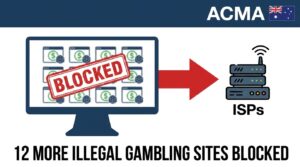
Australia’s communications regulator has moved to shut down a dozen more unlicensed online gambling platforms operating in breach of federal law. The Australian Communications and Media Authority (ACMA) directed domestic internet service providers to block access to 12 websites found to be offering interactive gambling services to Australian consumers without authorisation. The enforcement action, grounded in the Interactive Gambling Act 2001, marks another escalation in the regulator’s sustained campaign against offshore operators targeting the Australian market.
What the Latest ACMA Crackdown Means for the Industry
This round of site-blocking orders reinforces a pattern that has been building for several years: ACMA is not slowing down. Since it gained web-blocking powers in 2019, the authority has moved against hundreds of domains. Each new wave sends a signal not just to the operators named, but to the broader ecosystem of affiliates, payment processors, and white-label providers that sustain these platforms. Here’s what stands out from the latest action:
- 12 domains blacklisted in a single directive, suggesting ACMA is batching enforcement actions for efficiency and broader deterrent effect
- One domain, Pointsbetz.com, was singled out for mimicking the branding of a licensed Australian operator (a tactic regulators globally have been slow to address at scale)
- The blocked sites span a range of product types, from slots-heavy platforms like Spinrise and Slots Gem to broader casino offerings such as Donbet’s interactive gambling platform
- ISPs are legally compelled to comply, leaving little room for delay or negotiation
- The action reinforces Australia’s position as one of the most aggressive jurisdictions in the Asia-Pacific region when it comes to online gambling enforcement
The Domains: Who Got Blocked?
The 12 platforms targeted in this round vary in scale and market positioning, but all share one trait: none held a licence to offer gambling services in Australia.
| Domain | Primary Offering | Notable Detail |
|---|---|---|
| 7Signs | Online casino | Multi-language platform targeting several markets |
| ChromaBet | Casino and sports | Relatively new entrant |
| Donbet | Casino, sports, live dealer | Wide game portfolio |
| Duospin | Casino and slots | Crypto-friendly payment options |
| Freshbet | Sports and casino | Aggressive bonus marketing |
| Slots Gem | Slots-focused | Narrow product range |
| Jacks Club | Casino | Limited public profile |
| Lucky Start | Casino | Operated across multiple jurisdictions |
| Pointsbetz.com | Sports betting | Flagged for mimicking licensed Australian brand |
| Spinrise | Slots and casino | Part of a larger white-label network |
| Vinyl Casino | Casino | Retro-themed branding |
| Wildsino | Casino | Curaçao-licensed offshore operator |
The inclusion of Pointsbetz.com deserves particular attention. ACMA explicitly called out this domain for leveraging branding designed to confuse Australian punters into believing they were dealing with a legitimate, licensed operator. That kind of deliberate impersonation crosses a line from mere unlicensed activity into something closer to consumer fraud.
Why Brand Mimicry Is a Growing Regulatory Headache
Pointsbetz.com didn’t just happen to resemble an Australian brand. The naming convention, the visual identity, the .com domain structure all pointed toward a calculated effort to siphon traffic from consumers searching for a licensed alternative. And while ACMA flagged it here, the broader question is whether current enforcement tools are fast enough to catch these copycat operations before real consumer harm occurs. Domain registration takes minutes. Regulatory investigation takes months.
This asymmetry is arguably the central tension in online gambling enforcement worldwide. Regulators operate within legal frameworks that demand due process, evidence gathering, and formal orders. Operators spinning up new domains face no such constraints. Even so, ACMA’s willingness to publicly name the tactic may serve a secondary purpose: putting ISPs and domain registrars on notice that facilitating such sites carries reputational and potentially legal risk.
How Australia’s Enforcement Model Compares
Since gaining its web-blocking mandate under amendments to the Interactive Gambling Act, ACMA has blocked over 1,000 illegal gambling and affiliate websites. That figure places Australia among the most active regulators globally in terms of sheer volume of enforcement actions. The UK Gambling Commission, by contrast, relies more heavily on payment blocking and operator-level sanctions than on ISP-directed site takedowns.
Still, blocking alone has limits. Determined users can circumvent ISP-level blocks through VPNs, and operators frequently resurface under new domains. What makes Australia’s approach distinctive is the combination of site blocking with financial disruption. ACMA has also targeted payment processors and affiliates who funnel Australian customers toward unlicensed platforms, creating a multi-layered enforcement net that is harder to evade entirely.
Consumer Protection and the Psychology of Trust
Beyond the legal mechanics, there’s a behavioural dimension worth examining. Unlicensed gambling platforms exploit cognitive shortcuts that consumers rely on when assessing trustworthiness online. A familiar-sounding brand name, a polished interface, the presence of well-known game titles from major software providers: these cues create an illusion of legitimacy that most users never think to question. The mental model most consumers carry is simple: if it looks professional, it probably is.
That assumption is precisely what operators like Freshbet with its aggressive promotional campaigns exploit. Bonus offers, loyalty programmes, and slick onboarding flows are designed to reduce friction and build commitment before a user ever considers checking for a licence. Anchoring bias plays a role too. When a consumer sees a large welcome bonus figure, their evaluation of the platform shifts. The number becomes the reference point, and the absence of regulatory credentials fades into the background.
ACMA’s public naming of blocked sites serves a reframing function. By associating these brands with enforcement action, the regulator introduces a competing anchor: risk. For consumers who encounter these names in future search results or social media ads, the association with illegality may trigger a pause that wouldn’t otherwise occur. This kind of environmental restructuring, changing the context in which decisions are made rather than trying to change the decision-maker, is often more effective than direct warnings.
Regulators who understand these dynamics have a sharper toolkit. The challenge is deploying it at the speed the market demands.
Frequently Asked Questions
What happens if I try to access one of the blocked sites from Australia?
Your ISP will prevent the page from loading. You’ll typically see a browser error or a notice indicating the site has been blocked under Australian law. No penalty applies to the consumer, but the sites themselves are operating unlawfully.
Can operators get around ISP blocking?
Yes, and many do. Mirror domains, VPN access, and rebranded platforms are common workarounds. ACMA addresses this by continuously investigating and issuing new blocking orders as replacement domains surface.
How does ACMA decide which sites to block?
The authority conducts formal investigations to determine whether a site is offering interactive gambling services to Australians in breach of the Interactive Gambling Act 2001. Sites must meet a specific evidentiary threshold before a blocking order is issued, which is part of why enforcement lags behind the speed of new site creation.
Are there penalties for the operators behind these sites?
The Interactive Gambling Act provides for civil penalties, and ACMA can refer matters for further action. But many of these operators sit in jurisdictions where Australian enforcement has limited practical reach.