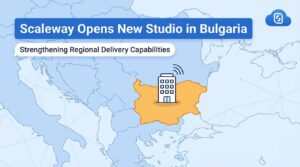
Scaleway, the European cloud provider and subsidiary of the Iliad Group, has expanded its operational footprint by launching a new studio in Bulgaria. The move signals a deliberate push to deepen engineering and service delivery capacity across Central and Eastern Europe. While the company has not disclosed specific headcount targets or investment figures for the facility, the strategic intent is clear: tap into Bulgaria’s growing tech talent pool and reinforce regional infrastructure at a time when European cloud sovereignty remains a hot-button issue.
What the Bulgarian Expansion Tells Us About Scaleway’s Strategy
Before diving into the specifics, it’s worth framing why this matters for the broader European cloud landscape. Scaleway has consistently positioned itself as a European alternative to hyperscalers like AWS, Azure, and Google Cloud. Opening a studio in Bulgaria fits that narrative, but it also carries practical implications for cost structure, talent acquisition, and service resilience.
- Regional talent access: Bulgaria ranks among the top countries in Eastern Europe for software engineering graduates, with competitive labour costs compared to Western European hubs.
- Operational diversification: By distributing capabilities across multiple geographies, Scaleway reduces concentration risk and improves redundancy in its delivery model.
- The timing aligns with increased demand from European enterprises seeking GDPR-compliant, sovereignty-conscious cloud providers.
- Competitive positioning: Against a backdrop where OVHcloud, Hetzner, and other European players are also scaling, Scaleway’s move keeps it in the expansion race rather than ceding ground.
Bulgaria’s Tech Ecosystem: Why It Attracts Cloud Players
Sofia, Bulgaria’s capital, has quietly become one of Southeastern Europe’s more compelling tech hubs. The country produces roughly 7,000 IT graduates annually, and its tech sector has grown at double-digit rates for several consecutive years. That growth hasn’t gone unnoticed. Companies like VMware (now Broadcom), SAP, and several fintech firms already maintain significant operations there.
For Scaleway, the calculus is straightforward. Engineering salaries in Bulgaria typically run 40–60% lower than equivalent roles in Paris or Amsterdam, without a proportional drop in output quality. And while cost arbitrage alone rarely justifies a new office, combined with proximity to European markets and a favourable regulatory environment, it becomes a compelling package.
Still, challenges exist. Bulgaria’s tech labour market is tightening. Competition for senior engineers has intensified, and retention rates have become a concern across the sector (a distinction that separates companies with strong employer brands from those merely chasing headcount).
How This Fits the European Cloud Sovereignty Push
The broader context here is impossible to ignore. European institutions have spent the better part of three years trying to reduce dependency on American and Chinese cloud infrastructure. Initiatives like Gaia-X, the European Cybersecurity Certification Scheme, and various national cloud strategies all point in the same direction: build European capacity.
Scaleway’s cloud infrastructure platform has been a vocal participant in this movement. The company already operates data centres in France and the Netherlands, and its services are designed with European data residency requirements in mind. Adding a Bulgarian studio doesn’t mean adding a data centre, but it does mean adding the people who build, maintain, and improve the products that run on those data centres.
That distinction matters more than it might seem at first glance.
Talent Strategy or Infrastructure Play?
One question worth asking: is this primarily a talent play, an infrastructure play, or both? The company’s use of the word “studio” rather than “office” or “data centre” suggests a focus on product development and engineering rather than hardware deployment. Studios, in Scaleway’s lexicon, tend to be lean, delivery-focused teams embedded in specific technical domains.
If that reading is correct, expect the Bulgarian operation to concentrate on software engineering, DevOps tooling, or platform feature development. Whether it eventually evolves into something larger depends on execution and market conditions. But for now, it appears designed to augment existing capabilities rather than replicate them.
Comparing European Cloud Provider Expansion Moves
| Provider | Recent Expansion | Focus Area | Region |
|---|---|---|---|
| Scaleway | New studio in Bulgaria | Engineering & delivery | Southeastern Europe |
| OVHcloud | New data centres in Germany, UK | Infrastructure capacity | Western Europe |
| Hetzner | Expanded Finnish data centre | Compute and storage | Northern Europe |
| Infomaniak | Swiss sovereign cloud push | Data sovereignty services | Central Europe |
What This Means for Enterprise Buyers
Enterprise procurement teams evaluating European cloud options should note this development for what it signals about Scaleway’s trajectory. A company investing in new regional studios is a company planning to scale its product surface area. For buyers prioritising vendor stability and long-term commitment to European operations, that’s a relevant data point.
Yet the real test comes later. Can Scaleway translate geographic expansion into measurably better products, faster release cycles, or improved support coverage? The studio is the input. Customers will judge the output.
Frequently Asked Questions
What does Scaleway’s new Bulgarian studio focus on?
Based on the company’s terminology and pattern of operations, the studio appears oriented toward software engineering and product development rather than data centre infrastructure. Specific team compositions have not been publicly detailed.
Why did Scaleway choose Bulgaria?
Bulgaria offers a strong pipeline of IT graduates, competitive operating costs relative to Western Europe, and an established tech ecosystem in Sofia. Several major technology companies already operate development centres in the country.
Does this affect Scaleway’s data centre locations?
No. The studio announcement is separate from data centre operations. Scaleway’s data centres remain in France and the Netherlands. The Bulgarian facility is a capability and talent expansion, not a hosting infrastructure addition.
How does this relate to European cloud sovereignty?
Scaleway positions itself as a European-first cloud provider. Expanding its workforce within EU member states reinforces that positioning and supports the broader push among European institutions to build homegrown cloud capacity. Whether this translates into new certifications or sovereign cloud contracts remains to be seen.