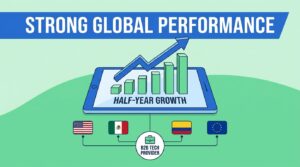
A B2B technology provider has posted robust half-year results, attributing its growth trajectory to expanding operations across the United States, Mexico, Colombia, and select European jurisdictions. The company’s performance underscores a broader trend in B2B tech: geographic diversification as a hedge against single-market dependency. And while specific revenue figures were not disclosed in the initial announcement, the directional signal is clear — emerging and established markets alike are driving demand for enterprise technology solutions at an accelerating pace.
What’s Behind the Half-Year Momentum
Before unpacking the strategic implications, it’s worth grounding the headline in what we actually know. The provider identified four distinct growth engines: the US market (still the largest single driver), Mexico and Colombia in Latin America, and a handful of European jurisdictions that remain unnamed. That geographic spread tells a story about where B2B technology adoption is intensifying — and where enterprise buyers are willing to commit budget mid-year rather than wait for annual planning cycles.
- The US market continues to anchor the company’s revenue base, reflecting sustained enterprise demand for technology infrastructure and digital transformation tools
- Mexico and Colombia represent expanding Latin American footprints, regions where regulatory modernization and digital commerce growth are creating new procurement cycles
- European jurisdictions — though unspecified — suggest the provider is gaining traction in markets with complex compliance environments, a strong indicator of product maturity
- Half-year growth, rather than back-loaded annual performance, points to recurring revenue streams or multi-year contract structures gaining share in the company’s mix
- Geographic diversification reduces concentration risk, a factor increasingly scrutinized by investors and partners evaluating B2B tech vendors
Why Latin America Keeps Showing Up in B2B Growth Stories
Colombia and Mexico are no longer peripheral markets for enterprise technology. Both countries have undergone significant regulatory shifts in recent years, particularly around electronic invoicing, digital payments infrastructure, and cross-border trade compliance. Mexico’s mandatory electronic invoicing regime (CFDI) has been a catalyst for enterprise technology adoption across tax and compliance workflows, pushing companies to modernize back-office systems that were, in many cases, still paper-dependent five years ago.
Colombia tells a similar story. The country’s push toward digital government services and its growing fintech ecosystem have created fertile ground for B2B providers offering integration, compliance, and data management solutions. For a technology vendor reporting half-year growth from these markets, the implication is that their product suite aligns with regulatory-driven demand — arguably the stickiest kind of enterprise revenue there is.
Still, Latin American expansion carries its own complexities. Currency volatility, political transitions, and uneven broadband infrastructure can all compress margins or slow deployment timelines. Whether this provider has built local teams or relies on channel partners in these markets remains an open question (a distinction that often separates sustainable growth from opportunistic wins).
The US Market: Reliable but Increasingly Competitive
Calling the US a growth driver for a B2B technology company is, on its surface, unremarkable. But context matters. Enterprise technology spending in the United States has become more selective in 2024 and into 2025, with CFOs demanding faster time-to-value and tighter alignment between tech investments and measurable business outcomes. Growth in this environment suggests the provider is either displacing incumbents or expanding wallet share within existing accounts.
Neither outcome happens passively.
The competitive landscape for B2B technology in the US includes entrenched players with deep integration into enterprise workflows, alongside a growing cohort of AI-native startups promising to leapfrog legacy architectures entirely. For a provider to report meaningful US growth at the half-year mark, their value proposition likely sits at the intersection of compliance, operational efficiency, and cross-border capability — areas where generalist platforms often fall short.
European Jurisdictions: A Compliance-Driven Opportunity
The reference to “some European jurisdictions” is deliberately vague, yet it carries weight. Europe’s regulatory environment for digital business operations has grown more demanding, not less. The EU’s ViDA (VAT in the Digital Age) initiative, evolving e-invoicing mandates across France, Germany, and Poland, and tightening data sovereignty requirements all create procurement triggers for B2B technology providers with compliance-ready platforms. Companies operating across multiple European markets need vendors who can navigate jurisdictional fragmentation without requiring bespoke implementations for each country.
That fragmentation, paradoxically, becomes a moat for providers who solve it well.
Strategic Framing: What Growth Across Four Regions Signals
Simultaneous growth across the US, Latin America, and Europe is not simply a geographic achievement. It reflects product-market fit across regulatory regimes, languages, and enterprise maturity levels. For B2B technology companies, this kind of multi-region traction typically correlates with three underlying capabilities:
| Capability | Why It Matters |
|---|---|
| Regulatory adaptability | Products must conform to local compliance mandates without full rebuilds per market |
| Localization depth | Language, currency, tax logic, and reporting standards vary significantly across these regions |
| Scalable delivery model | Cloud-native or SaaS architecture enables faster deployment without heavy on-premise commitments — though not every B2B buyer has fully embraced that shift |
How Market Perception Shapes B2B Technology Adoption
Beyond the numbers, there’s a psychological dimension to why certain B2B providers gain traction across diverse markets while others plateau. Decision-makers in enterprise procurement don’t evaluate technology in a vacuum. They assess vendors through a lens shaped by peer behavior, perceived market leadership, and the narrative a company projects about its own trajectory. When a provider announces multi-region growth, it triggers what behavioral economists call social proof at the institutional level: if peers in comparable markets are adopting, the perceived risk of adoption drops.
This dynamic plays out differently across regions. In the US, enterprise buyers tend to weight analyst coverage and integration ecosystem breadth. Latin American buyers, particularly in markets like Colombia and Mexico, often prioritize regulatory alignment and local support responsiveness — factors that carry outsized influence in procurement committees. European buyers, meanwhile, frequently anchor decisions on data handling practices and compliance certifications, reflecting the continent’s regulatory culture.
Understanding these perceptual filters matters for any B2B provider scaling internationally. Product capability alone rarely wins deals. The framing of that capability — how it’s positioned relative to a buyer’s existing mental model of risk, value, and competitive necessity — often determines whether a pilot converts to a multi-year contract. Providers who tailor not just their product but their communication strategy to match regional decision-making patterns tend to sustain growth more effectively than those relying on a single global pitch.
Frequently Asked Questions
Which specific markets drove the B2B provider’s half-year growth?
The company cited the United States, Mexico, Colombia, and certain European jurisdictions as the primary contributors to its half-year performance.
Why are Mexico and Colombia emerging as significant B2B technology markets?
Both countries have implemented regulatory modernization programs — particularly around electronic invoicing and digital compliance — that compel enterprises to adopt new technology platforms. This creates sustained, regulation-driven demand rather than discretionary spending cycles.
What does multi-region growth indicate about a B2B technology provider?
It typically signals strong product adaptability across different regulatory, linguistic, and operational environments. Achieving this requires more than translation — it demands deep localization of tax logic, reporting standards, and compliance workflows. Not every vendor manages it at scale.