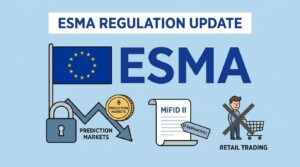
The European Securities and Markets Authority (ESMA) has issued a binding public statement classifying prediction markets and event contracts as derivative financial instruments under MiFID II. The move, driven by surging global retail participation on digital platforms, effectively subjects binary-outcome event contracts to the same strict marketing and distribution prohibitions that govern traditional binary options across the European Union. For platforms operating in or targeting EU-based retail clients, the regulatory landscape just shifted beneath their feet.
What ESMA’s Classification Means for Event Contract Platforms
Before unpacking the strategic implications, it helps to understand what changed and why it matters for market participants across the value chain. ESMA’s statement does not introduce new legislation. Instead, it applies existing MiFID II definitions to a product category that had, until now, occupied a grey zone in European financial regulation (a distinction regulators have been slow to enforce). The key takeaways carry weight for exchanges, intermediaries, and retail traders alike:
- Binary event contracts are now formally treated as derivatives where the underlying event or asset falls within MiFID II’s scope, closing a classification gap that platforms had relied on to operate outside traditional regulatory perimeters.
- Retail marketing, distribution, and sale of these products face the same national product intervention measures already applied to binary options — in practice, this means outright bans in several EU member states.
- Platforms offering prediction markets to EU retail clients without proper authorisation risk enforcement action, regardless of where they are domiciled.
- The statement signals a coordinated supervisory posture, reducing the likelihood that individual national regulators will diverge in their interpretation.
- Institutional and professional-client channels remain open, but the compliance burden for client categorisation will increase substantially.
Why Prediction Markets Triggered Regulatory Alarm
Prediction markets have grown from niche academic tools into mainstream retail products. Platforms like Polymarket saw trading volumes spike dramatically during high-profile political and sporting events in 2024, drawing millions of users who had never interacted with regulated financial products. That exponential growth caught the attention of regulators on both sides of the Atlantic.
ESMA’s concern is structural, not philosophical. A contract that pays out a fixed amount if an event occurs and nothing if it doesn’t is, functionally, a binary option. The wrapper may differ. The economic substance does not. And when retail participants trade these contracts without the protections afforded by securities regulation, the risks mirror those that led the EU to ban binary options for retail clients in 2018.
Still, the timing raises questions. Prediction markets have existed for years. What arguably tipped the balance was the sheer scale of recent retail inflows and the visibility of platforms marketing these products aggressively to non-professional users across EU jurisdictions.
How MiFID II’s Framework Applies
Under MiFID II, a financial instrument includes derivatives relating to securities, currencies, interest rates, commodities, and certain other underlyings. ESMA’s statement clarifies that event contracts whose outcomes are tied to any of these categories meet the definitional threshold. That is not a stretch of the regulation. It is a plain reading that platforms had been sidestepping.
The practical consequences are layered:
| Requirement | Impact on Prediction Market Platforms |
|---|---|
| Authorisation under MiFID II | Platforms must hold appropriate investment firm licences or partner with authorised entities to offer products in the EU. |
| Product governance obligations | Target market assessments become mandatory; products must be designed with specific client categories in mind. |
| Retail distribution restrictions | National bans on binary options apply directly, effectively shutting retail access in most EU member states. |
| Transaction reporting | All trades must be reported to competent authorities under MiFIR, adding operational and technology costs. |
| Best execution and suitability | Platforms must demonstrate that execution quality and product suitability standards are met for every client interaction, a requirement many current prediction market operators are not built to handle. |
The Broader Regulatory Signal
ESMA’s statement does not exist in isolation. The U.S. Commodity Futures Trading Commission (CFTC) has been engaged in its own prolonged debate over event contracts, with ESMA’s approach to prediction market oversight now providing a reference point that American regulators may find difficult to ignore. Cross-border regulatory convergence on this issue seems more likely than not.
What remains less clear is how enforcement will play out against platforms domiciled outside the EU but accessible to European users. Jurisdictional reach has always been the soft underbelly of digital financial regulation. ESMA can set the classification. Whether national competent authorities have the resources and political will to pursue offshore operators is another matter entirely.
Reframing Risk: What Retail Participants Should Understand
For individual traders, this classification shift carries implications that go beyond access. Binary-outcome products concentrate risk in ways that are poorly understood by most retail participants. The all-or-nothing payoff structure encourages overconfidence and frequent trading, behavioural patterns that academic research has consistently linked to capital erosion over time.
Cognitive biases play a significant role here. Anchoring — the tendency to fixate on a specific probability or price level — distorts decision-making in prediction markets just as it does in traditional options trading. Availability bias amplifies the problem: traders overweight recent, memorable events when estimating probabilities, leading to systematic mispricing at the individual level even when aggregate market prices appear efficient.
And there is a framing effect at work in how these products are marketed. Calling something a “prediction market” rather than a “binary option” changes how people perceive the risk. The language suggests skill, analysis, forecasting. The underlying mechanics suggest something closer to a coin flip with a spread. ESMA’s reclassification, at least on paper, strips away that framing and forces the product to be presented for what it is.
Understanding these psychological dynamics matters because regulation alone cannot eliminate the demand for high-risk, high-reward products. But it can ensure that the products are labelled honestly and that the most vulnerable participants are not exposed to instruments designed to exploit behavioural tendencies they may not even recognise in themselves.
Frequently Asked Questions
Are all prediction markets now banned in the EU?
Not all. ESMA’s statement applies specifically to event contracts whose underlying assets or events fall within MiFID II’s definitional scope. Contracts tied to non-financial events that sit outside this scope may not be captured, though the boundary is narrow and will likely be tested.
Can professional or institutional clients still trade these products?
Yes. The retail distribution bans stem from national product intervention measures targeting binary options sold to retail clients. Professional and eligible counterparty classifications remain unaffected, though firms must rigorously verify client categorisation.
What should platforms do now?
Platforms serving EU clients should conduct an immediate product classification review, assess their licensing status, and engage legal counsel on MiFID II compliance. Operating without authorisation after a binding ESMA statement carries significant enforcement risk.
Does this affect platforms based outside the EU?
In principle, yes — if they actively market to or accept EU retail clients. Enforcement against offshore entities remains challenging, but the regulatory intent is clear, and passporting or reverse solicitation arguments will face heightened scrutiny.