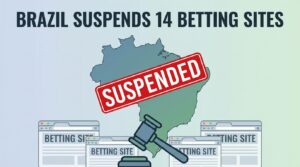
Brazil’s Secretariat of Prizes and Betting (SPA) has ordered the immediate suspension of 14 federally authorised betting sites for failing to meet mandatory regulatory requirements. The action, which targets operators that had already received federal licences, signals a sharpening enforcement posture from Brazilian regulators as the country’s newly formalised sports betting market enters its first full year of operation. Several of the suspended platforms were found to lack adequate responsible gambling tools, while others fell short on financial transparency obligations tied to anti-money laundering frameworks.
What Brazil’s Betting Crackdown Means for Licensed Operators
The suspensions land at a moment when Brazil’s regulated betting market is still finding its footing. Operators that secured federal authorisation expected a degree of regulatory stability. Instead, the SPA has made clear that holding a licence is not a shield against enforcement. Here’s what stands out from a strategic perspective:
- 14 sites suspended despite holding valid federal authorisation, underscoring that compliance is treated as an ongoing obligation, not a one-time gate
- Deficiencies in responsible gambling protocols were cited as a primary trigger for several suspensions
- Anti-money laundering (AML) shortcomings featured prominently, suggesting regulators are aligning with international financial integrity standards
- The SPA’s willingness to act swiftly may deter operators from treating compliance as a secondary priority
- Market confidence among consumers and institutional investors could be affected in the short term, though long-term credibility may benefit
Why the SPA Acted Now
Brazil legalised sports betting through a 2018 framework law, but implementation dragged for years. The regulatory apparatus only became fully operational in late 2024, when the SPA began issuing federal licences to qualifying operators. That delay created a grey market of enormous scale (a distinction regulators have been slow to enforce), with hundreds of unlicensed platforms serving millions of Brazilian bettors.
By suspending 14 already-licensed operators, the SPA is doing something arguably more consequential than blocking unlicensed sites. It is establishing that the licence itself carries weight only when paired with genuine compliance. The message to the broader market is blunt: authorisation is conditional.
What remains less clear is whether the suspended operators will face permanent revocation or be given a remediation window. The SPA has not publicly detailed the timeline for resolution, and the affected companies have not issued coordinated responses.
The Compliance Gaps That Triggered Action
According to the SPA’s enforcement notice, the violations fell into several categories. Not all 14 operators were cited for the same failures, which suggests the regulator conducted individualised audits rather than applying a blanket assessment.
| Compliance Area | Issue Identified | Number of Operators Affected |
|---|---|---|
| Responsible Gambling | Missing or inadequate self-exclusion tools, deposit limits, and player protection disclosures | Multiple |
| AML/CFT Controls | Insufficient transaction monitoring and customer due diligence processes | Several |
| Financial Reporting | Failure to submit required financial disclosures to the SPA | At least 3 |
| Technical Standards | Platform integrity issues, including geolocation and identity verification gaps | A smaller subset |
That last category is worth watching. Geolocation and identity verification sit at the intersection of consumer protection and tax enforcement. Operators that cannot reliably verify where a bettor is located or who they are create exposure not just for themselves but for the entire regulatory framework.
How This Reshapes Brazil’s Betting Landscape
Brazil’s legal sports betting market is projected to generate billions of reais in annual revenue. Estimates from industry analysts have placed the total addressable market north of R$100 billion in gross gaming revenue within the next several years. But scale without governance invites exactly the kind of political backlash that could constrain growth.
The SPA’s enforcement action functions, in practice, as a credibility investment. By demonstrating that even licensed operators face consequences for non-compliance, the regulator positions Brazil’s framework as more than paper regulation. International operators evaluating market entry will read this as a sign that the rules carry teeth. Still, the suspensions also introduce uncertainty for operators already investing heavily in the Brazilian market.
Some of the suspended platforms had built meaningful user bases. Disrupting access for those customers creates friction, and whether those bettors migrate to compliant licensed platforms or drift back toward Brazil’s regulated online betting ecosystem remains an open question.
Broader Implications for Latin American Regulation
Brazil is not operating in isolation. Across Latin America, governments are grappling with how to regulate online gambling in ways that balance revenue generation, consumer protection, and financial crime prevention. Colombia’s Coljuegos has been active for years. Argentina’s fragmented provincial system offers a contrasting model. And Mexico’s regulatory framework remains a work in progress.
What Brazil does matters disproportionately because of its market size. A population exceeding 200 million, deep smartphone penetration, and a cultural affinity for sports betting make it the region’s most significant prize. Regulatory decisions made by the SPA will inevitably influence how neighbouring jurisdictions calibrate their own approaches.
And while enforcement actions like this one may look punitive on the surface, they serve a dual purpose: protecting consumers and protecting the market’s long-term viability from the reputational damage that unchecked operators can inflict.
Frequently Asked Questions
What is the SPA in Brazil?
The Secretariat of Prizes and Betting (SPA) is the federal body responsible for regulating and overseeing sports betting and lottery operations in Brazil. It sits within the Ministry of Finance and handles licensing, compliance monitoring, and enforcement.
Can suspended operators resume operations?
The SPA has not publicly confirmed whether the 14 suspended operators will receive a remediation period or face permanent licence revocation. Much depends on the severity of each operator’s specific violations and their willingness to implement corrective measures quickly.
Does this affect all online betting in Brazil?
No. The suspension targets 14 specific platforms. Dozens of other federally authorised operators continue to operate. However, the action sends a clear signal that all licensed operators should audit their own compliance posture immediately.
Why does responsible gambling compliance matter so much to regulators?
Responsible gambling tools like deposit limits, self-exclusion options, and player activity monitoring are central to preventing gambling harm. Regulators worldwide treat these as non-negotiable because failures in this area generate public health consequences and political pressure that can threaten entire regulatory frameworks.