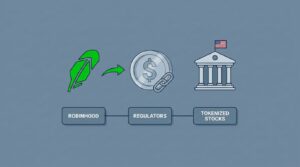
Robinhood CEO Vlad Tenev has publicly urged American policymakers to overhaul existing securities regulations, arguing that tokenized stocks should be permitted to trade within the United States. In a detailed post published Tuesday, Tenev identified the absence of US Stock Tokens as “one glaring gap” in the company’s broader tokenization strategy. The statement arrived just five days after the SEC signaled renewed interest in digital asset frameworks, adding weight to a conversation that has simmered across Wall Street and crypto circles for months.
Why Tenev’s Call for Tokenized Stocks Matters Right Now
Tenev’s public appeal isn’t happening in a vacuum. Robinhood has been steadily expanding its crypto and digital asset offerings, and the company’s leadership clearly views tokenization as the next frontier for retail investing. But US securities law, much of it dating back to the 1930s, doesn’t accommodate the idea of stocks living on a blockchain. That regulatory mismatch has pushed tokenized equity products offshore, where platforms in Europe and Asia already offer them to investors.
What makes this moment different is timing. The SEC has been engaging more openly with industry participants on crypto-related rulemaking, and several legislative proposals in Congress aim to clarify the status of digital assets. Tenev’s post reads less like a wish list and more like a positioning document, staking Robinhood’s claim in a policy debate that could reshape how equities are issued, settled, and traded.
- Regulatory modernization is the bottleneck: Tenev explicitly pointed to outdated securities rules as the primary barrier preventing tokenized stocks from reaching US investors.
- Robinhood sees tokenization as core strategy: The company has already moved into crypto custody and international token offerings, making US stock tokens a logical next step.
- Settlement efficiency stands to improve dramatically if equities move to blockchain-based rails, potentially cutting the current T+1 cycle to near-instant finality.
- Competitive pressure from abroad: Platforms in the EU and Asia-Pacific already offer tokenized equities, and US firms risk falling behind if domestic regulation doesn’t evolve.
- The SEC’s recent openness to digital asset dialogue suggests a narrowing window for industry players to shape the rules before they’re written.
What Tokenized Stocks Actually Change
Tokenized stocks are digital representations of traditional equity shares, recorded on a blockchain rather than through conventional clearinghouse infrastructure. In practice, this means fractional ownership becomes simpler, cross-border trading gets cheaper, and settlement can happen in minutes instead of a full business day. The technology itself isn’t experimental at this point. Several platforms already facilitate tokenized equity trading outside the US.
Still, the distinction between a token that represents a stock and the stock itself remains legally murky in American jurisdictions (a distinction regulators have been slow to enforce). Whether a tokenized share qualifies as a security under the Howey test, whether it requires registration, and who bears custodial responsibility are all questions without settled answers.
That ambiguity has kept major US brokerages from launching tokenized equity products domestically, even as they experiment with them internationally. Robinhood’s expanding digital asset infrastructure positions it to move quickly once regulatory clarity arrives, but clarity is precisely what’s missing.
The SEC’s Shifting Posture
Five days before Tenev’s post, the SEC took steps that signaled a more collaborative approach to digital asset regulation. While the agency hasn’t endorsed tokenized stocks outright, its willingness to engage with industry stakeholders marks a departure from the enforcement-first posture that characterized much of the previous leadership’s tenure.
Whether this translates into rulemaking that actually accommodates on-chain equities remains an open question. Congressional action may ultimately prove more decisive than SEC guidance alone, particularly given the overlapping jurisdictional claims between the SEC and CFTC over various digital asset classes.
How Tokenization Reshapes Market Infrastructure
Beyond the headline debate about whether stocks can live on blockchains, the deeper structural implications deserve attention. Consider the current settlement ecosystem:
| Feature | Traditional Settlement | Tokenized Settlement |
|---|---|---|
| Settlement Time | T+1 (one business day) | Near-instant or same-day |
| Fractional Ownership | Limited, broker-dependent | Native to token architecture |
| Cross-Border Access | Complex, multi-intermediary | Simplified through blockchain interoperability |
| Custodial Model | Centralized clearinghouses (DTCC) | Smart contract-based or hybrid custody, with regulatory frameworks still under development |
| Transparency | Periodic reporting | Real-time on-chain visibility |
The efficiency gains are real. But so are the risks. Smart contract vulnerabilities, oracle dependencies, and the absence of established investor protections on-chain all represent challenges that regulators will need to address before tokenized equities can operate at scale in US markets.
Strategic Framing: What Industry Leaders Should Watch
Tenev’s public statement carries a subtext that goes beyond policy advocacy. By framing tokenized stocks as a gap in Robinhood’s offering rather than a speculative ambition, he’s anchoring the conversation in commercial reality. This is a company with over 23 million funded accounts telling regulators: the demand exists, the technology works, and the only missing piece is permission.
For competing brokerages, the signal is hard to ignore. If Robinhood gains first-mover advantage in US tokenized equities, it could pull younger, crypto-native investors even further from legacy platforms. And for regulators, the calculus involves balancing innovation incentives against investor protection mandates that were designed for a fundamentally different market structure.
One thing worth watching: how traditional exchanges like NYSE and Nasdaq respond. Neither has publicly embraced tokenized equity trading, but both have invested in blockchain-adjacent infrastructure. Their silence on this particular debate won’t last.
Frequently Asked Questions
What are tokenized stocks?
Tokenized stocks are blockchain-based digital tokens that represent ownership in traditional equity shares. They mirror the price and dividends of the underlying stock but settle on distributed ledger technology rather than through conventional clearinghouses.
Why can’t tokenized stocks trade in the US currently?
Existing US securities laws don’t clearly accommodate blockchain-based equity instruments. Questions around registration requirements, custodial obligations, and jurisdictional oversight remain unresolved, effectively blocking domestic platforms from offering these products.
What did Robinhood’s CEO specifically propose?
Vlad Tenev called on policymakers to modernize securities rules to permit tokenized stock trading in the US. He characterized the absence of US Stock Tokens as a significant gap in Robinhood’s tokenization strategy, framing it as a regulatory problem rather than a technological one.
Could this actually happen soon?
Arguably, the conditions are more favorable than at any point in the past five years. The SEC has adopted a more open posture toward digital assets, and multiple legislative proposals are advancing in Congress. But rulemaking timelines are unpredictable, and interagency jurisdictional disputes could slow progress considerably.