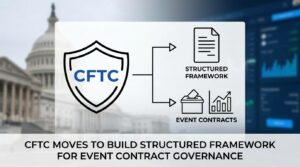
The Commodity Futures Trading Commission is advancing efforts to create a formal regulatory architecture around event contracts, a category of derivatives that has grown rapidly in recent years but operated in something of a governance grey zone. The initiative signals a shift from ad hoc oversight to a more deliberate, rules-based approach. And while the details of the framework remain under development, the direction is clear: the CFTC wants predictability, both for itself and for the platforms seeking to list these products.
What the CFTC’s Framework Push Means for Derivatives Markets
Event contracts allow participants to take positions on the outcome of specific occurrences, from economic data releases to climate events to, more controversially, elections. The market for these instruments has expanded considerably, driven in part by platforms like Kalshi and the broader appetite for alternative trading products. But the regulatory treatment of event contracts has been uneven, shaped more by enforcement actions and individual product reviews than by any coherent policy.
The CFTC’s move toward a structured framework attempts to change that. Here are the key strategic implications:
- Regulatory clarity could accelerate product innovation by giving exchanges and clearinghouses a defined pathway for listing new event contracts without prolonged uncertainty.
- A formal governance structure may reduce the frequency of legal challenges from platforms contesting CFTC decisions on individual contract approvals or denials.
- Market integrity standards for event contracts would likely align more closely with those governing traditional futures and options, raising the compliance bar for newer entrants.
- The framework could draw sharper lines around which event categories are permissible, potentially narrowing the scope for politically sensitive contracts (a distinction regulators have been slow to enforce).
- Institutional participation in event contract markets may increase if the regulatory environment becomes more transparent and stable.
Why Now? The Pressure Behind the Policy Shift
Several forces converged to push the CFTC toward formalizing its approach. The agency faced a high-profile legal setback when a federal court ruled against its attempt to block Kalshi from offering election-related contracts. That case exposed gaps in the CFTC’s existing authority and highlighted the absence of a clear, pre-established standard for evaluating event contracts.
Simultaneously, trading volumes on event contract platforms have surged. Kalshi’s regulated event contract marketplace reported significant growth in user activity and contract diversity throughout 2024, putting pressure on the CFTC to keep pace with a market that was, in practice, outrunning its oversight capacity. The agency’s traditional model of reviewing contracts on a case-by-case basis proved too slow and too vulnerable to legal challenge.
There’s also a political dimension. Congressional interest in event contracts has intensified, with lawmakers on both sides raising questions about whether these instruments constitute gambling, legitimate hedging tools, or something in between. A structured framework gives the CFTC a stronger institutional footing to defend its decisions before Congress and the courts alike.
How a Governance Framework Might Reshape Market Dynamics
The practical effects of a formalized approach would ripple across several layers of the derivatives ecosystem. For exchanges, clearer rules reduce the cost and uncertainty of product development. For market participants, standardized governance means more consistent disclosure requirements, margin rules, and settlement procedures across event contract types.
But not everyone sees uniform regulation as a net positive. Smaller platforms and fintech-oriented entrants have argued that overly rigid frameworks could entrench incumbents and stifle the experimental character that makes event markets attractive in the first place. What remains less clear is whether the CFTC intends to create a single set of rules for all event contracts or a tiered system that accounts for differences in risk profile and public interest sensitivity.
| Dimension | Current State | Under Proposed Framework |
|---|---|---|
| Contract approval process | Case-by-case review, often contested | Defined criteria and standardized evaluation pathway |
| Permissible event categories | Ambiguous; shaped by enforcement precedent | Explicit classification of allowable and restricted categories |
| Market integrity oversight | Varies by platform and product | Uniform standards aligned with broader derivatives regulation |
| Legal exposure for CFTC | High, as recent court rulings demonstrated | Reduced, with decisions anchored in pre-established rules rather than discretionary judgment |
The Broader Regulatory Landscape for Prediction Markets
The CFTC’s framework initiative does not exist in isolation. Globally, regulators are grappling with how to classify and oversee prediction-style instruments. The UK’s Financial Conduct Authority has taken a cautious stance, while certain jurisdictions in Asia have moved more aggressively to either permit or prohibit these products outright. The CFTC’s approach, arguably, sits somewhere in the pragmatic middle: neither banning event contracts nor granting them blanket approval, but instead trying to build guardrails that can flex as the market evolves.
Still, the agency faces a tension that no framework alone can resolve. Event contracts blur the boundary between financial derivatives and wagering. That conceptual ambiguity is not a regulatory failure; it reflects a genuine disagreement about the economic function these instruments serve. A structured framework can impose procedural order, but the underlying philosophical question persists.
Frequently Asked Questions
What are event contracts?
Event contracts are derivatives that pay out based on the outcome of a specific event, such as whether an economic indicator exceeds a threshold or whether a particular weather event occurs. They function differently from traditional futures in that the underlying is an outcome, not a commodity or financial asset.
Why has the CFTC struggled to regulate them?
The Commodity Exchange Act gives the CFTC broad authority over derivatives but contains limited guidance on event-based products. The agency has historically relied on case-by-case determinations, which courts have found insufficient in certain instances. A structured framework would fill that gap, at least on paper.
Will this affect retail traders?
Potentially, yes. Clearer governance could expand the range of event contracts available to retail participants while also imposing stronger consumer protections. The net effect depends on how the CFTC balances access with risk management.
When will the framework be finalized?
The CFTC has not published a definitive timeline. Given the complexity of the rulemaking process and the likelihood of public comment periods, implementation could extend well into 2025 or beyond.