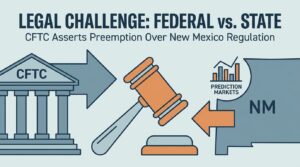
The Commodity Futures Trading Commission filed suit Thursday in federal court against the state of New Mexico, escalating a jurisdictional battle over who gets to regulate prediction-market exchanges. At stake is whether states can classify federally registered prediction markets as gambling operations subject to local gaming statutes. The CFTC’s complaint seeks a declaratory judgment affirming that federal law grants the agency exclusive oversight authority over these platforms. It marks a rare instance of a federal regulator directly suing a state to defend the regulatory perimeter of an emerging asset class.
Why the CFTC’s Legal Challenge Against New Mexico Matters
This lawsuit doesn’t exist in a vacuum. Prediction markets have been gaining traction across financial and political circles, and the regulatory framework governing them remains fragmented. The CFTC’s move signals that the agency views state-level interference as a direct threat to the viability of federally registered exchanges (a distinction regulators have been slow to enforce consistently). Here are the key strategic takeaways from this development:
- Federal preemption doctrine in play: The CFTC is asserting that the Commodity Exchange Act preempts state gaming laws when applied to registered prediction-market platforms, setting up a potentially precedent-defining legal contest.
- Operational certainty for exchanges: A favorable ruling would shield CFTC-registered platforms from a patchwork of state-by-state gambling regulations that could otherwise fragment or cripple their operations.
- The case could reshape how other states approach prediction markets, particularly those with aggressive gaming enforcement postures.
- Broader implications for digital markets: If the court sides with the CFTC, it strengthens the agency’s hand not just over prediction markets but over any novel derivatives product that states might attempt to classify under existing gambling frameworks.
The Jurisdictional Fault Line
New Mexico’s position rests on a straightforward argument: prediction markets look like wagering, and wagering falls under state gaming authority. The CFTC disagrees. Under the Commodity Exchange Act, event contracts traded on designated contract markets or swap execution facilities fall within federal jurisdiction. The agency has spent years building a regulatory framework for these instruments, issuing no-action letters, approving exchange applications, and defining the boundaries of permissible event contracts.
But states haven’t always deferred. Several have questioned whether prediction markets, particularly those involving political or sports-adjacent outcomes, belong in the same regulatory bucket as corn futures or interest rate swaps. New Mexico appears to have pushed that skepticism into enforcement territory, prompting the CFTC to act.
What remains less clear is whether New Mexico took specific enforcement action against a particular exchange or whether the state’s regulatory posture alone was enough to trigger the federal suit.
How Prediction Markets Reached This Inflection Point
The growth of platforms like Kalshi and Polymarket has forced regulators at every level to confront a product category that doesn’t fit neatly into existing boxes. Kalshi, which operates as a CFTC-regulated designated contract market, has already fought and won battles over the right to list election-related contracts. Polymarket, operating largely offshore, occupies a different regulatory space entirely.
This fragmentation is the point. The prediction market ecosystem spans fully regulated U.S. exchanges, decentralized crypto-native platforms, and everything in between. States eyeing these platforms through a gaming lens aren’t necessarily wrong about the surface-level resemblance to betting. They’re arguably wrong about jurisdiction, at least where federally registered entities are concerned.
And that’s precisely the line the CFTC is asking the court to draw.
What a Federal Court Ruling Could Reshape
Should the court issue the declaratory judgment the CFTC seeks, the ripple effects would extend well beyond New Mexico. At least a dozen states maintain gaming statutes broad enough to potentially capture prediction-market activity. A clear federal preemption ruling would neutralize those statutes as applied to CFTC-registered platforms.
The timing matters too. Congress has been debating market structure legislation that touches on digital assets and derivatives. A judicial affirmation of CFTC preemption could influence how lawmakers draft future oversight frameworks, particularly around the boundary between gambling regulation and financial market supervision.
Still, courts have not always sided with federal agencies asserting broad preemptive authority, especially in the current judicial climate favoring state sovereignty. The CFTC’s case will likely hinge on the specificity of the Commodity Exchange Act’s preemption provisions and whether prediction markets fall squarely within the statutory definition of regulated instruments.
The Regulatory Landscape at a Glance
| Dimension | Federal (CFTC) Position | State (New Mexico) Position |
|---|---|---|
| Classification | Event contracts / derivatives | Gaming / wagering activity |
| Legal basis | Commodity Exchange Act | State gaming statutes |
| Regulatory authority | Exclusive federal jurisdiction over registered exchanges | State police powers over gambling within its borders |
| Precedent risk | Losing would invite 50-state regulatory fragmentation | Losing could limit state authority over novel financial products that resemble wagering |
Framing the Stakes: Why Market Participants Should Pay Attention
For executives operating prediction-market platforms or considering entry into the space, this case is not academic. The outcome will determine whether federal registration provides a genuine regulatory shield or merely adds a layer of compliance without displacing state-level risk. That distinction carries real capital allocation consequences. Investors backing prediction-market startups need to know whether a single federal license is sufficient or whether they face a state-by-state licensing gauntlet that could multiply costs and delay launches.
Even so, the CFTC’s willingness to litigate sends its own signal. The agency is treating prediction markets as a category worth defending, not a peripheral experiment. For an agency that has sometimes been criticized for reactive enforcement, filing an affirmative lawsuit against a state government represents a notable shift in posture. Whether the courts validate that confidence is a question that could take months, possibly years, to resolve.
Frequently Asked Questions
What is the CFTC seeking in this lawsuit?
The CFTC is asking a federal court for a declaratory judgment confirming that federal law preempts New Mexico’s gaming statutes as applied to CFTC-registered prediction-market exchanges. The agency wants to establish that it holds exclusive regulatory authority over these platforms.
Does this affect all prediction markets?
Not directly. The suit specifically concerns exchanges registered with the CFTC. Unregistered or offshore platforms like Polymarket would not benefit from a preemption ruling, since they operate outside the federal regulatory framework to begin with.
Could other states face similar lawsuits?
Potentially. If the CFTC prevails, the precedent would discourage other states from applying gaming laws to federally registered platforms. But if the agency loses, expect more states to assert jurisdiction. The case is a bellwether either way.