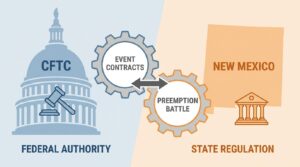
The Commodity Futures Trading Commission has filed a lawsuit against the state of New Mexico, seeking to block state-level gambling enforcement actions targeting federally regulated event contracts. The case marks an extraordinary escalation in the jurisdictional tug-of-war between federal derivatives regulators and state authorities over prediction markets. At its core, the dispute forces a question that has simmered for years: who ultimately governs the boundary between regulated financial instruments and gambling?
Why the CFTC’s Legal Challenge Against New Mexico Reshapes Regulatory Boundaries
Before diving into the strategic implications, it helps to frame what this lawsuit actually disrupts. The CFTC is not merely defending its turf in an abstract bureaucratic sense. It is asserting that federally authorized event contracts, traded on designated contract markets under its oversight, cannot be reclassified as illegal gambling by individual states. That distinction carries weight far beyond New Mexico’s borders.
- Federal preemption at stake: If the CFTC prevails, states would lose the ability to independently classify CFTC-regulated event contracts as gambling, setting a binding precedent for all 50 states.
- Prediction market operators gain clarity: Platforms operating under CFTC designation would no longer face a patchwork of conflicting state gambling statutes, reducing compliance costs and legal exposure.
- The case could accelerate congressional interest in codifying the legal status of event contracts, a legislative gap that has persisted since the Dodd-Frank Act’s ambiguous treatment of the category.
- State regulators face a narrowing window to assert authority over financial products that increasingly blur the line between speculation and wagering.
What Triggered the Confrontation
New Mexico’s gambling enforcement authorities had moved to restrict or penalize activity related to event contracts within the state, treating them as a form of wagering subject to state gaming law. The CFTC’s response was swift and unusually aggressive. Rather than issuing guidance or pursuing informal resolution, the agency chose litigation, a signal that it views the state’s actions as a direct threat to its regulatory framework.
Event contracts allow participants to take positions on the outcome of future events, from economic data releases to, more controversially, political elections. The CFTC’s regulatory authority over derivatives markets extends to these instruments when they are listed on exchanges the agency has approved. But states have long argued that certain event contracts, particularly those resembling binary bets on outcomes with no underlying commodity, fall squarely within gambling statutes.
New Mexico is not the first state to raise this objection. Yet it appears to be the first where the CFTC has responded with a federal lawsuit rather than negotiation.
The Preemption Doctrine and Its Limits
Federal preemption, the constitutional principle that federal law overrides conflicting state law, is well-established in financial regulation. Still, its application to event contracts sits on less settled ground. The Commodity Exchange Act grants the CFTC broad jurisdiction over futures and swaps, but the statute’s treatment of event contracts contains carve-outs and ambiguities that states have exploited (a distinction regulators have been slow to enforce).
Under the Dodd-Frank Act, the CFTC was given authority to review and approve event contracts, but Congress also allowed the agency to prohibit contracts involving “activity unlawful under any Federal or State law.” That language is the crux of the dispute. New Mexico argues its gambling laws render certain event contracts unlawful at the state level, which should, in turn, prevent the CFTC from authorizing them. The CFTC reads the provision differently, contending that Congress intended federal approval to supersede state-level gambling classifications.
Less clear is how a federal court will interpret that statutory tension. No appellate court has squarely addressed it.
Broader Market Implications for Prediction Platforms
Prediction market operators have watched this jurisdictional friction intensify throughout 2024 and into 2025. Platforms like Kalshi, which secured a federal court victory against the CFTC in 2024 over election-related contracts, now find themselves in an odd position: winning against the federal regulator only to face potential state-by-state bans.
The CFTC’s lawsuit against New Mexico arguably benefits these platforms more than any single regulatory approval could. A favorable ruling would eliminate the most potent legal weapon states hold against prediction markets. And while the case concerns New Mexico specifically, the precedent would ripple outward. States like Nevada, New Jersey, and others with robust gambling regulatory frameworks would need to reassess their enforcement posture toward CFTC-regulated event contracts.
How This Dispute Reflects Deeper Structural Tensions
What makes this case particularly revealing is the way it exposes a structural misalignment in U.S. financial regulation. Derivatives law was built around commodities, interest rates, and currencies. Event contracts stretch that framework into territory that looks, to many observers, indistinguishable from betting. The regulatory architecture was never designed to answer whether a binary contract on a presidential election outcome is a financial instrument or a wager. It is, arguably, both.
This ambiguity has created a governance vacuum. The CFTC wants to fill it with federal authority. States want to fill it with consumer protection and gambling oversight. Neither side is entirely wrong, which is precisely why the courts will have to decide.
For market participants, the practical consequence is uncertainty. Firms building products around event contracts must currently navigate federal registration requirements and a fragmented state landscape simultaneously. Compliance teams at these firms describe the environment as operationally exhausting, with legal opinions that shift depending on jurisdiction and political climate.
Frequently Asked Questions
What are event contracts?
Event contracts are financial instruments that allow participants to take a position on whether a specific future event will occur. They function similarly to binary options, paying out based on a yes-or-no outcome rather than the price movement of an underlying asset.
Why is the CFTC suing New Mexico?
The CFTC filed suit to prevent New Mexico from enforcing state gambling laws against event contracts that the federal agency has authorized for trading on regulated exchanges. The commission argues federal law preempts state gambling statutes in this context.
Could this case affect prediction markets nationwide?
Yes. A ruling in the CFTC’s favor would significantly limit the ability of any state to classify federally regulated event contracts as illegal gambling, effectively clearing a major legal obstacle for prediction market platforms operating under CFTC oversight. The inverse outcome, however, would hand states a powerful enforcement tool that could fragment the market entirely.
Has Congress addressed this issue?
Not directly. The Dodd-Frank Act gave the CFTC authority over event contracts but included language that some interpret as preserving state gambling law applicability. Legislative clarification has not materialized despite growing market activity in this space.