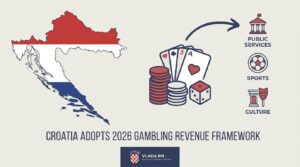
Croatia’s government has formally enacted its updated Regulation on the Criteria for Identifying Beneficiaries and the Distribution of Gambling Revenue for 2026, establishing a detailed framework for channelling proceeds from sports betting, casinos, slot machine lounges, and digital gaming platforms into public interest programs. The executive decree, adopted under Prime Minister Andrej Plenković’s administration, reflects a broader legislative restructuring of the country’s domestic gaming sector. It arrives at a moment when fiscal receipts from gambling activities have been climbing, raising both the stakes and the scrutiny around how that money gets spent.
What the 2026 Decree Actually Changes
At its core, the regulation defines which public entities and programs qualify to receive a share of gambling-generated revenue, and in what proportions. This is not a cosmetic update. The structural roadmap embedded in the decree touches sports development, social welfare, cultural institutions, and healthcare initiatives, all of which depend on predictable funding streams from the gambling sector.
Previous iterations of the regulation drew criticism for opaque allocation criteria and uneven distribution across beneficiary categories. The 2026 version, at least on paper, attempts to address those gaps by tightening eligibility requirements and introducing clearer metrics for how funds are divided among competing public priorities.
Still, whether the new criteria will meaningfully shift resources toward underserved programs remains an open question that the regulation itself does not fully resolve.
Strategic Implications for Croatia’s Gambling Sector
Before diving into the specifics, it’s worth framing why this regulation matters beyond its immediate fiscal mechanics. Croatia’s gambling market sits at a crossroads: growing digital participation, evolving EU regulatory expectations, and a domestic political environment that increasingly views gaming revenue as a lever for public policy goals.
- The decree formalises how revenue from four distinct gambling verticals — sports betting, retail slots, land-based casinos, and interactive digital platforms — will be redistributed, signalling regulatory maturity in treating each segment with differentiated fiscal logic
- Digital gaming platforms are now explicitly included in the distribution framework, reflecting the sector’s growing share of total gambling revenue in Croatia
- Eligibility criteria for beneficiaries have been updated, which could narrow the pool of qualifying organisations and concentrate funding among fewer, larger recipients
- The regulation reinforces the Plenković administration’s broader agenda of using gambling policy as a vehicle for social investment rather than treating it purely as a tax base
- Transparency provisions, while improved, still leave room for discretionary allocation at the ministerial level (a distinction regulators have been slow to enforce)
Revenue Streams and Allocation Architecture
Croatia generates gambling revenue across a diversified set of channels. Land-based casinos and slot machine lounges have historically dominated, but interactive digital platforms have been gaining ground rapidly. The 2026 regulation acknowledges this shift by structuring allocations that account for the different revenue profiles of each vertical.
| Gambling Vertical | Revenue Trend | Allocation Focus |
|---|---|---|
| Sports Betting | Steady growth driven by mobile adoption | Sports development, youth athletics |
| Retail Slot Lounges | Stable but facing regulatory pressure | Social welfare, addiction prevention |
| Land-Based Casinos | Moderate, tourism-linked | Cultural institutions, tourism infrastructure |
| Interactive Digital Platforms | Fastest-growing segment with expanding user base | Healthcare, digital literacy programs |
That the fastest-growing segment now feeds into healthcare and digital literacy funding is notable. It suggests the government views online gambling not just as a revenue source but as a category whose social externalities require targeted reinvestment.
How This Fits Into Croatia’s Broader Regulatory Trajectory
The Plenković administration has been methodical in reshaping Croatia’s gambling laws. This regulation is one piece of a larger puzzle that includes licensing reforms, anti-money laundering compliance upgrades, and alignment with EU-level frameworks governing cross-border digital gambling services.
And while the Croatian government’s official policy communications frame these changes as modernisation, not all market participants agree on this point. Smaller operators worry that tightened beneficiary criteria could indirectly favour larger, better-resourced entities in the allocation process. The regulation’s language around eligibility thresholds leaves enough ambiguity to sustain that concern.
Arguably, the most consequential aspect of the decree is not any single provision but the precedent it sets: gambling revenue in Croatia is being treated as a structured fiscal instrument, not a windfall to be divided ad hoc.
Reframing the Narrative: Why Language Around Gambling Policy Matters
Public perception of gambling regulation tends to oscillate between two poles: moral anxiety and economic pragmatism. Croatia’s 2026 decree operates firmly in the pragmatic register, but the way it frames beneficiaries reveals something subtler about the government’s communication strategy.
By linking gambling proceeds directly to healthcare, youth sports, and cultural preservation, the regulation constructs a narrative where gambling revenue becomes synonymous with public good. This is a deliberate framing choice. It anchors the policy in outcomes that voters and civic organisations can support, even if they harbour reservations about the gambling industry itself. The effect is to shift the conversation from “should gambling exist” to “how should gambling contribute.”
That reframing carries real weight in a political environment where EU accession pressures and domestic social spending demands compete for attention. It also gives the administration a defensible position when critics question the expansion of digital gambling licensing: the money, the argument goes, flows back into the public interest.
Whether that flow is sufficient, equitable, or well-targeted is a separate question entirely. But the discursive architecture of the regulation is designed to make that question harder to ask.
Frequently Asked Questions
What types of gambling contribute to Croatia’s public revenue pool?
Four primary verticals feed into the distribution framework: sports betting, retail slot machine lounges, land-based casinos, and interactive digital gaming platforms. Each carries different revenue characteristics and allocation priorities under the 2026 regulation.
Who decides which organisations receive gambling revenue?
The regulation establishes criteria at the government level, but ministerial discretion still plays a role in final allocation decisions. The 2026 update tightens eligibility requirements compared to earlier versions, though some ambiguity persists.
Does this regulation affect gambling operators directly?
Not in terms of licensing or operational rules. The decree governs the distribution side — how revenue already collected gets allocated to public programs. Operators are affected indirectly, insofar as the regulatory environment signals the government’s long-term posture toward the sector.
Is Croatia’s approach aligned with EU standards?
Broadly, yes. The regulation reflects a trend across EU member states toward structured, transparent allocation of gambling proceeds. Specific alignment with EU-level digital gambling frameworks remains a work in progress.



