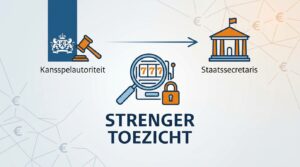
The chairman of the Kansspelautoriteit (KSA), the Netherlands’ gambling regulatory authority, has formally urged the Secretary of State responsible for gambling policy to strengthen enforcement measures across the sector. The request signals growing unease within the regulator about the pace and scope of current protections for Dutch consumers. While specifics of the proposed measures remain under discussion, the move marks a notable escalation in the KSA’s public posture toward both licensed and unlicensed operators active in the Dutch market.
What the KSA’s Request Means for the Dutch Gambling Landscape
The Dutch regulated online gambling market, which opened in October 2021 under the Remote Gambling Act (Kansspelen op afstand, or KOA), has faced persistent criticism over advertising saturation, player protection gaps, and the continued presence of unlicensed operators targeting Dutch consumers. The KSA chairman’s direct appeal to the Secretary of State represents more than routine regulatory communication. It carries political weight.
- Regulatory escalation: The chairman’s public request suggests internal tools available to the KSA may be insufficient to address current market challenges, prompting a call for legislative or executive support.
- Unlicensed operator pressure: Despite enforcement actions, unauthorised gambling platforms continue to attract Dutch players, undermining the regulated market’s integrity and tax revenue projections.
- Licensed operators could face tighter compliance obligations, particularly around responsible gambling protocols and advertising restrictions.
- Political signal: The appeal puts gambling policy squarely on the Secretary of State’s agenda, increasing the likelihood of near-term policy adjustments or parliamentary debate.
A Market Still Finding Its Footing
The Netherlands launched its regulated online gambling framework with considerable ambition. The KOA was designed to channel Dutch players away from unlicensed offshore sites and into a supervised environment with consumer protections, addiction safeguards, and tax contributions. But the transition has been uneven, at best.
Advertising became a flashpoint almost immediately. A partial ban on untargeted gambling advertising took effect in 2023, restricting television and radio spots as well as outdoor campaigns. Still, operators found ways to reach consumers through digital channels and sponsorship arrangements. The Dutch gambling authority’s enforcement division has issued fines and warnings, yet the volume of complaints from addiction prevention groups and consumer advocates has not subsided.
And while the licensed market has grown, the black market hasn’t disappeared. Some estimates suggest a meaningful share of Dutch gambling activity still occurs on platforms without KSA authorisation (a distinction regulators have been slow to quantify publicly). That persistent leakage weakens the economic rationale for the regulated framework and frustrates operators who invested heavily in obtaining licences.
Why the Chairman Went Public
Regulatory bodies typically prefer to resolve policy gaps through internal channels. When a regulator’s chairman makes a public appeal to a government minister, it usually means quieter approaches have stalled or proved inadequate. The KSA’s move could reflect frustration with the pace of legislative updates, resource constraints within the authority itself, or both.
There’s also a timing dimension worth noting. The Netherlands has seen broader political shifts, and gambling regulation rarely sits at the top of any government’s priority list unless public pressure forces it there. By making the request visible, the KSA chairman arguably creates a record that compels a response.
Less clear is whether the Secretary of State will act swiftly or treat this as one input among many in an ongoing policy review.
How Tighter Dutch Regulation Could Ripple Across Europe
The Netherlands isn’t operating in isolation. Across the European Union, gambling regulators are grappling with similar tensions between market liberalisation and consumer protection. Germany’s fragmented interstate treaty system, Italy’s evolving concession model, and Spain’s aggressive advertising restrictions all reflect the same underlying struggle: how to build a regulated market that actually captures the majority of player activity.
If the Dutch government responds to the KSA’s appeal with meaningful new measures, it could set a template. Possible directions include:
| Potential Measure | Likelihood | Impact on Operators |
|---|---|---|
| Expanded advertising restrictions covering digital channels | High | Reduced customer acquisition flexibility; higher cost per acquisition |
| Increased fines for unlicensed operator facilitation | Moderate | Payment processors and ISPs face greater compliance burden |
| Mandatory affordability checks for players | Moderate | Operational complexity rises; potential revenue impact on high-spend segments |
| Enhanced data-sharing between KSA and financial institutions | Lower, but under discussion | Deeper surveillance of player transactions across platforms |
The Operator Perspective
Licensed operators in the Netherlands have invested significant capital in compliance infrastructure, responsible gambling tools, and local staffing. For them, the KSA chairman’s call is a double-edged development. On one hand, stronger enforcement against unlicensed competitors levels the playing field. On the other, additional compliance layers add cost and complexity to an already demanding regulatory environment.
Some operators have publicly supported tighter rules for the black market while lobbying against measures they view as disproportionately burdening licence holders. That tension won’t resolve easily.
Frequently Asked Questions
What is the KSA?
The Kansspelautoriteit is the Dutch regulatory authority overseeing all forms of gambling in the Netherlands, including online, land-based, and lottery operations. It issues licences, monitors compliance, and enforces the Remote Gambling Act.
When did the Netherlands legalise online gambling?
The Dutch online gambling market officially opened on 1 October 2021 under the KOA (Kansspelen op afstand) legislation, after years of parliamentary debate and regulatory preparation.
Why is the KSA chairman appealing to the Secretary of State?
The chairman appears to believe that current regulatory tools and enforcement powers are not sufficient to address ongoing challenges in the market, including unlicensed operator activity and gaps in player protection. A direct appeal to the responsible government minister escalates the issue to a level where legislative or executive action becomes possible.
Could this affect gambling operators already licensed in the Netherlands?
Yes. Depending on the government’s response, licensed operators may face stricter advertising rules, enhanced responsible gambling requirements, or new reporting obligations. The scope remains uncertain until the Secretary of State responds formally.