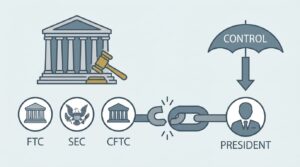
The U.S. Supreme Court ruled Monday that President Trump can fire commissioners at the Federal Trade Commission and other independent regulatory agencies without cause, dismantling a 91-year-old precedent that had insulated bodies like the SEC and CFTC from direct presidential removal power. The 6-3 decision in Trump v. Federal Trade Commission reshapes the balance of power between the executive branch and the regulatory apparatus that oversees everything from securities markets to consumer protection. For financial services, crypto, and commodities markets, the implications are immediate and structural.
What the Ruling Actually Changes for Markets and Regulators
Before diving into the strategic takeaways, it’s worth understanding the scale of what just shifted. Since Humphrey’s Executor v. United States in 1935, independent agency commissioners have enjoyed protection from at-will removal by the president. That firewall was designed to keep regulatory enforcement free from political interference. The Supreme Court has now torn it down, and the consequences ripple across every sector these agencies touch.
- Presidential authority over the FTC, SEC, and CFTC is now direct. Commissioners at these agencies can be removed without cause, fundamentally altering their independence from the White House.
- Regulatory enforcement priorities could shift with each administration. Agencies that previously operated on longer institutional timelines may now face pressure to align with short-term political agendas.
- The crypto and digital assets industry, which has clashed repeatedly with the SEC under Chair Gary Gensler’s tenure, may see enforcement postures change rapidly depending on who occupies the Oval Office.
- Market certainty takes a hit. Businesses that relied on the relative stability of independent agency leadership now face a more volatile regulatory environment.
- The ruling does not eliminate the agencies themselves, but it strips away the structural independence that distinguished them from executive departments like the Department of Justice.
A 91-Year Precedent, Gone in a Morning
The Humphrey’s Executor decision was not some obscure footnote. It was the constitutional bedrock for the entire concept of independent regulatory agencies in the United States. Congress created bodies like the FTC and SEC precisely because it wanted expert-driven, politically insulated oversight of complex markets. The theory was simple: commissioners with fixed terms and removal protections would make decisions based on evidence and expertise, not electoral cycles.
That theory is now, at least on paper, obsolete.
The 6-3 split fell along ideological lines, with the Court’s conservative majority holding that the Constitution vests executive power in the president and that for-cause removal protections impermissibly limit that authority. The dissent argued that Congress has broad latitude to structure agencies as it sees fit, and that the majority was overriding nearly a century of settled governance.
How This Reshapes the SEC and Crypto Regulation
Few sectors will feel this ruling more acutely than digital assets. The SEC’s aggressive posture toward crypto firms has been one of the defining regulatory battles of the past several years. Under previous leadership, the agency pursued enforcement actions against major exchanges and token issuers, often arguing that most digital assets qualify as securities. That approach generated fierce pushback from the industry and from members of Congress sympathetic to blockchain innovation.
With commissioners now subject to at-will removal, a president who disagrees with the SEC’s crypto enforcement strategy has a direct lever to pull. And while the current administration has signaled a more accommodating stance toward digital assets, the structural point cuts both ways. A future administration hostile to crypto could just as easily install aggressive enforcers and remove those who resist.
The Securities and Exchange Commission’s regulatory framework was built on the assumption that its leadership would operate with a degree of autonomy. Strip that away, and the agency’s credibility as a neutral arbiter becomes harder to maintain (a distinction that matters enormously in capital markets, where trust in regulatory consistency underpins trillions of dollars in investment).
The CFTC and Commodities Markets Face Similar Uncertainty
The Commodity Futures Trading Commission, which oversees derivatives markets and has been positioning itself as a potential primary regulator for certain crypto assets, faces the same new reality. Its commissioners can now be removed at presidential discretion.
For commodities traders and clearinghouses, this introduces a variable that didn’t previously exist in their risk calculus. Regulatory continuity has long been a stabilizing force in derivatives markets. Whether that continuity survives the new regime depends entirely on how aggressively future presidents choose to exercise their expanded authority.
What Happens to Ongoing Enforcement Actions?
One question the ruling doesn’t directly answer: what becomes of enforcement actions initiated under commissioners who might now be replaced? Agencies like the SEC have dozens of active cases against crypto firms, financial institutions, and public companies. If commissioners are removed mid-case, new appointees could theoretically deprioritize or settle matters that their predecessors would have litigated aggressively.
This isn’t hypothetical. It’s already the pattern in executive-branch agencies like the DOJ, where prosecutorial priorities shift with administrations. The difference is that markets had previously been shielded from that volatility by the independent agency structure. That shield is gone.
Broader Implications for Financial Regulation
Beyond the immediate impact on specific agencies, the ruling raises a harder question about the architecture of American financial regulation itself. Congress designed independent agencies to serve as expert bodies insulated from political pressure. Courts deferred to their technical expertise. Markets priced in their relative stability.
| Agency | Primary Jurisdiction | Impact of Ruling |
|---|---|---|
| FTC | Consumer protection, antitrust | Commissioners now removable at will; enforcement priorities subject to direct presidential influence |
| SEC | Securities, capital markets, crypto enforcement | Leadership independence eliminated; ongoing crypto cases could face strategic shifts |
| CFTC | Derivatives, commodities, certain digital assets | Same removal vulnerability; potential jurisdictional battles with SEC may intensify under political pressure |
Still, the ruling does not grant the president power to unilaterally change agency rules or override existing regulations. Rulemaking processes, notice-and-comment requirements, and judicial review remain intact. But personnel is policy, as the saying goes. And the power to hire and fire is, in practice, the power to set direction.
Frequently Asked Questions
Does this ruling abolish the FTC, SEC, or CFTC?
No. The agencies continue to exist and operate. What changed is the job security of their commissioners, who can now be removed by the president without needing to show cause.
Will this affect current SEC enforcement cases against crypto companies?
Not automatically, but the ruling creates a mechanism for change. If commissioners leading those cases are replaced, new leadership could settle, drop, or deprioritize pending actions. The practical effect depends on presidential intent.
How does this compare to how executive-branch agencies already work?
Cabinet departments like the DOJ have always had leadership that serves at the president’s pleasure. Independent agencies were deliberately structured differently to provide continuity and insulation. That structural distinction has now collapsed, at least regarding commissioner removal.
Could Congress restore removal protections?
Legislatively, Congress could attempt to create new protections, but any such law would likely face immediate constitutional challenge under this ruling’s framework. The Court has now held that such protections violate Article II. Reversing that would require either a future Court willing to overturn this decision or a constitutional amendment.