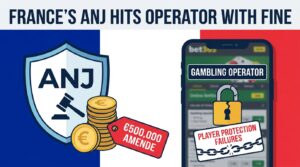
France’s gambling regulator, L’Autorité Nationale des Jeux (ANJ), has levied a €500,000 penalty against an unnamed online betting operator for systematic failures in identifying and supporting players showing signs of excessive or pathological gambling. The sanction followed a deep-dive investigation into the operator’s digital vault, the secure repository that logs every online player transaction. What the regulator found was a company that had, in its assessment, drastically fallen short of its statutory duty of care. The case lands at a moment when European regulators are collectively sharpening their enforcement posture around responsible gambling obligations.
What the ANJ Investigation Uncovered
The ANJ’s Sanctions Committee examined player data spanning a substantial review period, scrutinising transaction records, behavioural markers, and the operator’s internal response protocols. At the core of the findings: the operator had failed to flag players whose activity patterns clearly indicated problematic gambling behaviour. That is not a minor procedural gap. Under French law, licensed operators carry an affirmative obligation to detect, intervene, and offer support when player behaviour crosses defined thresholds.
The regulator identified cases where players exhibited classic warning signs (rapid deposit escalation, loss-chasing patterns, extended session durations) without triggering any meaningful intervention from the operator’s responsible gambling systems. In several instances, the operator’s own internal tools had the capacity to detect these patterns but were either misconfigured or simply not acted upon.
Still, the ANJ did not publicly name the operator, a practice that varies across European jurisdictions and one that has drawn criticism from transparency advocates who argue that anonymity dilutes the deterrent effect of sanctions.
Why This €500,000 Penalty Carries Strategic Weight
Before unpacking the broader implications, here are the critical takeaways from this enforcement action:
- Regulatory teeth are sharpening: The fine signals that the ANJ is willing to impose material penalties for player protection failures, not just issue warnings or corrective orders.
- Operators relying on passive compliance systems face growing exposure; having the tools is no longer sufficient if those tools sit idle
- Digital vault audits are becoming a primary enforcement mechanism. Regulators are increasingly mining transaction-level data to build cases, making it harder for operators to claim ignorance.
- Cross-border precedent: This action aligns with similar enforcement trends in the UK, Italy, and the Netherlands, suggesting a coordinated European shift toward stricter player protection standards.
- The decision not to name the operator raises questions about whether anonymised sanctions achieve their intended deterrent purpose
A Broader European Pattern Takes Shape
France’s action does not exist in isolation. Across the continent, regulators have been escalating both the frequency and severity of sanctions tied to responsible gambling failures. The UK Gambling Commission has imposed multi-million-pound penalties on operators for similar shortcomings. The Netherlands’ Kansspelautoriteit has taken aggressive action against unlicensed operators while simultaneously tightening requirements for licence holders. Italy’s ADM has pursued enforcement actions targeting inadequate self-exclusion mechanisms.
The ANJ, which oversees France’s regulated gambling market, has been steadily building its enforcement capacity since its establishment in 2020. This latest penalty suggests the authority is moving beyond its initial phase of market supervision into a more assertive regulatory stance.
What makes the French approach particularly notable is the reliance on digital vault analysis. By requiring operators to maintain comprehensive, tamper-proof records of all player interactions and transactions, the ANJ has effectively built a forensic audit trail that can be examined retrospectively. The operator in this case could not argue that the data was unavailable. It was all there, sitting in the vault, unacted upon.
How Operators Should Recalibrate Their Compliance Frameworks
For operators licensed in France and other tightening European markets, this case offers a concrete compliance roadmap. Arguably, the most critical lesson is that passive detection systems are no longer defensible. Regulators expect active intervention, documented escalation procedures, and evidence that flagged players received timely, meaningful support.
| Compliance Area | Minimum Expectation | What the ANJ Found Lacking |
|---|---|---|
| Behavioural monitoring | Real-time detection of at-risk patterns | Systems existed but were not acted upon consistently |
| Player intervention | Proactive outreach when thresholds are breached | No evidence of timely contact with flagged players |
| Internal escalation | Documented chain of responsibility for flagged cases | Unclear accountability and response protocols |
| Record-keeping | Complete digital vault with full transaction history | Data was available but underutilised for its intended protective purpose |
The gap between having a system and operating one effectively is where most enforcement actions land. And that gap is exactly what regulators are now auditing for.
The Psychology Behind Regulatory Enforcement: What Operators Often Miss
Beyond the legal mechanics, there is a cognitive dimension to compliance failures that deserves attention. Operators frequently fall into what behavioural scientists call the “normalisation of deviance,” where repeated exposure to borderline player behaviour gradually shifts internal thresholds for what triggers concern. A player depositing €2,000 in a single session might alarm a fresh compliance team, but after months of processing similar transactions, the same pattern barely registers.
This desensitisation effect is compounded by confirmation bias. When an operator’s revenue model benefits from high-frequency, high-value players, there is an unconscious institutional tendency to interpret ambiguous behavioural signals as normal engagement rather than distress. Reframing how compliance teams perceive player data requires deliberate cognitive restructuring, not just better software.
Effective responsible gambling programmes build in what might be called “pattern interrupts”: mandatory review triggers that force human assessment regardless of whether automated systems flag an issue. These interrupts counteract the drift toward passive monitoring. They also create the kind of documented intervention trail that regulators like the ANJ specifically look for during audits.
Training programmes that incorporate scenario-based learning, where compliance staff work through real (anonymised) case studies of players who escalated from recreational to pathological gambling, have shown measurably better outcomes than abstract policy briefings. The difference is emotional engagement with the data, not just procedural familiarity.
Frequently Asked Questions
Why didn’t the ANJ name the operator?
French regulatory practice allows for anonymised sanctions in certain circumstances. Whether this approach adequately serves the public interest remains a point of debate among industry observers and consumer advocates alike.
Is €500,000 a significant penalty in the French market?
Relative to the largest fines imposed by regulators like the UK Gambling Commission, it is modest. But for the French market, it represents a meaningful escalation and signals the ANJ’s willingness to use its sanctioning powers more aggressively. The reputational cost to the operator, even unnamed, likely exceeds the financial penalty itself.
What obligations do French-licensed operators have regarding player protection?
Under French gambling law, operators must actively monitor player behaviour, identify signs of excessive or pathological gambling, and intervene with appropriate support measures. Maintaining a complete digital vault of player transactions is mandatory, and that vault is subject to regulatory audit at any time.
Could this type of enforcement action happen in other European markets?
It already is. Similar actions have been taken in the UK, Netherlands, Italy, and Sweden. The trend points toward a continent-wide consensus that player protection failures will carry real financial consequences.



