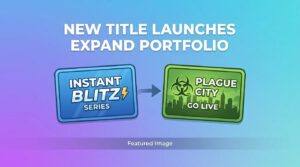
A fresh wave of gaming titles has entered the market, with the Instant Blitz series and Plague City among the latest additions now live and accessible to players. The launches signal a continued push to diversify content offerings across digital platforms, targeting both casual and engaged player segments. While details on the developer or publisher behind these releases remain limited, the timing aligns with a broader industry pattern of accelerated title rollouts during mid-year cycles.
What These New Launches Mean for the Gaming Content Pipeline
The introduction of multiple titles simultaneously reflects a strategic shift that has been gaining traction across the interactive entertainment sector. Rather than spacing releases months apart, publishers are increasingly bundling launches to capture attention in a crowded marketplace. Here’s what stands out from a business perspective:
- Portfolio diversification: The Instant Blitz series, with its emphasis on rapid-play mechanics, caters to short-session players, while Plague City appears to target a narrative-driven or strategy-oriented audience. Two very different bets placed at once.
- Simultaneous launches reduce per-title marketing costs when bundled under a single promotional push
- Player retention calculus: Offering varied genres at the same time increases the probability that at least one title resonates with any given user, improving platform stickiness
- Competitive positioning: Mid-year launches avoid the noise of Q4 release windows, where major AAA titles dominate consumer attention and advertising spend
The Instant Blitz Series: Speed as a Design Philosophy
The naming convention alone tells you something. “Instant Blitz” suggests gameplay built around immediacy, quick rounds, and low barriers to entry. This format has proven commercially resilient across mobile and browser-based platforms, where session length often dictates engagement metrics more than graphical fidelity or story depth.
Series-based releases also carry a built-in advantage that standalone titles lack: iterative audience building. Each new entry in the Instant Blitz lineup can refine mechanics based on player data from previous installments, creating a feedback loop that, at least on paper, should improve retention rates over time. Whether the studio behind these titles is leveraging that data pipeline effectively remains an open question.
Still, the instant-play category continues to attract investment. According to industry tracking, casual and hyper-casual game formats accounted for a significant share of global mobile downloads in 2024, and the appetite for quick-session content shows no sign of plateauing.
Plague City Enters a Crowded Thematic Space
Plague City occupies a thematic niche (survival, contagion, or post-apocalyptic strategy, depending on its exact genre classification) that has seen no shortage of entrants since the early 2020s. The challenge for any new title in this space isn’t originality of premise but execution and differentiation.
What separates a forgettable launch from one that builds a lasting player base often comes down to three factors: depth of gameplay systems, community features, and post-launch content cadence. Titles that ship with a roadmap of updates tend to outperform those that arrive as finished products with no expansion horizon. Whether Plague City has that kind of support infrastructure behind it will likely determine its trajectory over the next two quarters.
How Rapid Title Launches Reshape Platform Economics
The economics of putting multiple titles live in quick succession deserve scrutiny. For platforms hosting these games, each new release represents both an opportunity and a risk. More content means more surface area for player acquisition. But it also means diluted attention per title, higher QA demands, and the operational burden of supporting a larger active library.
Platforms that have mastered this balance tend to share a few characteristics:
| Factor | High-Performing Platforms | Struggling Platforms |
|---|---|---|
| Content curation | Algorithmic and editorial filtering | Undifferentiated catalog dumps |
| Post-launch support | Dedicated update cycles per title | Launch-and-abandon pattern |
| Player segmentation | Behavioral targeting across genres | One-size-fits-all recommendations |
| Monetization clarity | Transparent spend mechanics with varied depth | Aggressive early monetization that erodes trust |
And while volume strategies can work, they demand backend infrastructure that many mid-tier operators underestimate.
Player Psychology and the Appeal of Novelty
From a behavioral standpoint, the decision to launch titles like the Instant Blitz rapid-play game series taps into well-documented psychological patterns. Novelty triggers dopamine responses, and the mere availability of something new on a platform can re-engage lapsed users who had stopped visiting. This is not speculation; it is the foundational logic behind content refresh strategies across streaming, gaming, and digital media.
But novelty alone is a depreciating asset. The initial spike in engagement that accompanies any new launch decays rapidly unless the underlying product delivers genuine replay value. Game designers increasingly draw on principles adjacent to neuro-linguistic programming and behavioral design, framing in-game choices, reward structures, and progression systems in ways that align with how players naturally process motivation and achievement.
Anchoring effects play a role here. When a player’s first experience with a title delivers a strong positive signal, whether through an early win, a visually striking moment, or a well-timed reward, that anchor shapes their perception of the entire product. Titles that front-load these moments tend to convert trial users into repeat players at measurably higher rates. The Instant Blitz format, by compressing gameplay into short bursts, arguably has a structural advantage in creating these anchors quickly.
Framing matters too. How a game presents its challenges (as opportunities rather than obstacles, as progress rather than failure) directly influences player persistence. Studios that understand this distinction build it into their UI language, notification systems, and even loading screens. It is subtle work, but the performance gap between titles that get it right and those that don’t can be substantial.
Frequently Asked Questions
What is the Instant Blitz series?
The Instant Blitz series refers to a collection of titles designed around fast-paced, short-session gameplay. Each installment builds on the format with iterative refinements, targeting players who prefer quick engagement windows over extended play sessions.
What genre does Plague City fall into?
Specific genre details have not been fully disclosed, though the title’s name suggests themes related to survival, contagion management, or urban strategy. Its exact classification will become clearer as player reviews and gameplay footage emerge.
Why do platforms launch multiple titles simultaneously?
Bundled launches reduce marketing costs per title, increase the odds of engaging diverse player segments, and generate a broader content refresh signal that can reactivate dormant users. The trade-off is thinner attention spread across each individual release.
How do behavioral design principles influence game launches?
Developers use anchoring, reward framing, and progression psychology to shape early player experiences. These techniques, rooted in behavioral science, aim to convert first-time users into retained players by creating strong positive associations during initial sessions. Not every studio applies them with equal sophistication.