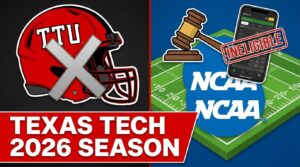
Quarterback Brendan Sorsby will not suit up for Texas Tech in 2026 after an NCAA sports betting investigation resulted in a ruling that effectively ends his collegiate career. The case, which had been under review for several months, underscores the growing tension between expanded legal sports wagering across the United States and the NCAA’s strict prohibitions on athlete gambling. Sorsby, who transferred to Texas Tech after stints at other programs, had been expected to compete for a starting role before the investigation surfaced.
What the Sorsby Ruling Signals for College Athletics
This isn’t simply a story about one player losing eligibility. The broader implications ripple through compliance departments, transfer portal strategy, and the NCAA’s still-evolving enforcement posture on sports betting violations. Before unpacking the details, here are the core takeaways:
- Sorsby’s ineligibility stems from an NCAA sports betting violation, not a criminal charge, yet the competitive consequences are identical to a suspension
- Texas Tech loses a quarterback it recruited through the transfer portal, raising questions about how programs vet incoming players for prior compliance issues
- The NCAA has signalled repeatedly that sports betting violations will be treated with zero tolerance, and this case reinforces that stance in practice
- For athletes in states where sports betting is legal for the general public, the disconnect between what’s permitted off campus and what’s prohibited under NCAA rules continues to generate confusion
- Programs investing heavily in NIL and portal acquisitions now face an additional layer of due diligence risk
How the Investigation Unfolded
Details surrounding the specific nature of Sorsby’s betting activity remain limited, though the NCAA’s enforcement process typically involves cooperation with state gaming commissions and digital sportsbook operators. What is known: the investigation predates his arrival at Texas Tech, meaning the violation likely occurred during his time at a previous institution. That timeline matters. It suggests the Red Raiders may not have been aware of the issue when they extended their offer through the portal.
Still, ignorance doesn’t insulate a program from the fallout.
The NCAA’s sports betting rules prohibit all student-athletes from placing wagers on any sport governed by the association, regardless of whether the bet involves their own team or sport. This blanket prohibition exists even in states where retail and mobile sports betting operate legally for adults over 21. The rule creates what critics call a regulatory paradox: an athlete can walk past a sportsbook kiosk in a campus-adjacent casino but faces career-ending consequences for using it.
Texas Tech’s Roster and Recruiting Implications
Losing a transfer quarterback this late in the cycle puts Texas Tech in a difficult position. The Red Raiders’ football program had built its 2026 quarterback room with Sorsby factored into the competition. Finding a replacement of comparable experience through the portal at this stage is possible but far from guaranteed. Programs that lose key players to eligibility rulings, rather than injury or voluntary departure, face a particular kind of instability because the timeline for resolution rarely aligns with recruiting windows.
And while head coach Joey McGuire has not publicly commented in detail, the situation inevitably raises internal questions about the program’s compliance screening process for transfer additions. Across the Big 12, compliance staffs have expanded in recent years precisely because the transfer portal introduced risks that didn’t exist under the old system. A player’s eligibility history, NIL arrangements, and now gambling compliance all require verification before a scholarship offer can be safely extended.
The NCAA’s Enforcement Landscape on Athlete Betting
Sorsby’s case arrives during a period of heightened NCAA attention to sports betting among athletes. Since the Supreme Court’s 2018 decision in Murphy v. NCAA opened the door for states to legalise sports wagering, the association has struggled to reconcile its internal rules with a rapidly shifting external environment. More than 30 states now permit some form of legal sports betting, and the industry generates billions in annual handle.
The NCAA updated its sports betting guidelines in 2023, maintaining the blanket prohibition while increasing educational outreach to member institutions. Whether that outreach has been sufficient is, arguably, the more uncomfortable question. Multiple cases across Division I programs in the past two years suggest that awareness alone hasn’t closed the gap between rule and behaviour.
| Factor | Current NCAA Position | Industry Reality |
|---|---|---|
| Athlete wagering on any NCAA sport | Prohibited regardless of state law | Legal for general public in 30+ states |
| Enforcement mechanism | Cooperation with state regulators and operators | Detection often delayed by months |
| Penalty range | Loss of eligibility, permanent in severe cases | Varies; some cases result in reduced suspensions |
| Educational mandate | Required programming for all athletes | Compliance officers report inconsistent engagement from players |
Why Compliance Culture Needs a Psychological Shift
Rules alone don’t change behaviour. This is where the conversation needs to move beyond policy documents and into the realm of how athletes actually process risk. From a behavioural standpoint, young adults between 18 and 23 are neurologically predisposed to underweight long-term consequences when short-term rewards feel immediate and accessible. Sports betting apps are engineered for exactly that kind of engagement: fast feedback loops, variable reward schedules, and frictionless access.
Effective compliance programming, then, can’t rely solely on telling athletes what they cannot do. It needs to reframe the decision architecture. Programs that have adopted scenario-based training, where athletes walk through realistic situations and articulate their own reasoning before being told the rule, report higher retention and fewer violations (a distinction regulators have been slow to enforce at the institutional level). Identity-based framing also matters: when an athlete internalises “I am someone who protects my eligibility” rather than “I must follow this rule,” the psychological commitment deepens. The difference between those two mental models is the difference between compliance as obligation and compliance as self-concept.
Peer influence compounds the challenge. If an athlete’s social circle includes non-athlete friends who bet openly and legally, the prohibition feels arbitrary. Addressing that perception requires honest conversation, not just policy recitation. Some programs have begun inviting former athletes who lost eligibility to speak directly to current rosters. The emotional weight of a real story outperforms a PowerPoint slide every time.
Frequently Asked Questions
Can college athletes legally place sports bets in states where wagering is permitted?
No. The NCAA prohibits all student-athletes from betting on any NCAA-governed sport, regardless of state law. This applies to bets placed on other teams and other sports, not just their own.
What happens to a player ruled ineligible for a betting violation?
The consequences vary. In some cases, athletes receive a defined suspension and can return. In more severe cases like Sorsby’s, eligibility is lost entirely, which can end a collegiate career depending on remaining years of competition.
Is Texas Tech facing any NCAA sanctions as a program?
Based on available information, the ruling applies to Sorsby individually. Programs typically face sanctions only if institutional staff were aware of or facilitated the violation.
How common are NCAA sports betting violations among athletes?
The NCAA has reported a notable increase in investigations since 2021. Several Division I programs across football and basketball have seen players disciplined, though the total number of cases remains a fraction of the overall athlete population.