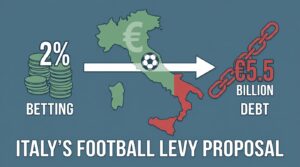
Senator Paolo Marcheschi has introduced a draft parliamentary bill in the Italian Senate that would impose a 2% mandatory levy on all domestic football wagers. Filed as Bill 1902 and now assigned to the Senate’s 7th Standing Committee, the proposal aims to channel betting revenues into a dedicated fund for sports infrastructure renewal. The move comes against the backdrop of systemic fiscal distress across Italian club football, where aggregate sector indebtedness has ballooned to an estimated €5.5 billion. If the bill clears both chambers, the levy would take effect on January 1, 2027.
What Bill 1902 Means for Italy’s Betting and Football Sectors
Before unpacking the strategic implications, it’s worth framing the scale of what’s being proposed. A flat 2% charge on every football wager placed domestically would represent one of the most direct fiscal linkages between sports betting revenue and club-level infrastructure funding anywhere in Europe. That alone makes this bill worth watching closely, regardless of its legislative odds.
- The proposed levy targets all domestic football wagers, creating a ring-fenced revenue stream independent of general taxation or government budget cycles
- Italy’s club football sector carries roughly €5.5 billion in accumulated debt, a figure that has prompted repeated calls for structural financial reform
- Bill 1902 has been assigned to the 7th Standing Committee, signalling that it has at least cleared the procedural threshold for formal legislative review
- A January 2027 implementation date gives operators, regulators, and clubs a roughly 18-month runway to prepare, assuming swift passage
- The mechanism could set a precedent for other European jurisdictions exploring hypothecated betting taxes tied to sport-specific outcomes
How the 2% Charge Would Actually Work
The proposed levy would apply directly to football betting turnover within Italy’s regulated market. That distinction matters. Italy already operates one of Europe’s most structured gambling frameworks, overseen by the Agenzia delle Dogane e dei Monopoli, which licenses and supervises all forms of legal wagering in the country. Layering a sport-specific surcharge onto this existing architecture is technically feasible, but it introduces new compliance obligations for licensed operators.
Unlike broader gambling taxes that feed into consolidated government revenue, Bill 1902 envisions a hypothecated model. Funds collected through the levy would flow into a dedicated infrastructure account, not the general treasury. In practice, this means the money would be earmarked for stadium upgrades, training facility construction, and grassroots development projects across Italian football.
Whether operators absorb the cost or pass it through to bettors in the form of adjusted odds remains an open question (and one the bill’s text, at least on paper, does not resolve).
The Debt Crisis Driving Legislative Action
Italian football’s financial fragility is not new. But the €5.5 billion figure attached to this bill gives it a sharper edge than previous reform attempts. Several Serie A and Serie B clubs have faced insolvency proceedings, ownership restructurings, or emergency recapitalisations in recent years. The pattern is familiar: overextended wage bills, declining matchday revenues post-pandemic, and infrastructure that lags behind Premier League and Bundesliga counterparts.
Senator Marcheschi’s bill frames the levy not as a punitive measure on the betting industry, but as a corrective mechanism. The logic runs roughly like this: football generates substantial betting activity, yet almost none of that economic value cycles back into the sport’s physical and financial foundations. Bill 1902 attempts to close that loop.
Still, not everyone in the Italian betting ecosystem is likely to welcome the proposal. Operators already contend with one of Europe’s higher effective tax rates on gambling, and an additional 2% extraction from football-specific turnover could compress margins further in a segment that drives significant volume.
European Context and Regulatory Ripple Effects
Italy would not be the first country to experiment with sport-linked betting levies, but the scale and specificity of Bill 1902 would arguably make it the most ambitious. France’s existing model channels a portion of betting taxes toward sport, though through a less direct mechanism. Spain has debated similar proposals without advancing them to formal committee review.
| Country | Betting Levy Model | Sport-Specific Allocation | Status |
|---|---|---|---|
| Italy (proposed) | 2% on football wagers | Yes, ring-fenced fund | Committee review stage |
| France | Portion of general betting tax | Partial, via national sport agency | Active |
| Spain | No dedicated sport levy | No | Under periodic discussion |
| United Kingdom | Voluntary contributions + statutory levy proposed | Under review via gambling white paper | Pending legislation |
If Italy moves forward, the precedent could accelerate similar legislative efforts elsewhere. The UK’s ongoing debate around a statutory gambling levy for sport and treatment funding is the closest parallel, though it encompasses all sports rather than isolating football.
What Operators and Stakeholders Should Prepare For
Even at the committee stage, Bill 1902 sends a signal that Italian lawmakers are willing to draw tighter fiscal connections between betting markets and the sports they depend on. For operators, the immediate task is scenario planning: modelling the margin impact of a 2% turnover levy on football products, which typically represent the highest-volume vertical in European sportsbooks.
Clubs and football federations, meanwhile, face a different calculation. Access to a self-sustaining infrastructure fund could reduce dependence on volatile commercial revenues and politically contingent government grants. But the governance of such a fund, who controls disbursement, what qualifies as eligible spending, how accountability is enforced, will determine whether the mechanism delivers real structural improvement or simply creates a new layer of bureaucratic allocation.
Frequently Asked Questions
Would the 2% levy apply to online and retail betting equally?
Based on the bill’s framing, the charge would cover all domestic football wagers, which in Italy’s regulated market includes both online platforms and physical betting shops licensed by the ADM.
How much revenue could the levy generate annually?
No official projection has been released. Italy’s regulated sports betting market generates billions in annual turnover, with football accounting for the dominant share, so even a 2% extraction could yield a substantial sum.
Is the bill likely to pass?
It has cleared the procedural threshold for committee assignment, which is a necessary but far from sufficient step. Legislative timelines in Italy’s bicameral system can stretch considerably, and opposition from the betting industry could slow progress.
Could this model be adopted by other sports in Italy?
The bill specifically targets football wagers. Whether success here would prompt analogous proposals for basketball, tennis, or other sports remains speculative, though the template would exist.