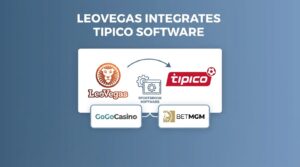
MGM Resorts’ online gambling subsidiary LeoVegas has become the latest brand under the group’s umbrella to deploy sportsbook technology originally acquired from Tipico in 2024. The integration places LeoVegas alongside GoGoCasino and BetMGM, both of which have already onboarded the platform. For a company that built its reputation almost entirely on casino and mobile slots, the sportsbook addition signals a deliberate pivot toward becoming a full-spectrum iGaming operator.
What the Tipico Sportsbook Deal Means for MGM’s Digital Brands
When MGM Resorts completed its acquisition of Tipico’s sportsbook technology in 2024, the strategic logic was straightforward: consolidate proprietary sports betting infrastructure across its growing portfolio of digital brands rather than leasing third-party solutions. The phased rollout across BetMGM, GoGoCasino, and now LeoVegas confirms that the parent company is executing on that vision with measurable pace.
- LeoVegas gains a fully integrated sportsbook capability, reducing its historical reliance on casino-only revenue streams
- MGM’s decision to deploy the Tipico platform across three distinct brands suggests confidence in the software’s scalability and adaptability to different market segments
- GoGoCasino’s earlier adoption likely served as a testing ground, with LeoVegas representing a higher-stakes deployment given its larger player base
- The move consolidates MGM’s tech stack, potentially lowering per-brand licensing costs and accelerating feature parity across its portfolio
- Competitors operating on third-party sportsbook platforms may face a structural cost disadvantage as MGM amortises its acquisition investment across multiple brands
Why LeoVegas Specifically, and Why Now
LeoVegas has long occupied an interesting position in the online gambling landscape. Acquired by MGM Resorts in 2022 for approximately $607 million, the Sweden-founded operator was primarily known for its mobile-first casino experience. Sports betting was never its core identity. But the European iGaming market has shifted beneath operators who rely on a single vertical. Regulatory frameworks in markets like Sweden, Denmark, and the Netherlands increasingly favour operators that offer both casino and sports betting under unified responsible gambling controls.
Adding a proprietary sportsbook to LeoVegas’ mobile-first platform addresses a gap that competitors had already exploited. Operators like Kindred (Unibet) and Entain (bwin) have offered combined casino-sportsbook products for years, making LeoVegas’ casino-only positioning a competitive liability in markets where cross-selling between verticals drives customer lifetime value.
Still, the timing raises a question worth sitting with: does a sportsbook addition genuinely change LeoVegas’ competitive position, or does it simply bring the brand to parity with where the market already stands?
The Tipico Technology: What MGM Actually Bought
Tipico’s sportsbook platform was built to serve the German market, one of the most technically demanding and regulatory-complex jurisdictions in European sports betting. That pedigree matters. The software handles real-time odds compilation, in-play betting infrastructure, and risk management at scale (a distinction that separates it from lighter, white-label solutions common among smaller operators).
By acquiring the technology outright rather than licensing it, MGM secured the ability to customise the platform for each brand’s specific market requirements. BetMGM’s deployment in the US operates under a fundamentally different regulatory regime than LeoVegas’ European footprint. The fact that the same underlying technology can serve both contexts suggests a degree of architectural flexibility that off-the-shelf solutions rarely provide.
Competitive Landscape and Cross-Brand Synergies
The three-brand rollout creates an interesting competitive dynamic within MGM’s own portfolio. BetMGM targets the North American market. GoGoCasino, a leaner brand, operates in Nordic markets. LeoVegas sits somewhere between the two in terms of scale and geographic reach.
| Brand | Primary Market | Sportsbook Status | Core Audience |
|---|---|---|---|
| BetMGM | United States | Deployed | Mass-market sports bettors |
| GoGoCasino | Nordics | Deployed | Casino-first players exploring sports |
| LeoVegas | Europe (multi-market) | Newly integrated | Mobile-first casino players with broader iGaming interests |
What remains less clear is how MGM plans to differentiate the sportsbook experience across these brands. Running identical technology under three names risks cannibalisation, particularly in markets where more than one MGM brand holds a licence. The answer likely lies in front-end customisation, promotional strategy, and market-specific odds offerings rather than backend divergence.
How Proprietary Tech Reshapes Operator Economics
Arguably the most consequential aspect of this rollout isn’t the product itself. It’s the economics. Third-party sportsbook providers typically charge operators a revenue share or per-bet fee. Over time, those costs compound significantly for high-volume operators. By bringing the technology in-house through the Tipico acquisition, MGM converts a variable cost into a fixed one, spread across every brand that adopts the platform.
And while the upfront acquisition price of Tipico’s technology hasn’t been publicly disclosed in granular detail, the return-on-investment calculation improves with each additional brand deployment. Three brands are live. If MGM launches further digital properties or acquires additional operators, the marginal cost of adding sportsbook capability drops further.
That structural advantage compounds quietly. It won’t show up in a single quarter’s earnings. But over a three-to-five-year horizon, the difference between paying a third party 10-15% of sports betting revenue and operating proprietary infrastructure is material enough to reshape margin profiles across MGM’s entire digital division.
Frequently Asked Questions
What sportsbook technology is LeoVegas now using?
LeoVegas has integrated sportsbook software that MGM Resorts acquired from Tipico in 2024. The same platform powers sports betting at BetMGM and GoGoCasino.
Does this change LeoVegas’ available markets?
The sportsbook addition expands LeoVegas’ product offering within its existing licensed markets. It does not, on its own, grant access to new jurisdictions, though it does make the brand more competitive in markets where combined casino-sportsbook products are the norm.
Why did MGM acquire Tipico’s sportsbook rather than license third-party software?
Owning the technology outright gives MGM greater control over customisation, reduces ongoing licensing costs across multiple brands, and eliminates dependency on external providers. In practice, it’s a bet on long-term margin improvement over short-term convenience.



