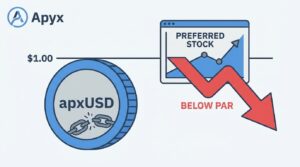
Apyx’s apxUSD, a dividend-backed stablecoin collateralized primarily by preferred shares of bitcoin-treasury companies, broke its $1 peg this week, dropping to roughly 92 cents. The de-pegging was triggered by a decline in Strategy’s STRC preferred stock below par value, compounded by a broader bitcoin selloff that rattled crypto-adjacent equities. The episode raises pointed questions about the durability of stablecoins backed by non-traditional, equity-linked collateral rather than cash equivalents or government bonds.
What the apxUSD De-Peg Reveals About Collateral Risk
Before unpacking the implications, it helps to understand what makes apxUSD structurally different from most stablecoins. Unlike USDT or USDC, which rely on reserves of short-dated Treasuries and cash, apxUSD derives its backing from preferred equity in companies whose balance sheets are themselves heavily exposed to bitcoin. That layered dependency creates a fragility most stablecoin users aren’t accustomed to evaluating.
- apxUSD fell approximately 8% below its intended $1 peg, trading near $0.92 at its lowest point this week
- The primary collateral driver was Strategy’s STRC preferred stock, which dropped below its par value amid bitcoin’s extended decline
- Bitcoin-treasury companies face a compounding risk loop: falling BTC prices erode equity valuations, which in turn weaken the collateral base for instruments like apxUSD
- The event underscores how dividend-backed stablecoins carry equity-market risk that traditional fiat-backed stablecoins largely avoid
- Regulatory scrutiny of novel stablecoin collateral structures is likely to intensify following this incident
How Preferred Stock Became Stablecoin Collateral
The premise behind apxUSD was, at least on paper, elegant. Preferred shares offer fixed dividend payments, which can theoretically generate yield to support a stablecoin’s peg. Apyx’s dividend-backed stablecoin model attempted to bridge traditional equity income with decentralized finance infrastructure. But elegance and resilience are not the same thing.
Strategy (formerly MicroStrategy) has become the most prominent corporate bitcoin holder, with tens of billions of dollars in BTC on its balance sheet. Its preferred stock, STRC, was designed to appeal to income-seeking investors willing to accept bitcoin exposure indirectly. When bitcoin prices hold steady or rise, the arrangement works. When they don’t, the preferred shares behave less like fixed income and more like a leveraged bet on crypto.
That distinction matters enormously for anyone holding apxUSD under the assumption it would behave like a dollar.
The Reflexivity Problem in Bitcoin-Linked Collateral
What happened this week wasn’t a black swan. It was a stress test that the collateral model arguably should have anticipated. Bitcoin dropped sharply, dragging down the equity valuations of companies whose primary treasury asset is BTC. Those falling equity prices then undermined the collateral backing apxUSD, creating a reflexive loop where each leg of the structure weakened the other.
This kind of reflexivity is well-documented in traditional finance. George Soros built an entire investment philosophy around it. Yet in DeFi, the feedback mechanisms can accelerate faster because liquidation thresholds, oracle updates, and market sentiment interact in compressed timeframes.
Still, the 8% de-peg didn’t trigger a catastrophic unwind. Whether that reflects adequate risk buffers within Apyx’s protocol or simply insufficient selling pressure remains an open question.
Comparing Collateral Models Across Stablecoins
| Stablecoin | Collateral Type | Primary Risk Factor | Peg Stability Record |
|---|---|---|---|
| USDT | Cash, Treasuries, commercial paper | Counterparty and reserve transparency | Generally stable; minor deviations during market stress |
| USDC | Cash and short-dated U.S. Treasuries | Banking counterparty risk (e.g., SVB in 2023) | Brief de-peg during SVB crisis, recovered quickly |
| DAI | Crypto-native assets, RWAs | Crypto volatility, governance decisions | Occasional minor fluctuations |
| apxUSD | Preferred equity in BTC-treasury firms | Equity price decline tied to bitcoin selloffs | Broke peg to ~$0.92 this week |
Why This Matters for Stablecoin Regulation
Regulators in the United States and Europe have spent the past two years debating what constitutes acceptable stablecoin reserves. The EU’s MiCA framework, now in effect, mandates specific reserve composition requirements for asset-referenced tokens. In the U.S., competing legislative proposals from the House and Senate both emphasize high-quality liquid assets as the baseline for permissible collateral.
apxUSD doesn’t fit neatly into either framework. Preferred equity in a bitcoin-heavy company is neither a liquid asset nor a traditional reserve instrument. Whether regulators will treat this week’s de-peg as a cautionary data point or an argument for stricter collateral mandates depends partly on how much attention it receives (a distinction regulators have been slow to enforce in the stablecoin space more broadly).
Reframing Risk Perception in DeFi Yield Products
One of the less discussed dimensions of this event involves how users perceive and process risk in decentralized finance. Behavioral finance research, echoed by principles in neuro-linguistic programming, suggests that framing effects heavily influence financial decision-making. When a product is labeled a “stablecoin,” users anchor to the expectation of stability. The word itself does cognitive work that no disclaimer can fully undo.
Apyx positioned apxUSD as dividend-backed, which is technically accurate. But the mental model most users carry for stablecoins is shaped by USDT and USDC, where the underlying assets are boring by design. Preferred equity in a bitcoin-treasury company is not boring. It carries directional market risk, credit risk, and liquidity risk that most retail participants are poorly equipped to evaluate.
This gap between label and substance creates what behavioral economists call a “representation bias.” Users assume apxUSD belongs in the same category as other stablecoins because it shares the name. The result is a mismatch between perceived safety and actual exposure. Protocols that introduce novel collateral structures bear a responsibility to bridge that gap, not just through documentation, but through interface design, risk scoring, and clear visual cues that signal departure from conventional stablecoin architecture. And yet, across DeFi, that kind of user-centric risk communication remains rare.
Frequently Asked Questions
What caused apxUSD to lose its dollar peg?
The de-peg was driven by a decline in Strategy’s STRC preferred stock below par value, which serves as primary collateral for apxUSD. A concurrent bitcoin selloff amplified the downward pressure on STRC and, by extension, the stablecoin’s backing.
Is apxUSD similar to USDT or USDC?
Not really. While all three are designed to maintain a $1 value, apxUSD uses preferred equity in bitcoin-treasury companies as collateral rather than cash and government securities. That makes it structurally more volatile and exposed to equity and crypto market risk simultaneously.
Could apxUSD recover its peg?
Recovery depends on whether STRC preferred stock returns above par and bitcoin stabilizes. The protocol’s mechanisms for restoring the peg under stress have not yet been fully tested at scale, so the trajectory remains uncertain.
What does this mean for other novel stablecoins?
It signals that collateral innovation carries real trade-offs. Stablecoins backed by non-traditional assets may offer higher yields, but they import risks that users and regulators are only beginning to price in.



