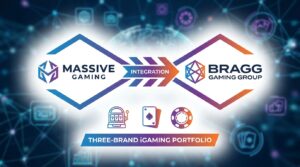
Massive Gaming has struck a distribution deal with Bragg Gaming Group, channeling igaming content from all three of its studio brands into Bragg’s aggregation platform. The integration positions Massive Gaming’s diverse slot and casino portfolio for broader operator access across regulated markets. For Bragg, the partnership deepens a content library that has become central to its B2B growth strategy.
What This Deal Signals for Both Parties
Content aggregation partnerships rarely make headlines on their own, but the structure of this one reveals something worth watching. Rather than a single-studio integration, Massive Gaming is funneling output from three distinct brands through a single distribution channel. That consolidation matters for operators evaluating supplier efficiency and content variety simultaneously.
- Massive Gaming gains access to Bragg’s network of licensed operators across multiple regulated jurisdictions, accelerating time-to-market for its titles
- Bragg strengthens its aggregation hub with a multi-brand supplier, adding differentiation to its content offering without negotiating three separate deals
- Operators connected to Bragg’s platform can now access Massive Gaming’s full catalogue through a single integration point, reducing technical overhead
- The deal reflects a broader industry pattern: mid-tier studios increasingly prefer aggregation over direct operator relationships, trading margin for reach
Why Aggregation Keeps Winning
The igaming supply chain has tilted decisively toward aggregation over the past three years. Studios that once pursued direct integrations with tier-one operators now face a harder calculus: the cost of maintaining dozens of individual technical connections, each with its own certification and compliance requirements, often outweighs the revenue benefit of cutting out a middleman.
Bragg Gaming Group has positioned itself squarely in this gap. Its remote game server and content aggregation technology serves as a single pipe between game studios and operator platforms. For a company like Massive Gaming, which operates multiple creative brands under one corporate umbrella, the appeal is straightforward: one integration, three brands live, dozens of operators reachable.
Still, aggregation is not without trade-offs. Studios cede a layer of commercial control. And the sheer volume of games flowing through platforms like Bragg’s means that visibility becomes its own challenge (a distinction that separates studios with strong brand identity from those that simply add volume to a crowded lobby).
Massive Gaming’s Multi-Brand Model
What sets Massive Gaming apart from many mid-tier suppliers is its deliberate decision to operate three separate studio brands, each with a distinct creative identity and target player segment. This approach mirrors what larger groups like Evolution or Light & Wonder do at scale, but Massive Gaming is attempting it with a leaner structure.
The strategy carries risk. Maintaining three coherent brand identities requires investment in design, narrative, and mathematical modeling that doesn’t always scale linearly. But when it works, the payoff is clear: operators can slot different brands into different lobby positions, targeting casual players with one label and high-volatility seekers with another.
Whether Massive Gaming’s three brands can each carve out enough market recognition to justify the overhead remains an open question.
Regulated Market Reach and Compliance Considerations
Arguably the most tangible benefit of routing content through Bragg’s infrastructure is jurisdictional reach. Bragg holds licenses and certifications across several regulated markets, including in Europe and North America. For studios entering or expanding in these territories, the compliance burden of going it alone can be prohibitive.
| Factor | Direct Integration | Aggregation via Bragg |
|---|---|---|
| Time to market | Months per operator | Significantly reduced through single integration |
| Compliance management | Studio bears full responsibility | Shared with aggregator; Bragg handles platform-level certification |
| Operator reach | Limited by studio’s own sales capacity | Access to Bragg’s full operator network |
| Revenue share | Higher per-operator margin | Lower margin, but broader distribution offsets volume |
| Brand visibility | Controlled directly by studio | Dependent on operator lobby placement and Bragg’s promotional support |
How Content Strategy Shapes Operator Decisions
The psychology behind operator content selection is more nuanced than raw game counts suggest. Operators don’t simply want more games. They want the right games for their player demographics, presented in ways that drive session depth and retention. This is where neuro-linguistic framing enters the picture, even if few in the industry use that term explicitly.
Game studios that understand player motivation at a cognitive level design experiences that tap into specific reward patterns: variable ratio reinforcement in bonus mechanics, loss aversion cues in near-miss animations, and anchoring effects in bet-size presentation. These aren’t accidental design choices. They reflect a sophisticated understanding of how players process information and make decisions under uncertainty.
For operators evaluating a new content supplier through an aggregator like Bragg, the question isn’t just “how many titles?” but rather how well those titles are engineered to sustain engagement within responsible gaming boundaries. Studios that can articulate their design philosophy in terms of player psychology, rather than just theme and volatility, tend to secure better lobby positioning. And lobby positioning, in practice, determines whether a game gets played or buried beneath hundreds of competitors.
Massive Gaming’s multi-brand approach suggests at least some awareness of this dynamic. By segmenting its output into distinct creative identities, the company can tailor its pitch to different operator needs without diluting any single brand’s positioning. That kind of strategic clarity is what separates studios that grow through aggregation from those that simply exist within it.
Frequently Asked Questions
What does Bragg Gaming Group’s aggregation platform do?
Bragg operates a remote game server and content aggregation system that connects game studios to online casino operators. It handles technical integration, content delivery, and in many cases supports compliance across regulated markets.
How many brands is Massive Gaming integrating?
All three of its studio brands are being integrated into Bragg’s platform, giving operators access to the company’s full content portfolio through a single connection.
Why do studios choose aggregation over direct operator deals?
Speed and reach. Direct integrations require separate technical work, certification, and commercial negotiation for each operator. Aggregation compresses that into one process, though studios accept a smaller revenue share per transaction in exchange.
Which markets will benefit from this integration?
Bragg holds licenses across multiple regulated jurisdictions in Europe and North America, so operators in those territories stand to gain the most immediate access to Massive Gaming’s content.