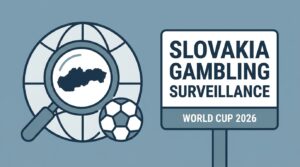
Slovakia’s gambling watchdog, the Regulatory Authority for Gambling (URHH), has ordered a sweeping surveillance operation targeting all domestic gambling advertising during the FIFA World Cup 2026. Director General Libuša Baranová authorized the deployment of maximum operational capacity across television, digital platforms, social media, and outdoor advertising channels. This marks the first major international sporting event where the URHH will actively enforce its newly acquired consumer protection mandate, a responsibility transferred from the Slovak Trade Inspection earlier this year.
What Slovakia’s World Cup Advertising Crackdown Means for Operators
The timing is deliberate. Major football tournaments generate enormous spikes in betting activity, and with that comes a flood of promotional content from both licensed and unlicensed operators. Slovakia’s regulator is signalling that it will treat the World Cup as a stress test for the country’s advertising compliance framework, with consequences for any operator that crosses the line.
- First enforcement under new statutory powers: The URHH now holds consumer protection authority previously managed by the Slovak Trade Inspection, giving it direct jurisdiction over misleading or irresponsible gambling advertisements.
- Cross-channel monitoring at scale: Broadcast TV, digital media, social networks, and physical outdoor placements will all fall under active surveillance during the tournament window.
- Operators marketing in Slovakia face heightened compliance risk during what is arguably the highest-volume sports betting period in the four-year cycle.
- Responsible marketing provisions are the benchmark: The regulator’s focus sits squarely on whether advertising meets the standards set out in Slovakia’s Consumer Protection Act, not just gambling-specific rules.
- Both domestic licensees and offshore brands targeting Slovak consumers should expect scrutiny, though the URHH has not yet detailed its enforcement mechanisms for unlicensed entities.
Why the Consumer Protection Mandate Changes the Equation
Before this year, gambling advertising oversight in Slovakia was split across agencies. The transfer of consumer protection powers to the URHH’s regulatory framework consolidates enforcement under a single body that understands the gambling sector’s operational nuances. That consolidation matters more than it might appear on paper.
Previously, a complaint about a misleading betting promotion might have bounced between the Trade Inspection and the gambling authority, with neither fully equipped to assess the other’s domain. Now the URHH can evaluate an advertisement’s compliance with both gambling-specific regulations and broader consumer protection standards simultaneously. The practical effect: faster investigations, fewer jurisdictional gaps, and a regulator with sharper teeth.
Still, the question of enforcement capacity looms. Deploying “maximum operational capacity” across four distinct media channels during a month-long tournament is resource-intensive. Whether the URHH can sustain that level of vigilance through the group stages, knockout rounds, and the inevitable late-tournament advertising blitz remains to be seen.
The Broader European Pattern
Slovakia is not acting in isolation. Across Europe, regulators have increasingly treated major sporting events as flashpoints for advertising enforcement. Italy’s AGCOM, Spain’s DGOJ, and Belgium’s Gaming Commission have all ramped up monitoring during previous World Cups and European Championships. The pattern reflects a shared concern: that the excitement surrounding elite football creates conditions where vulnerable consumers are most exposed to aggressive promotional tactics.
What distinguishes Slovakia’s approach is the institutional timing. Launching a full-scale surveillance operation during the first major event after acquiring new statutory powers sends a clear message to the market. It is, in effect, a public declaration that the URHH intends to use its expanded authority aggressively rather than ease into it.
Compliance Pressure Points for Operators
For gambling companies active in the Slovak market, several areas demand immediate attention ahead of the tournament.
| Risk Area | Regulatory Focus | Operator Action Required |
|---|---|---|
| Broadcast advertising | Timing restrictions, responsible gambling messaging | Audit all scheduled TV spots for compliance with placement rules |
| Social media promotions | Targeting controls, age-gating, misleading claims | Review audience targeting settings and promotional language across platforms |
| Influencer partnerships | Disclosure requirements, endorsement transparency | Ensure all influencer content carries proper regulatory disclosures |
| Outdoor placements | Proximity to schools, public spaces, content standards | Verify physical placement locations against restricted zones |
| Bonus and odds advertising | Accuracy of claims, terms visibility | Stress-test all promotional materials for Consumer Protection Act alignment — particularly around headline odds and wagering requirements |
How Operators Can Reframe Compliance as Strategic Advantage
Regulatory pressure during high-profile events often triggers a defensive posture among operators. But there is a more productive lens through which to view Slovakia’s surveillance push (a distinction not every compliance team instinctively makes). Operators who proactively align their World Cup campaigns with responsible marketing standards position themselves favourably for future licensing discussions, partnership negotiations, and public perception.
Consider the framing effect at work here. When a regulator publicly announces maximum enforcement capacity, the market’s attention shifts from “what can we get away with” to “what does best practice look like.” That cognitive reframe, well understood in behavioural science, can reshape internal compliance culture if leadership treats it as an opportunity rather than a burden. Companies that anchor their marketing teams to the highest standard during the World Cup create habits and processes that persist well beyond the final whistle.
And there is a competitive dimension. In a market where some operators will inevitably be caught out by the URHH’s surveillance, those with clean records emerge with reputational capital. Trust, once established with a regulator, compounds over time. The operators who invest in pre-tournament compliance audits are not just avoiding fines; they are building a relationship with an authority that now controls both gambling licensing and consumer protection oversight.
Frequently Asked Questions
What specific laws will the URHH enforce during the World Cup?
The regulator will primarily enforce responsible marketing provisions under Slovakia’s Consumer Protection Act, authority it acquired from the Slovak Trade Inspection at the start of this year. Gambling-specific advertising rules also apply.
Does this affect only Slovak-licensed operators?
The URHH’s announcement covers all domestic marketing and advertising activities. In practice, any operator whose promotions reach Slovak consumers could face scrutiny, though enforcement against offshore entities without a local licence presents obvious jurisdictional challenges.
When does the surveillance period begin?
The URHH has tied its enforcement campaign to the FIFA World Cup 2026 tournament window. Operators should assume monitoring will cover the full duration of the event, including pre-tournament promotional ramp-up periods.
What penalties could non-compliant operators face?
The URHH has not publicly detailed specific penalty ranges for this campaign. However, violations of the Consumer Protection Act in Slovakia can carry financial sanctions, and repeated non-compliance could affect licensing status.