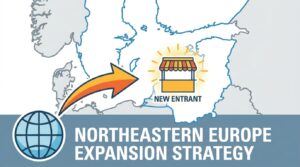
A company has launched its expansion into northeastern Europe, marking a strategic push into a region that has drawn increasing attention from businesses seeking growth beyond saturated western markets. The move signals confidence in the economic trajectory of the Baltic and Nordic corridor, where consumer demand and digital infrastructure have matured considerably over the past half-decade. While specific operational details remain limited at this stage, the decision to enter this geography reflects broader patterns in cross-border commercial strategy across the continent.
What This Northeastern European Push Signals for the Market
Expansion into northeastern Europe is not a decision companies make lightly. The region presents a mix of regulatory environments, language barriers, and competitive dynamics that demand careful calibration. Here’s what stands out about this move:
- The timing aligns with a period of renewed investor interest in Baltic and Nordic markets, where GDP growth has outpaced several eurozone averages
- Northeastern Europe’s digital adoption rates, particularly in Estonia, Latvia, and Lithuania, have created fertile ground for companies with tech-enabled service models
- Market entry at this stage suggests the company has likely completed preliminary regulatory and commercial due diligence, though no official filings have been confirmed
- The expansion could pressure existing regional players to accelerate their own growth strategies or risk ceding market share to an incoming competitor
Why Northeastern Europe, and Why Now?
The appeal of northeastern Europe has shifted dramatically in recent years. A decade ago, the region was largely viewed as a secondary market. That perception has eroded. Estonia’s e-residency programme and Lithuania’s fintech licensing framework have turned these small economies into outsized players in cross-border business facilitation. Latvia, meanwhile, has quietly built a logistics and services hub that connects Scandinavian supply chains to Central European demand.
And while western European markets offer scale, they also carry saturation risk. Margins compress. Customer acquisition costs climb. Northeastern Europe, by contrast, still offers the kind of unit economics that make CFOs pay attention.
The company has not disclosed which specific countries it will target first, but the northeastern corridor typically encompasses the three Baltic states alongside Finland and, in some strategic frameworks, Poland’s northern regions. Each carries distinct regulatory requirements (a distinction that catches more than a few companies off guard during their first cross-border attempt).
Regional Competitive Landscape
Entering northeastern Europe means contending with a competitive field that blends local incumbents, pan-European operators, and a surprisingly active startup ecosystem. The table below outlines key market characteristics across the primary northeastern European economies:
| Country | Population (approx.) | Digital Economy Ranking (EU) | Key Sector Strengths |
|---|---|---|---|
| Estonia | 1.3 million | Top 10 | Fintech, e-governance, cybersecurity |
| Latvia | 1.8 million | Mid-tier | Logistics, transit services, IT outsourcing |
| Lithuania | 2.8 million | Top 15 | Fintech licensing, shared services, laser technology — a niche but globally significant export sector |
| Finland | 5.5 million | Top 5 | Cleantech, gaming, advanced manufacturing |
What makes this region tricky is scale. None of these markets individually justify massive capital deployment. But taken together, they form a corridor of roughly 11 million consumers with above-average purchasing power parity and high digital literacy. The strategic play is almost always regional rather than national.
How Framing and Perception Shape Market Entry Success
Beyond the spreadsheets and regulatory filings, there’s a dimension of market expansion that rarely gets the attention it deserves: how a company frames its entry narrative. Drawing from principles rooted in neuro-linguistic programming, the way an organisation communicates its intentions to local stakeholders, regulators, employees, and early customers can materially influence outcomes.
Companies that anchor their messaging in partnership language rather than conquest language tend to gain traction faster in smaller European markets. Northeastern European economies, despite their openness to foreign investment, carry a strong sense of national identity and institutional pride. Framing matters. A company that positions itself as “entering to extract value” will face resistance that one framing itself as “building alongside local talent” simply won’t.
Rapport-building with local regulatory bodies is another underestimated lever. In markets like Estonia’s digitally advanced business environment, regulators are accessible but discerning. They respond well to companies that demonstrate understanding of local norms before requesting accommodations. Mirroring local communication styles, adapting pitch cadence to regional expectations, even adjusting the level of formality in initial outreach: these are not soft skills. They are operational advantages.
Arguably, the companies that fail in small-market expansion most often do so not because of product-market fit issues, but because of representational misalignment. They project a version of themselves that doesn’t resonate locally. The internal map they carry of “how business gets done” doesn’t match the territory they’ve entered. Adjusting that map, consciously and early, separates durable market entrants from expensive experiments.
What Remains Uncertain
The company has not yet confirmed its operational model for the region, whether it will pursue direct market entry, joint ventures, or acquisition of existing local operators. Each path carries different capital requirements and timelines. Nor has there been clarity on hiring plans, though northeastern Europe’s tight labour markets in tech and professional services could present a constraint if the company intends to scale quickly.
Still, the direction is clear enough. Northeastern Europe is no longer a footnote in pan-European strategy. It is becoming, for a growing number of companies, the opening chapter.
Frequently Asked Questions
Which countries are typically included in northeastern Europe for business expansion?
The term most commonly covers Estonia, Latvia, Lithuania, and Finland. Some strategic frameworks extend it to include northern Poland, though this varies by industry and company.
Why are Baltic states attractive for market entry?
High digital adoption, streamlined regulatory processes (particularly in fintech and tech services), and relatively low market saturation compared to western Europe make them appealing. Lithuania alone issued more fintech licences than most EU members combined in recent years.
What are the biggest risks of expanding into this region?
Scale limitations top the list. No single Baltic market offers the volume of a Germany or France. Labour market tightness in specialised sectors can also slow operational ramp-up. And then there’s the less quantifiable risk: cultural misreading, which has quietly derailed more than a few well-funded entries.