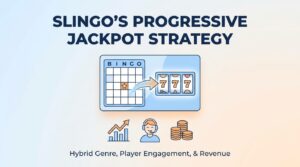
Slingo, the hybrid gaming format that fuses elements of slots and bingo, has quietly become one of the more effective vehicles for progressive jackpot growth across the online casino sector. The format’s inherent mechanics, which combine spinning reels with grid-based completion goals, create a layered engagement loop that progressive jackpots exploit with particular efficiency. What started as a niche crossover concept has matured into a commercial engine that operators and developers are increasingly building jackpot infrastructure around.
Why Slingo’s Jackpot Trajectory Deserves Attention
Progressive jackpots have long been a staple of traditional slot portfolios, but their integration into Slingo titles represents a strategic shift in how developers think about prize pool accumulation and player retention. The format’s session length, decision-making elements, and community-adjacent feel make it unusually well-suited to sustaining the kind of sustained play that feeds progressive pools. Here are the key business implications:
- Session depth drives contribution rates: Slingo games typically involve longer average sessions than standard slots, meaning each player contributes more per sitting to progressive pools.
- Hybrid mechanics broaden the player base: By appealing to both slot enthusiasts and bingo-oriented players, Slingo titles pull from two distinct demographics, widening the jackpot funding base.
- The format’s interactive decision points (buying extra spins, choosing grid strategies) create a sense of agency that keeps players engaged past the point where passive slot play might see drop-off.
- Operator differentiation: Progressive jackpot Slingo titles give operators a catalogue edge in markets where slot content has become largely commoditised.
- Regulatory positioning: In jurisdictions scrutinising high-volatility slot mechanics, Slingo’s blended format occupies a somewhat different regulatory profile, at least on paper.
The Mechanics Behind the Growth
What makes Slingo particularly effective as a jackpot vehicle isn’t any single feature. It’s the compounding effect of several design choices working in concert. Traditional progressive slots rely almost entirely on spin volume to grow their pools. Slingo adds another dimension: the grid completion mechanic means players are often just one or two numbers away from a full line or pattern, which creates a psychological pull toward additional spins. Each of those extra spins feeds the progressive pot.
That near-miss architecture is not accidental.
Developers building progressive jackpot Slingo games understand that the format’s grid-based visual feedback gives players a clearer sense of proximity to a goal than a standard slot reel ever could. A player watching four out of five numbers light up on a row experiences a qualitatively different kind of anticipation than someone watching symbols cascade on a payline. The result: higher opt-in rates for paid extra spins, which directly accelerates jackpot growth.
How Player Psychology Amplifies Jackpot Pools
From a neuro-linguistic programming perspective, Slingo’s design taps into several cognitive patterns that sustain engagement and, by extension, progressive jackpot contribution. The visual representation of progress on a grid activates what behavioural scientists call the “goal gradient effect,” where motivation intensifies as a person perceives themselves closer to completing a task. Every number that fills in on a Slingo card reinforces the player’s internal narrative of being “almost there.”
This is more than theoretical. The anchoring effect plays a role too: when a progressive jackpot figure is displayed prominently alongside the Slingo grid, it reframes the perceived value of each additional spin. Players aren’t just buying another chance at completing a line; they’re buying proximity to a life-changing sum. The framing shifts from cost to opportunity, a distinction that traditional slot interfaces struggle to communicate with the same clarity.
And while the conscious decision to purchase an extra spin feels like agency, the underlying nudge architecture is carefully calibrated. The combination of sunk cost awareness (“I’ve already filled most of this grid”), visual progress cues, and the ever-ticking jackpot counter creates a motivational cocktail that is, arguably, more potent than anything a five-reel slot can generate. Players report feeling more “in control” during Slingo sessions compared to standard slots, even when the mathematical house edge remains comparable. That perception of control extends session times and, with them, jackpot pool contributions.
Market Positioning and Competitive Dynamics
The competitive landscape for progressive jackpots has historically been dominated by a handful of mega-jackpot slot networks. Slingo titles are unlikely to dethrone those established ecosystems overnight. But they don’t need to. Their value proposition is different: smaller, more frequently hitting progressive pools attached to a gameplay format that retains a distinct audience segment.
| Factor | Traditional Progressive Slots | Progressive Slingo Titles |
|---|---|---|
| Average session length | Shorter, spin-driven | Longer, grid-completion driven |
| Player agency | Minimal (spin and wait) | Moderate (extra spin decisions, grid strategy) |
| Demographic reach | Slot-focused players | Slot and bingo crossover audiences |
| Jackpot hit frequency | Typically lower, larger payouts | Higher frequency, smaller to mid-range payouts (though this varies significantly by title and network size) |
| Regulatory scrutiny | Increasing in several markets | Comparatively less targeted, for now |
Still, the question of scalability lingers. Can Slingo-based progressive networks grow large enough to generate the kind of headline-grabbing jackpots that drive organic player acquisition? Or will they remain a mid-tier engagement tool, effective but never quite spectacular enough to compete with the mega-jackpot brands on raw marketing power?
What Operators Should Be Watching
For operators evaluating their progressive jackpot strategy, Slingo titles offer a compelling portfolio diversification play. They attract players who might otherwise skip the jackpot category entirely because they find traditional slots repetitive or overly passive. The format’s interactive layer also creates natural touchpoints for bonus mechanics, loyalty programme integration, and cross-sell opportunities that pure slot titles lack.
Yet the real test comes in retention data over the next 12 to 18 months. Early indicators suggest that Slingo jackpot players exhibit stickier behaviour patterns than their slot-only counterparts, but the sample sizes remain modest in several markets. Operators with robust analytics infrastructure are best positioned to capture and act on these signals before the format’s jackpot potential becomes conventional wisdom across the industry.
Frequently Asked Questions
What is a progressive jackpot in Slingo?
A progressive jackpot in Slingo works similarly to those in slots: a portion of each wager contributes to a growing prize pool. The difference lies in how the Slingo format’s grid-completion mechanics and extra-spin purchases create additional contribution points beyond the base spin.
Are Slingo progressive jackpots as large as traditional slot jackpots?
Generally, no. Slingo progressive pools tend to be smaller but hit more frequently. The format is still building its network scale, and whether it can sustain truly massive jackpots remains an open question that depends heavily on player volume growth.
Why do players seem to engage longer with Slingo than standard slots?
The grid-based visual feedback and the option to purchase extra spins create a sense of proximity to completion that sustains engagement. Players perceive more control over outcomes, even when the underlying odds are structurally similar to slot games. That perception is powerful.