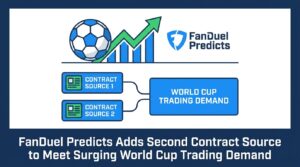
FanDuel Predicts has expanded its contract sourcing infrastructure by onboarding a second provider, a move timed to coincide with rising interest in World Cup-related betting and trading activity. The expansion signals a deliberate push by the Flutter Entertainment subsidiary to deepen liquidity and broaden market coverage ahead of one of the most heavily wagered sporting events globally. It also reflects a broader trend among prediction market platforms seeking to capture event-driven trading volume before competitors lock in user attention.
What FanDuel’s Expansion Means for Prediction Markets
Adding a second contract source isn’t merely a technical upgrade. For platforms operating in the prediction market space, contract sourcing diversity directly affects the range of tradable events, pricing accuracy, and the speed at which new markets can be listed. Here’s what stands out from this development:
- Liquidity depth increases: A second source allows FanDuel Predicts to offer tighter spreads and more responsive pricing, particularly during high-volume periods like the World Cup.
- Market coverage widens: More contract sources mean more event types can be listed, from match outcomes to in-play propositions, without relying on a single provider’s catalog.
- The timing is strategic — World Cup cycles generate some of the highest sustained trading volumes in sports prediction markets, and platforms that can’t scale sourcing risk losing users to those that can.
- Competitive positioning sharpens: With rivals like Kalshi and Polymarket also expanding aggressively, FanDuel’s move keeps it in the conversation among serious traders, not just casual bettors.
Why the World Cup Changes the Calculus
Global football tournaments create a demand spike that few other sporting events can match. The 2022 FIFA World Cup in Qatar generated an estimated $35 billion in global betting turnover, according to industry analysts. That figure alone explains why platforms are scrambling to build infrastructure now rather than later.
But volume isn’t the only factor. World Cup markets attract a different user profile — more internationally diverse, more comfortable with exchange-style trading, and more likely to engage with derivative-style contracts rather than simple moneyline bets. FanDuel Predicts, which operates as a prediction exchange rather than a traditional sportsbook, stands to benefit disproportionately from this shift in user behavior. The platform’s exchange model, where users trade contracts on event outcomes, aligns naturally with how sophisticated bettors approach tournament-length competitions.
How Contract Sourcing Shapes Platform Reliability
Single-source dependency has been a quiet vulnerability for prediction platforms. When one provider experiences latency, data gaps, or settlement disputes, the entire market listing can stall. A dual-source model introduces redundancy.
That redundancy matters most during peak events. Consider a World Cup semifinal where in-play contract prices need to update every few seconds. If the primary source lags, the secondary can maintain price continuity. For traders holding positions worth hundreds or thousands of dollars, even a 30-second gap in pricing can erode trust — and trust, in prediction markets, is the product.
Still, dual sourcing introduces its own complexity. Reconciling pricing between two providers requires robust aggregation logic, and discrepancies between sources can create arbitrage opportunities that sophisticated traders will exploit. Whether FanDuel Predicts has built the middleware to handle this smoothly remains an open question (and one the company has not publicly addressed).
The Competitive Landscape Is Shifting Fast
FanDuel’s parent company, Flutter Entertainment, has been investing heavily across its portfolio of brands to capture regulated prediction market share in the United States. The prediction market segment, once a niche corner of the broader betting ecosystem, has attracted serious regulatory and investor attention since the CFTC’s evolving stance on event contracts.
Kalshi, which holds a CFTC-regulated designation, has been expanding its own event contract listings. Polymarket, operating largely outside U.S. regulatory frameworks, saw explosive volume during the 2024 U.S. presidential election cycle. And newer entrants continue to emerge.
| Platform | Regulatory Status (U.S.) | Primary Model | Key Differentiator |
|---|---|---|---|
| FanDuel Predicts | State-regulated | Prediction exchange | Integration with FanDuel’s existing user base of over 12 million |
| Kalshi | CFTC-regulated | Event contracts | Broadest regulatory approval for event-based trading |
| Polymarket | Largely unregulated in U.S. | Crypto-based prediction | High volume on political and cultural events |
FanDuel’s advantage arguably lies not in regulatory novelty but in distribution. Access to FanDuel’s sportsbook and daily fantasy user base gives Predicts a built-in funnel that standalone prediction platforms simply cannot replicate.
Reading the Signals: What Traders and Operators Should Watch
Prediction markets are entering a phase where infrastructure decisions carry outsized strategic weight. The platforms that invest in sourcing diversity, settlement speed, and regulatory compliance now will likely define the category’s next chapter. And while the World Cup provides an immediate catalyst, the longer-term question is whether these platforms can sustain engagement between tentpole events.
For operators evaluating their own contract sourcing strategies, FanDuel’s move offers a template worth studying. Dual sourcing reduces single points of failure, improves pricing resilience during peak demand, and sends a credibility signal to institutional-grade traders who are increasingly entering the space.
Frequently Asked Questions
What is FanDuel Predicts?
FanDuel Predicts is a prediction exchange operated under the FanDuel brand, part of Flutter Entertainment. Users trade contracts based on the outcomes of real-world events, including sports, rather than placing traditional bets.
Why does adding a second contract source matter?
It reduces dependency on a single provider, which improves pricing accuracy and platform reliability — especially during high-traffic events like the World Cup. In practical terms, it means fewer gaps in market availability and tighter contract spreads for traders.
How do prediction markets differ from sportsbooks?
Prediction markets function more like exchanges. Users buy and sell contracts that pay out based on whether an event occurs. Sportsbooks set odds and take the other side of a bet. The distinction matters for how risk is distributed and how prices are discovered.
Is FanDuel Predicts available in all U.S. states?
No. Availability depends on state-level regulations governing prediction markets and event-based trading. FanDuel has been expanding access incrementally as regulatory clarity improves in individual jurisdictions.