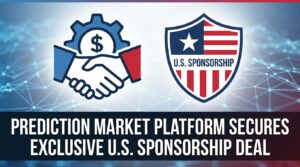
A prediction market platform has locked in an exclusive sponsorship position within the United States, marking a significant commercial milestone for an industry that has spent years navigating regulatory grey zones. The deal positions the company as the sole prediction market sponsor operating under this designation in the U.S. market. While details on the specific terms and counterparties remain sparse, the exclusivity clause itself signals a maturing sector where brand positioning and mainstream legitimacy are becoming as important as the underlying technology.
What This Exclusive Sponsorship Signals for the Prediction Market Industry
Prediction markets have historically operated at the margins of U.S. financial regulation, caught between classification as gambling products and legitimate forecasting instruments. Securing an exclusive sponsorship arrangement in this environment carries weight that extends well beyond marketing.
- The deal establishes a first-mover advantage in brand association, effectively blocking competitors from equivalent sponsorship visibility in the U.S.
- Exclusivity suggests the company has reached a level of regulatory comfort (or at least tolerance) that sponsors and partners are willing to bet on
- For the broader prediction market sector, this kind of commercial arrangement normalises the product category in the eyes of mainstream audiences and institutional stakeholders
- Rival platforms will likely face increased pressure to secure their own high-profile partnerships or risk falling behind in consumer recognition
Why Sponsorship Exclusivity Matters More Than It Appears
On the surface, an exclusive sponsorship might look like a standard marketing play. It isn’t. In a sector where regulatory status can shift with a single enforcement action, the willingness of a U.S.-based entity to grant exclusivity to a prediction market operator represents a quiet vote of confidence. That confidence has commercial consequences.
Consider the trajectory. Just two years ago, the CFTC was actively challenging certain prediction market contracts, and the legal standing of event-based derivatives remained contested. The Commodity Futures Trading Commission’s evolving posture toward these platforms has created a narrow but real window for operators willing to invest in legitimacy infrastructure. Sponsorship deals are part of that infrastructure.
And while exclusivity protects the company from direct competition within the sponsorship context, it also creates obligations. Sponsors typically demand brand safety, compliance assurances, and audience engagement metrics. Meeting those standards pushes the platform toward more transparent operations (a distinction regulators have been slow to enforce but quick to notice when it’s absent).
The Competitive Landscape Shifts
This move doesn’t happen in isolation. The U.S. prediction market space has grown increasingly crowded, with platforms competing for both retail users and institutional credibility. Polymarket’s event-driven contracts drew massive attention during the 2024 U.S. presidential election cycle, pulling prediction markets into mainstream political discourse in a way that hadn’t happened before.
Kalshi, meanwhile, has fought legal battles to list election-related contracts on a CFTC-regulated exchange. The competitive dynamics are fierce. Securing exclusive sponsorship rights in this climate is arguably as much a defensive manoeuvre as an offensive one.
Less clear is whether this exclusivity extends across all categories of sponsorship or is limited to a specific vertical, such as sports, entertainment, or political forecasting. The scope matters enormously. A broad exclusivity clause would represent a far more aggressive market position than a narrow, category-specific arrangement.
How Perception Shapes Market Adoption
Prediction markets face a perception challenge that pure fintech products do not. For many U.S. consumers, the line between a prediction market and a betting platform remains blurry. Sponsorship deals help redraw that line, not through argument but through association. When a prediction market brand appears alongside established institutions, the implicit message is one of legitimacy.
This is where neuro-linguistic framing becomes relevant to the business strategy. The language a platform uses to describe itself, the contexts in which its brand appears, and the anchoring effect of being labelled the “exclusive” partner all shape how potential users categorise the product in their minds. Exclusivity, in particular, triggers a scarcity heuristic. It tells the audience this platform was chosen above others, which subtly repositions it from “one of many” to “the one.”
Behavioural research consistently shows that perceived authority and social proof drive adoption in financial products more than feature comparisons. A sponsorship deal, especially an exclusive one, functions as a trust shortcut. It compresses the evaluation process for new users who might otherwise hesitate before depositing funds on a platform they associate with speculation rather than analysis. The framing effect here is potent: the same product, presented in a sponsorship context alongside recognised brands, registers differently in the user’s decision-making framework than it would through a standalone digital ad. Platforms that understand this distinction tend to convert curiosity into engagement far more efficiently than those relying solely on product superiority.
Still, perception without substance erodes quickly. The sponsorship creates expectations the platform must now meet.
Frequently Asked Questions
What is a prediction market?
A prediction market allows participants to trade contracts based on the outcome of future events, from elections to economic indicators. Prices in these markets reflect the collective probability assessment of participants, making them both a trading venue and a forecasting tool.
Are prediction markets legal in the U.S.?
The legal status depends on the specific contracts offered and the regulatory framework under which the platform operates. Some platforms hold CFTC designation as designated contract markets, while others operate in less clearly defined regulatory territory. The landscape continues to evolve.
Why does sponsorship exclusivity matter for a prediction market?
It blocks competitors from occupying the same brand space and signals to users, regulators, and partners that the platform has achieved a threshold of credibility sufficient for mainstream commercial relationships.