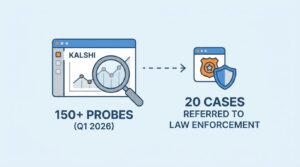
Kalshi, the CFTC-regulated prediction market, disclosed Tuesday that it opened more than 150 insider-trading investigations during the first quarter of 2026 and blocked over 100 suspected insider trades through automated screening systems. At least 20 cases were referred to law enforcement. The figures arrived alongside three new compliance measures the platform announced, signaling a sharp escalation in self-policing at a moment when prediction markets face intensifying regulatory scrutiny.
What Kalshi’s Enforcement Surge Means for Prediction Markets
These numbers are not routine. For a platform that only recently secured its legal footing after a protracted court battle with the CFTC over event contracts, the scale of internal investigations suggests both a maturing compliance infrastructure and a recognition that credibility hinges on visible enforcement. The disclosure also raises a question regulators and competitors alike will be watching closely: whether this level of activity reflects genuinely rising misconduct or simply better detection.
- Over 150 insider-trading investigations opened in Q1 2026 alone, a volume that positions Kalshi’s surveillance operation closer to traditional exchange standards than most crypto-adjacent platforms
- Automated screening tools intercepted more than 100 potential insider trades before execution, pointing to significant investment in pre-trade compliance technology
- At least 20 cases were escalated to law enforcement, a threshold that implies the platform identified conduct serious enough to warrant external prosecution
- Three new compliance measures were introduced alongside the data, though full details of those measures have yet to be publicly elaborated
- The timing matters: prediction markets are under growing political and regulatory attention heading into the second half of 2026
Automated Screening at Scale
Blocking 100-plus trades before they settle is not a trivial operational feat. It requires real-time surveillance systems capable of flagging anomalous patterns across thousands of contracts, many of which are tied to inherently information-sensitive events (a distinction that makes prediction markets uniquely vulnerable to insider activity compared to traditional derivatives). Kalshi’s deployment of automated tools at this scale suggests the platform has moved well beyond manual review.
Still, the effectiveness of any screening regime depends on what happens after a flag is raised. Referring 20 cases to law enforcement indicates that Kalshi is not merely identifying suspicious activity internally but is actively cooperating with external authorities. That pipeline, from detection to referral, is where most compliance programs either prove their worth or quietly collapse under institutional reluctance to escalate.
How Q1 2026 Compares
| Metric | Q1 2026 | Context |
|---|---|---|
| Investigations opened | 150+ | First public disclosure of this scale from Kalshi |
| Trades blocked (automated) | 100+ | Pre-trade intervention, not post-trade sanctions |
| Law enforcement referrals | 20+ | Suggests cooperation with DOJ or CFTC enforcement divisions |
| New compliance measures | 3 | Announced concurrently; specifics pending full release |
No prior quarter has seen Kalshi publish comparable figures publicly. Whether that reflects a genuine spike in misconduct or the maturation of detection systems capable of catching what was previously invisible remains an open question.
Why Prediction Markets Attract Insider Risk
Prediction markets sit at an uncomfortable intersection. They price real-world outcomes, which means anyone with advance knowledge of a political decision, a corporate announcement, or even a weather event can, at least in theory, trade on that edge. Traditional securities markets have decades of case law and enforcement infrastructure built around insider trading. Prediction markets do not.
That gap is precisely what makes Kalshi’s disclosure significant. By voluntarily publishing enforcement data, the CFTC-regulated prediction market platform is attempting to establish a norm before regulators impose one. And while the CFTC has oversight authority, the agency’s bandwidth for policing individual trades on event contracts is limited. Self-regulation, in practice, becomes the first and sometimes only line of defense.
The Psychology Behind Compliance Transparency
Kalshi’s decision to publicize these numbers is as strategic as the enforcement itself. Behavioral research consistently shows that perceived certainty of detection deters misconduct more effectively than the severity of punishment. By broadcasting that 150 investigations were opened in a single quarter, the platform is engineering a deterrence signal aimed squarely at would-be bad actors.
This approach aligns with what behavioral economists call “salience bias.” When participants on a platform know that surveillance is active, visible, and producing real consequences, their risk calculus shifts. The 20 law enforcement referrals are not just an enforcement outcome; they function as a credibility anchor. Every participant now operates with the understanding that misconduct does not merely result in a blocked trade but can trigger a federal investigation.
There is also a reputational dimension. Prediction markets have struggled to shed their association with gambling and unregulated speculation. Institutional adoption, the kind that would bring deeper liquidity and more sophisticated participants, requires trust. Publishing enforcement metrics is one way to build that trust without waiting for a regulator to mandate it. But trust built on transparency only holds if the numbers are consistent over time. A single quarter of aggressive enforcement followed by silence would undermine the signal entirely.
And the three new compliance measures announced alongside the data, while not yet fully detailed, suggest Kalshi is attempting to institutionalize this posture rather than treat it as a one-off communications exercise. Whether the market rewards that effort with deeper participation or whether competitors adopt similar disclosure standards will say more about the industry’s trajectory than any single enforcement action.
Frequently Asked Questions
What types of insider trading does Kalshi investigate?
Kalshi’s investigations target trading activity where participants appear to have non-public information about the outcome of an event contract. This could involve political decisions, economic data releases, or other real-world events priced on the platform. The specifics of each case are not publicly disclosed during active investigation.
How does Kalshi’s automated screening work?
The platform uses real-time surveillance tools that flag anomalous trading patterns, such as unusually large positions taken shortly before an event resolves, or clusters of activity from accounts with correlated behavior. Flagged trades can be blocked before settlement.
Does the CFTC oversee Kalshi’s enforcement?
Yes. Kalshi operates as a CFTC-regulated designated contract market. The agency has oversight authority, and the 20 law enforcement referrals suggest active cooperation between Kalshi’s compliance team and federal enforcement bodies.
Are prediction markets more vulnerable to insider trading than stock markets?
Arguably, yes. Because prediction markets price real-world events rather than corporate securities, the universe of potential insiders is broader and harder to define. Someone with advance knowledge of a government policy announcement, for instance, may not fall neatly into existing insider-trading frameworks designed for corporate officers and directors.