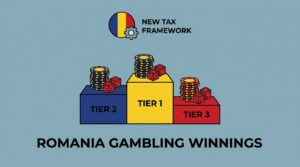
Romania’s government has enacted a significant restructuring of how gambling winnings are taxed, replacing the previous flat entry-rate model with a progressive three-tier system that increases deductions at higher income thresholds. The reform, which applies across both land-based and online gambling operations, reshapes the fiscal landscape for operators and players alike in one of Eastern Europe’s more active regulated markets. At its core, the new framework shifts the tax burden more heavily onto larger payouts while offering modest relief on smaller wins.
What Romania’s New Gambling Tax Tiers Mean for the Market
The restructured system introduces graduated taxation brackets that distinguish between low, mid-range, and high-value winnings. Rather than applying a uniform deduction at the point of entry, Romania now calibrates its tax extraction based on the size of the payout. This is a meaningful departure from the prior approach, and it carries implications that stretch well beyond individual players.
- Smaller winnings face a reduced tax rate, which could encourage broader participation among recreational gamblers
- Mid-tier payouts see a moderate increase in deductions, aligning Romania’s approach with progressive taxation models used in other EU jurisdictions
- High-value winnings attract the steepest deductions, a move likely aimed at capturing more revenue from VIP and high-stakes segments
- Operators will need to adjust payout systems and reporting infrastructure to accommodate bracket-based withholding
- The reform signals Romania’s intent to extract greater fiscal value from its gambling sector without imposing blanket rate hikes
How the Progressive Model Reshapes Operator Economics
For gambling operators licensed in Romania, the shift to tiered taxation introduces operational complexity that goes beyond simple rate changes. Platforms must now calculate and withhold taxes dynamically based on individual payout amounts, which demands updated software, revised terms and conditions, and potentially renegotiated agreements with payment processors.
The cost of compliance here is not trivial. Operators running both casino and sports betting verticals face the added challenge of applying the correct tier across product lines where average payout sizes differ substantially. A sportsbook paying out frequent small wins operates in a fundamentally different tax environment under this model than a high-roller poker room.
Still, the structure arguably benefits operators targeting mass-market recreational players. Lower taxes on smaller wins preserve more of the payout for the customer, which in turn supports retention and lifetime value metrics. That trade-off (higher taxes on big wins, lower friction on small ones) mirrors a pattern regulators across Europe have been experimenting with, though not all market participants agree on whether it actually drives sustainable growth.
A Regulatory Signal Beyond Revenue Collection
Romania’s national gambling regulator ONJN has been tightening its oversight framework over the past several years, and this tax reform fits within a broader pattern of regulatory modernization. The three-tier approach does more than optimize revenue; it creates a structural incentive for operators to channel activity toward lower-stakes products, which regulators generally view as carrying less social risk.
Whether that incentive actually redirects player behavior remains an open question.
What’s clearer is the political calculus. By protecting smaller winners from heavier taxation, the government insulates itself from the populist critique that gambling taxes punish ordinary citizens. The steeper rates on large payouts, meanwhile, are easier to defend publicly as targeting wealth extraction rather than everyday entertainment. It is a framework designed as much for political durability as for fiscal efficiency, and in that sense, Romania is reading from the same playbook as several Western European governments that have restructured gambling levies in recent years.
Comparative Context: Where Romania Sits Among EU Gambling Tax Models
| Country | Tax Model | Rate Structure | Applied To |
|---|---|---|---|
| Romania (new) | Progressive / Three-tier | Graduated by payout size | Player winnings |
| Italy | Flat rate on net winnings | Varies by product (typically 20–25%) | Player winnings above threshold |
| Spain | Flat rate | 20% on winnings above €40,000 | Player winnings |
| United Kingdom | GGR-based operator tax | 21% on gross gambling yield | Operator revenue, not player winnings directly |
| Sweden | Exempt for licensed play | Players tax-free; operators taxed on GGR | Operator revenue |
Romania’s decision to tax at the player level rather than shifting entirely to a GGR-based operator model distinguishes it from the UK and Nordic approaches. That choice keeps the administrative burden partly on the operator (who must withhold) but places the economic incidence squarely on the player, particularly those collecting larger payouts.
Strategic Implications for Cross-Border Operators
International operators with Romanian licenses now face a jurisdiction where tax treatment varies not just by product type but by payout magnitude within each product. This layered complexity could influence market entry decisions for operators evaluating expansion into Romania’s online gambling sector, which has grown steadily since the country formalized its licensing regime.
And while the reform targets winnings rather than operator revenue directly, the downstream effects on player acquisition costs and bonus economics are real. Operators offering sign-up bonuses or promotional payouts will need to model how tiered taxation affects the net value proposition for new customers. A welcome bonus that triggers a mid-tier tax deduction delivers less perceived value than one that stays within the lower bracket, a nuance that marketing teams will need to internalize quickly.
Frequently Asked Questions
Does the new Romanian tax apply to both online and land-based gambling?
Yes. The three-tier structure applies across all licensed gambling formats in Romania, including online casinos, sports betting, poker, and physical gaming establishments.
Are operators responsible for withholding the tax?
Operators are required to calculate and withhold the appropriate tax based on the payout tier before disbursing winnings to players. This places a compliance obligation directly on the operator’s platform infrastructure.
How does this compare to how other EU countries tax gambling?
Most EU countries use either a flat rate on player winnings or a gross gaming revenue tax on operators. Romania’s progressive tiered model is relatively unusual and more closely resembles income tax logic than typical gambling levies.
Will this affect the size of jackpots or promotional payouts?
Potentially. Larger payouts now attract higher deductions, which could influence how operators structure jackpot tiers and promotional campaigns to optimize net player value within the lower tax brackets.



